In the early Eastern Jin Dynasty, Prime Minister Wang Dao had a very famous nephew named Wang Xizhi.
Wang Xizhi, courtesy name Yishao, pseudonym Danzhai, originally from Linyi, Shandong, later moved to Kuaiji (present-day Shaoxing, Zhejiang), served as General of the Right Army and Governor of Kuaiji, and is known as "Wang Youjun."
Wang Xizhi was influenced by his father's love for calligraphy from a young age. By his early teens, he had developed a strong interest in the art, often browsing through the rubbings and writings left by previous masters in his father's study. Seeing his son's deep passion for calligraphy, his father taught him the techniques of brushwork. Wang Xizhi was diligent and eager to learn; even while walking, he would practice writing on his clothes with his finger, eventually wearing them out. Later, he studied under the renowned female calligrapher Lady Wei, who was a student of Zhong Yao. She passed on to him Zhong Yao's methods, the Wei family's generations of calligraphy techniques, and her own unique style and principles developed through years of dedicated study.
Wang Xizhi spent a great deal of time studying calligraphy. He excelled at drawing on the strengths of others to develop his own style. When learning from Zhong Yao, he noticed that Zhong Yao's calligraphy had a "divided" momentum, with brushstrokes tending to expand outward. Wang Xizhi reduced this divided momentum, using inward-pressing brushwork that favored turning over folding, making his characters appear more fluid. While studying Zhang Zhi's cursive script, Wang Xizhi analyzed and synthesized Zhang Zhi's techniques, forming his own distinctive style.
After continuous study and practice, Wang Xizhi eventually became a very famous calligrapher. Once his calligraphy gained renown, both high-ranking officials and common people treasured his characters as precious gems.
Once, Wang Xizhi saw an elderly woman selling fans on the street. The fans were hexagonal and very plain, making it hard to attract passersby. Worried that she wouldn't be able to sell them, the old woman looked very anxious. Wang Xizhi felt great sympathy for her, so he approached and said, "Your fans aren't selling because they have no writing or paintings on them. How about I inscribe some characters on them for you?" The old woman didn't realize that the man before her was the famous Wang Xizhi. Seeing this stranger so eager to help, she handed him the fans. Wang Xizhi wrote just five characters on each fan and returned them to her. Noticing the writing was very rough, the old woman grew a bit upset. Wang Xizhi told her, "Just tell anyone who wants to buy a fan that the characters were written by Wang Xizhi, and that will be enough."
After saying this, Wang Xizhi left. The old woman followed Wang Xizhi's advice, and sure enough, she quickly sold all the fans. Wang Xizhi had a very unique hobby: he loved raising geese. Wherever there were fine geese, he would eagerly go to see them or buy some to bring home and admire. Outside the city of Shanyin (present-day Shaoxing, Zhejiang), there was a Taoist temple where an old priest lived. He also greatly admired Wang Xizhi's calligraphy and wanted Wang Xizhi to copy a passage of theTao Te ChingBut he knew that Wang Xizhi was a complete stranger to him and would not help him copy the sutras. Later, he heard that Wang Xizhi loved white geese, so he raised many fine breeds of geese in a pond outside the Taoist temple and deliberately had someone leak this news to Wang Xizhi. Upon hearing the news, Wang Xizhi immediately went to see them with great delight. Arriving outside the temple, he saw a flock of geese with pure white feathers swimming leisurely in the pond and was instantly captivated. He stood by the bank, silently watching, unwilling to leave for a long time. He liked these geese so much that he sent someone to find the Taoist priest, asking him to sell the flock to him.
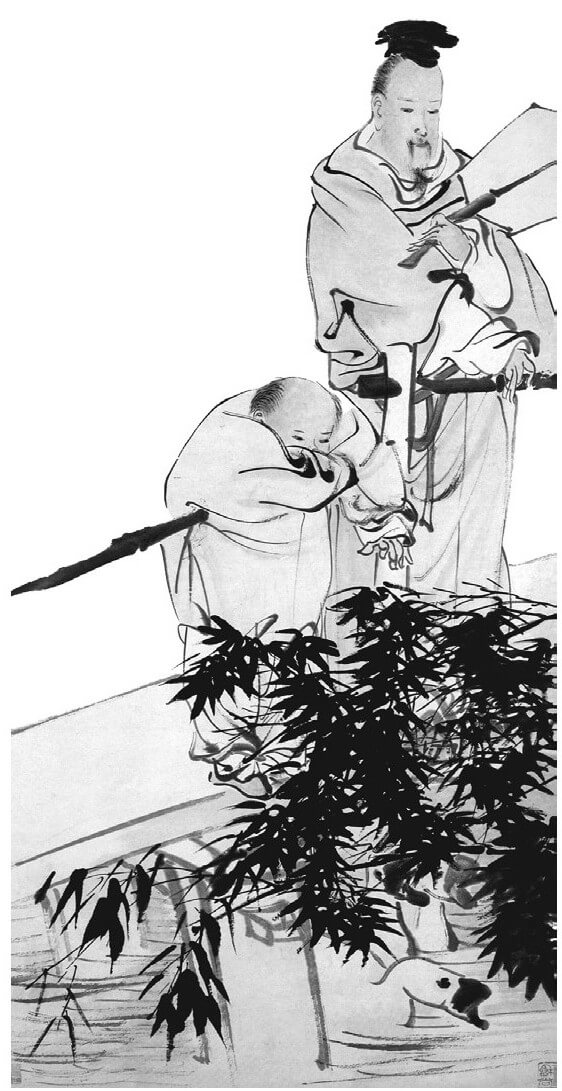
After a moment, the Taoist priest approached Wang Xizhi. Wang Xizhi said to him, "I really like these white geese. Would you be willing to sell them to me, Master?"
The Taoist priest replied, "We raise these white geese for tourists to enjoy, not for sale."
Xi Zhi said, "Since that's the case, I'll trade more of my geese for yours. Is that acceptable now?"
The Taoist priest said, "Since you are so fond of these white geese, I will give them to you. However, I have a small request. I have heard that your calligraphy skills are exceptional, and I would like to trade my white geese for your writing. I would like to ask you to write a copy of the Tao Te Ching for our temple. Would you be willing to do so?"
Wang Xizhi, who had a deep fondness for geese, readily agreed to the request. The "Dao De Jing" that Wang Xizhi wrote for the Taoist temple displayed his exceptional calligraphic skill, and later generations referred to it as the "Goose-Swapping Calligraphy."