
After Liu Yu defeated Huan Xuan and restored Emperor An of Jin to the throne, the Eastern Jin Dynasty was already in name only. It was at this time that the great poet Tao Yuanming shone like a brilliant star, lighting up the dim sky of the Eastern Jin.
Tao Yuanming, courtesy name Yuanliang, was born into a declining scholar-official family. His great-grandfather Tao Kan was a renowned politician and military strategist of the Eastern Jin Dynasty, who made significant contributions to the dynasty, rising to the highest official position of Grand Marshal, commanding the military of eight provinces, and being enfeoffed as the Duke of Changsha. Although his grandfather and father were not as famous as Tao Kan, they both served as governors.
Born into a scholarly family, Tao Yuanming should have had a happy childhood. However, when he was nine years old, his father passed away, and his family's fortunes declined from then on. His mother, unable to support him and his sister, took them to live with her father, Meng Jia. Meng Jia was a very famous figure at the time, known for his love of drinking and his unrestrained behavior. Young Tao Yuanming was deeply influenced by his grandfather, which was reflected in his cultivation and personality. Meng Jia's home had a large collection of books, allowing Tao Yuanming to read widely and gain a deeper understanding of history. The scholars of the time revered Daoism, regarding Laozi and Zhuangzi as classics, and looked down upon Confucianism. However, the young Tao Yuanming not only studied theLaozi》 and 《ZhuangziHe also studied many Confucian classics and historical texts.
In the final years of the Eastern Jin Dynasty, treacherous ministers held power, the imperial court was corrupt, and officialdom was steeped in darkness. Tao Yuanming, a man of noble character who despised vanity, persisted in his studies despite his family's humble circumstances and nurtured the ideal of "greatly benefiting the common people," hoping one day to bring happiness to all under heaven.
In 393 AD, at the age of twenty-nine, Tao Yuanming was summoned by the imperial court to serve as the Libationer of Jiangzhou. Due to his humble origins, he received little recognition, and the tedious formalities of officialdom became unbearable for him, so he resigned and returned home after a short time. Not long after, the prefecture summoned him again, but he declined the offer. For the next five or six years, he remained content at home, reading books and living a tranquil life.
In the year 400 AD, Huan Xuan, an Eastern Jin general commanding a formidable army and eyeing the regime with ambition, extended an invitation to Tao Yuanming, hoping he would offer strategic counsel. Unaware of Huan Xuan's ambitions and schemes, Tao Yuanming joined his ranks. However, upon learning of Huan Xuan's true intentions, he regretted his decision and refused to collude with him. Yet, he was uncertain how to leave. As he agonized over this dilemma, news arrived of his mother's death. Seizing this pretext, he left Huan Xuan and returned home.
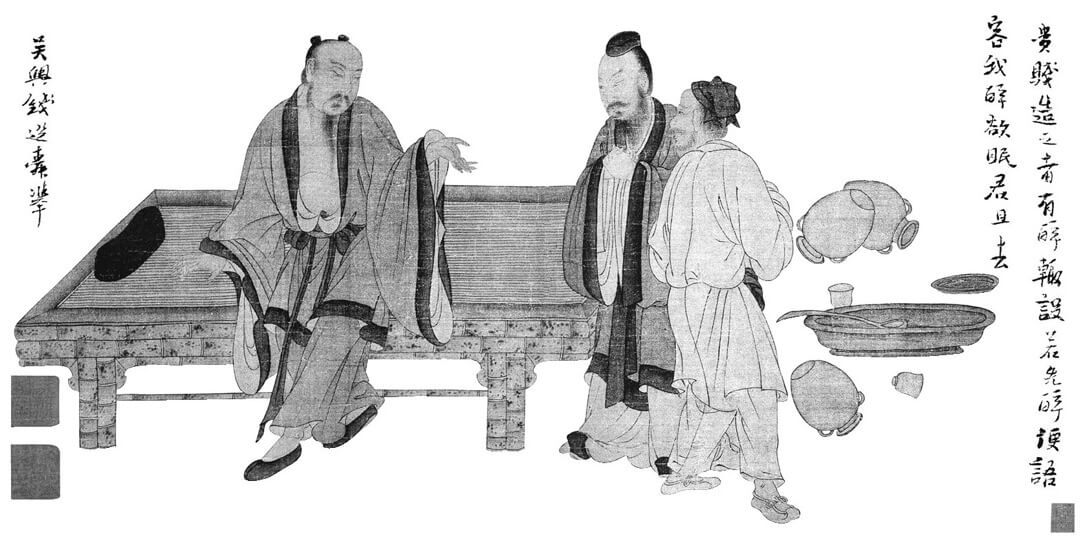
Tao Yuanming supported himself by farming at home, and in his spare time he composed poetry and prose. When he heard that Huan Xuan had usurped the Eastern Jin Dynasty's power, he recited this poem: "Sleeping in obscurity beneath a humble gate, far removed from the world, I see no one who knows me, my thornwood door shut tight even by day." Through this, he expressed his unwillingness to speak of Huan Xuan's seizure of power.
Upon hearing that General Liu Yu, who had been appointed as the General Who Establishes Military Power and the Grand Administrator of Xiapi, raised an army to punish Huan Xuan, Tao Yuanming joined Liu Yu's forces as a military aide. After Liu Yu captured Jiankang, he rectified the long-standing corruption that had plagued the Eastern Jin Dynasty, bringing a fresh new look to the regime. Tao Yuanming initially admired Liu Yu as a highly capable man and developed a favorable impression of him. However, it was not long before Liu Yu began to bend the law for personal gain and eliminate those who opposed him, which deeply disappointed Tao Yuanming, leading him to resign from his post and return home.
After this, Tao Yuanming's uncle Tao Kui recommended him to serve as the magistrate of Pengze County. Within just a few dozen days of taking office, he heard that Liu Yu had appointed himself General of Chariot and Cavalry, in charge of military affairs across all provinces. Tao Yuanming grew deeply disheartened, because he knew that the ambitious Liu Yu was planning to seize the throne. He was fully aware that the Eastern Jin Dynasty had reached its end, so he became somewhat dispirited and decided to resign and return to his hometown.
Tao Yuanming's wife Zhai Shi saw the solemn expression on his face and asked him what had happened. Tao Yuanming replied bluntly, "I want to resign and return to my hometown." This was not the first time Tao Yuanming had said such words to Zhai Shi, so she understood clearly that he must have suffered another grievance in officialdom. A few months earlier, Tao Yuanming had told Zhai Shi he wanted to resign and go home, but she advised him then that the hundreds of acres of official fields were about to be planted with rice, and in just a few months they would be ready for harvest—so he should wait until then. After hearing her words, Tao Yuanming had held back. This time, Zhai Shi tried to comfort him in the same way, saying the rice in the official fields was nearly ready to harvest and he should wait a little longer. Tao Yuanming sighed helplessly and said, "It seems I must continue to be a slave to grain!" He decided to endure for a while longer.
On the eighty-first day of Tao Yuanming's tenure as the magistrate of Pengze County, a clerk reported to him that a superior inspector from the commandery would be arriving in a few days to conduct an inspection. His subordinates advised him to take the matter seriously, saying that when the inspector came, he should dress in formal attire and wear a headband to greet him. Tao Yuanming knew this inspector well—he was a man of shallow learning who clung to the powerful and was adept at flattery. Reflecting on having to humble himself before such a person, Tao sighed and said, "How could I bow to a village brat for five pecks of rice?" By this, he meant, "How could I stoop low for a salary of official grain before a vulgar and shameless man?" After saying this, he returned home, packed his belongings, and left the government office with his wife, heading back to his hometown. This resignation also ended his thirteen-year career as an official.
During these thirteen years, he had been striving tirelessly to realize his ideal of "greatly benefiting the common people," yet the dark political situation in the late Eastern Jin Dynasty repeatedly disappointed him, until finally he was driven to utter despair.
After returning to his hometown, Tao Yuanming wrote a poem titled "Returning Home," expressing his dissatisfaction with and rejection of the political realities of his time, especially his life as an official, reflecting his noble character that despised fame and fortune.
After this, Tao Yuanming lived a life sustained by his own physical labor. Because he planted five willow trees in front of his home, people called him "Master Five Willows." In his later years, his living conditions steadily worsened. Sometimes his friends would voluntarily send him money to help, and other times he would go to friends to borrow money. Although he was poor, his noble character was not affected by this. When Tan Daoji, the governor of Jiangzhou, visited him at his home, Tao had not eaten for several days and was so weak from illness that he could not even get out of bed. Tan Daoji said to him, "A wise man lives in seclusion when the world is chaotic and serves as an official when the world is orderly. Now is an orderly society, so why do you treat yourself this way?" With these words, Tan Daoji offered him meat to eat. However, Tao Yuanming, disgusted by Tan Daoji's condescending and disdainful attitude, firmly refused to eat.
In 427 AD, Tao Yuanming passed away at the age of sixty-three. His noble character and the large number of excellent pastoral poems he created will never be forgotten by future generations.