
After more than a decade of painstaking efforts, Fu Jian turned the Former Qin dynasty into a powerful state. At this point, he grew somewhat complacent and decided to lead his army to attack the Eastern Jin dynasty. When the ministers of Former Qin heard this news, they repeatedly advised Fu Jian not to do so. However, Fu Jian insisted on his own way, and in 383 AD, he personally led a massive army from Chang'an, marching southward in a grand and imposing manner. A month later, Fu Jian's main force arrived at Xiangcheng (present-day southern Shenqiu, Henan), while troops coming from north of the Yellow River also reached Pengcheng (present-day Xuzhou, Jiangsu), and the navy from Yizhou advanced eastward along the river. The combined land and naval forces of Former Qin pressed toward the Eastern Jin, which faced an unprecedented disaster.
This news caused a huge stir within the city of Jiankang. Emperor Xiaowu of Jin and all his civil and military officials were extremely anxious, fearing that the Eastern Jin Dynasty would be destroyed by the powerful Former Qin army. At this moment, they placed all their hopes on Prime Minister Xie An, hoping he could quickly devise a strategy to counter the Former Qin forces.
Xie An was born into a prestigious family, with ancestors who were highly renowned scholar-officials. At the age of four, he was praised by the famous Eastern Jin scholar Huan Yi, who remarked that he had an "elegant and outstanding demeanor" and would surely achieve great things when he grew up. After the fall of the Western Jin Dynasty, he moved from the north to the south and became close friends with a group of notable scholars of the time, including Wang Xizhi, Sun Chuo, and Zhi Daolin. They spent their days enjoying themselves on the Eastern Mountain, drinking wine, reciting poetry, and discussing profound philosophical theories. When the imperial court learned of his exceptional talent, they repeatedly summoned him to serve as an official, but he only held a position for a month before resigning and returning to the Eastern Mountain. His wife, Lady Liu, seeing his lack of ambition, said to him, "Taking office and bringing glory to your family is what a true man should do! Why do you repeatedly refuse the court's summons?" Xie An replied, "Entering the court as an official is not my true intention, but I fear that day will come sooner or later."
Xie An was right; soon he had no choice but to leave seclusion and take up an official post. In 359 AD, Xie An's cousin Xie Wan, the Governor of Yuzhou, was demoted to commoner status, and Yuzhou, a territory the Xie family of Chen Commandery had managed for years, was seized by others. This event severely impacted the Xie family's economic, political, and social standing. At this point, for the sake of the entire Xie clan's interests, Xie An had to leave the Eastern Mountains and enter government service. He quickly accepted the summons of Grand General Huan Wen and became his military aide. Although this was only a low-ranking eighth-grade position, it allowed him to mend the Xie family's relationship with Huan Wen, who held the reins of state power—a move that clearly demonstrated Xie An's far-sighted strategy.
When Xie An first reported for duty at Huan Wen's headquarters, he was met with ridicule. Someone deliberately sent Huan Wen a package of medicinal herbs, among which was a herb called "Yuanzhi" (meaning "far-reaching ambition"). Upon seeing it, Huan Wen said to Xie An, "This herb is truly strange. The same plant has its root called Yuanzhi and its shoot called Xiaocao (meaning 'little grass'). Why is that?" Huan Wen's military advisor loudly replied, "This question is far too simple. The root, buried in the soil and not yet emerged, is called Yuanzhi; the shoot, growing above ground and having emerged, is called Xiaocao." Huan Wen burst into loud laughter. The advisor's words were a complete mockery of Xie An, implying that before he left seclusion, he was hailed as a sage, but once he entered officialdom, he amounted to nothing. Xie An understood that the two of them had orchestrated this performance to embarrass him, so he said nothing in response.
Shortly after Xie An served in Huan Wen's headquarters, Xie Wan passed away. Xie An resigned from his post on the grounds of mourning. However, not long after, Prime Minister Sima Yu recommended him as the Governor of Wuxing. In Wuxing, Xie An fully demonstrated his abilities, governing the region with order and ensuring the people lived in peace and prosperity within just a few years. A few years later, he was promoted to Attendant-in-Ordinary, becoming a high-ranking court official. Because Xie An had long lived in seclusion on Dongshan Mountain, later generations came to refer to returning to officialdom as "rising again from Dongshan."
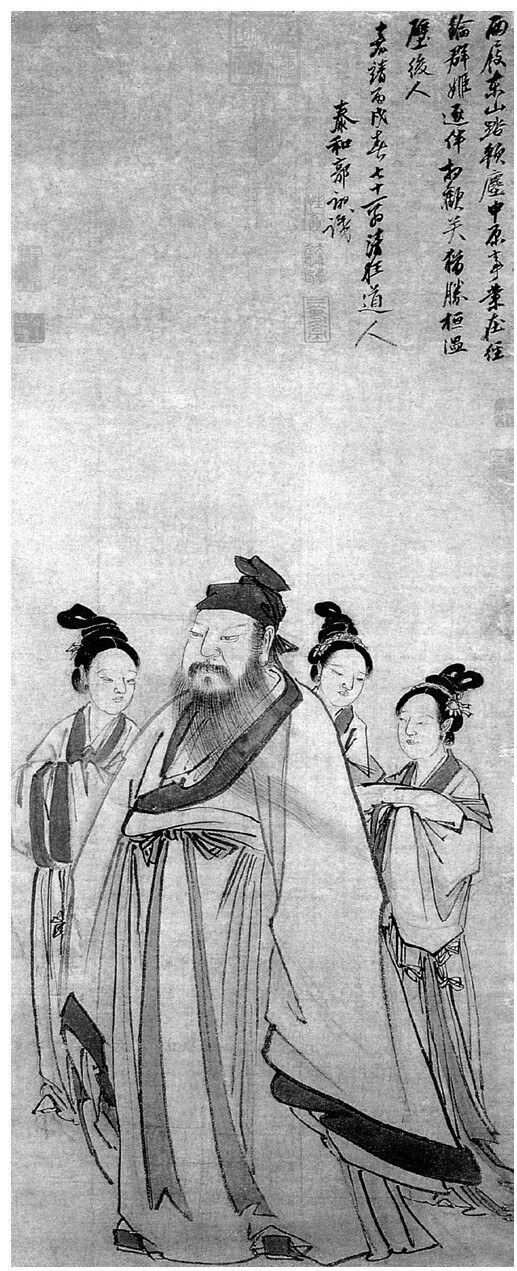
After the Former Qin grew powerful under the efforts of Fu Jian and Wang Meng, it frequently sent troops to harass the northern borders of the Eastern Jin. The Eastern Jin court, troubled by these disturbances, wanted to send a capable general to guard the area and thoroughly resolve the border crisis. At this time, Xie An recommended his nephew Xie Xuan to guard the border.
The reason Xie An recommended Xie Xuan was not simply because Xie Xuan was his nephew, but also because Xie Xuan was truly a general skilled in both civil and military affairs. From a young age, Xie Xuan was exceptionally intelligent and highly valued by Xie An. Xie An once posed a question to test his nephews and children, and among those present, only Xie Xuan was able to answer it, and he did so with such cleverness that it greatly pleased Xie An. As he grew older, Xie Xuan demonstrated extraordinary military talent and was entrusted with important responsibilities by the imperial court. It was for these reasons that Xie An, without fear of suspicion, recommended Xie Xuan to carry out this arduous mission.
Of course, Xie Xuan did not disappoint Xie An. After arriving at Guangling, Xie Xuan immediately began expanding the army. He carefully analyzed the current situation and, believing that the Jin army lacked combat strength, recruited a group of peasants who had fled from the north to form the "Northern Mansion Army." These peasants had endured many hardships and were especially eager to recover the north and return to their homeland. As a result, their will to fight was much stronger than that of the Jin army, which was composed of southerners. After a period of rigorous training, the combat effectiveness of the "Northern Mansion Army" improved significantly.
When the Former Qin army of hundreds of thousands was approaching, Emperor Xiaowu of Jin and all his civil and military officials knew that only Xie An could preserve the Eastern Jin dynasty. Xie An also understood clearly that this would be the most severe challenge of his life. After careful deliberation, he devised a comprehensive defense plan, personally stationed himself in Jiankang, and sent Xie Shi and Xie Xuan from his own clan to confront the enemy north of the Yangtze River.
Before setting out, Xie Xuan went to see Xie An and asked him how to defeat an enemy several times larger than their own forces. Xie An, however, calmly told him, "Just rest assured—I have already made all the arrangements."
Xie Xuan thought that before he left, Xie An would surely have something to say to him, so he kept waiting for Xie An to speak. But after waiting for a long time, Xie An did not say a single word. When Xie Xuan returned home, he felt uneasy and anxious. The next day, he asked his friend Zhang Xuan to go to Xie An's place to probe for information. When Zhang Xuan met Xie An, before he could even speak, Xie An pulled him into a game of Go. After finishing the game, Xie An then gathered a group of people to go sightseeing in the mountains and rivers, not returning home until nightfall.
Everyone assumed Xie An knew nothing about military affairs, but they did not realize he already had a well-thought-out plan. He explained his analysis of the battle to Xie Shi and Xie Xuan, among others, and assigned them their respective tasks. The officers and soldiers followed Xie An's command and ultimately succeeded in repelling the offensive of the Former Qin army.