
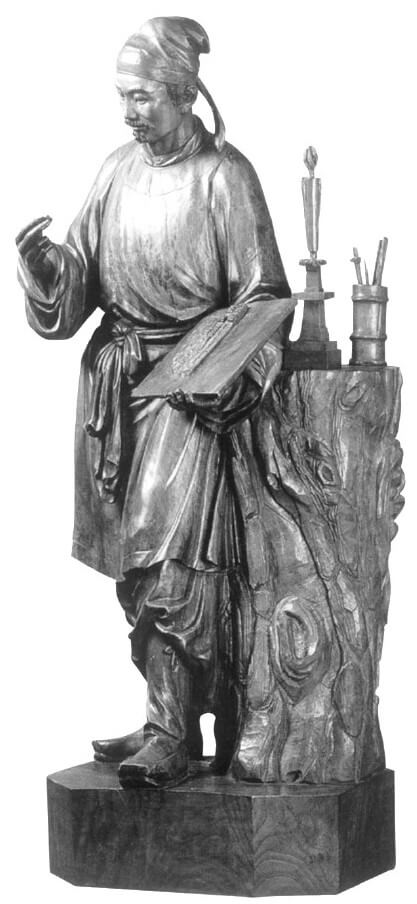
During the reign of Emperor Renzong of the Northern Song Dynasty, movable-type printing was invented by an obscure printer named Bi Sheng.
Printing, as one of the four great inventions of ancient China, made a tremendous contribution to the spread and development of human culture. Before the advent of printing, people mainly relied on handwritten books to transmit culture. As is well known, after the eunuch Cai Lun of the Eastern Han Dynasty improved papermaking, paper gradually became the everyday writing material for humans. Prior to this, people wrote on materials such as oracle bones, bamboo slips, and silk fabrics. Compared to these materials, paper was clearly lighter and more affordable. However, handwritten books were very time-consuming and labor-intensive, and they were prone to errors and omissions, creating significant obstacles to the transmission of culture. As society and civilization advanced, handwritten books gradually could no longer meet people's daily needs. It was at this point that printing emerged in response to the demand.
The earliest printing technique was invented by people inspired by seals and stone carvings, where patterns or characters were carved onto wooden blocks and then printed using ink and water; this method, known as "woodblock printing," has been passed down to the present day, and the woodblock watercolor prints we commonly see today are produced using this technique.
In China, the development of printing technology primarily went through two stages: first woodblock printing, followed by movable-type printing. Woodblock printing originated during the Sui Dynasty and became widely spread during the Tang Dynasty. By the Song Dynasty, woodblock printing had reached its peak.
Bi Sheng lived during the Qingli era of the Northern Song Dynasty and was a worker in a printing workshop, engaged in woodblock printing for many years. He was a thoughtful person, highly skilled at observing and summarizing. He discovered that woodblock printing had significant drawbacks: carving the blocks required a great deal of time, effort, and materials; each book needed a new set of blocks to be carved; accumulating large numbers of blocks took up considerable storage space; and once the blocks were carved, if errors were found, correcting them was extremely difficult.
After discovering these issues, Bi Sheng began to think about solutions. Later, he found inspiration from his two sons. One year, just before the Qingming Festival, Bi Sheng took his wife and children back to their hometown to sweep their ancestors' graves. His two young sons, feeling bored, started playing with mud. They molded the mud into small figures, pigs, tables, chairs, and other toys, then arranged them in rows and kept swapping their positions.
This scene caught Bi Sheng's eye and suddenly enlightened him. Bi Sheng thought to himself, if each character were carved into a single seal, then for whichever character appeared in the book, that character's seal could be arranged in place—in this way, wouldn't it be possible to assemble a complete page of text? Once this page was printed, these same seals could be rearranged to form the next page; once this book was printed, these seals could be rearranged to form the next book. Wouldn't this method of printing be far simpler and more convenient than the existing woodblock printing?
After returning, Bi Sheng immediately began researching this new type of movable-type printing. Initially, he used wood to make the movable type, but during his research, he discovered that wood easily swells and deforms when exposed to water, making the process very troublesome. He eventually switched to using clay to make the movable type. Around 1040, Bi Sheng finally invented clay movable-type printing, which was four hundred years earlier than Gutenberg's invention of lead alloy movable type in Germany. Bi Sheng is truly the world's first inventor of movable-type printing.
The renowned Northern Song Dynasty scientist Shen Kuo recorded the method of movable-type printing in detail in his work "Dream Pool Essays": first, individual character stamps were made from clay, each uniform in size and specification. After being fired, these became clay movable-type pieces. Several copies of each character were made, with frequently used characters like "zhi" and "ye" requiring over twenty copies for backup. When not in use, these types were stored in wooden compartments sorted by category. Before typesetting and printing, the needed characters were taken out one by one and arranged according to the text's content into an iron mold, which had been pre-coated with a mixture of rosin, wax, and paper ash. After typesetting, the iron mold was heated over fire, and once the mixture slightly melted, a flat board was used to press the surface of the types flat. When the mixture cooled and solidified, the typesetting was complete. Then, ink was applied to the surface, and paper was pressed onto it for printing. Typically, two iron molds were prepared: while one was being used for printing, the other was used for typesetting, alternating between them to effectively improve printing efficiency. After printing, the mixture in the iron mold was heated again to melt it, and with a gentle shake, the types fell off the mold, ready to be collected back into the wooden compartments for future use. This movable-type method was not convenient for printing just two or three books, but for printing dozens or more, it was far simpler and faster than the original woodblock printing.
After Bi Sheng's clay movable type emerged, various other types such as tin, copper, wood, and lead movable type appeared within China, with wooden movable type being the most widely used. In ancient Korea, iron movable type was once developed. In the 1450s, the German Johannes Gutenberg invented lead movable type printing, which is the familiar lead type we know. However, as printing technology has evolved, computer typesetting has become widespread, and lead movable type has largely faded from people's view.
In 1965, the "Amitayurdhyana Sutra" was unearthed in Wenzhou, Zhejiang, and it is the world's earliest surviving movable-type print; according to expert research, it dates back to 1103, during the Northern Song Dynasty.
The commoner Bi Sheng, relying on his own wisdom and practical experience, invented movable-type printing, which was a great revolution in the history of printing in China and the entire world, greatly promoting the development of civilization in both China and the world.