
During the reign of Emperor Shenzong of the Song Dynasty, Wang Anshi was appointed as Prime Minister and began implementing large-scale reforms. As a leading figure of the conservative faction, Sima Guang submitted a memorial stating that "the laws of the former kings cannot be changed," firmly opposing Wang Anshi's reforms. For this reason, Sima Guang even engaged in heated debates with Wang Anshi before the emperor. At the time, Emperor Shenzong's resolve to carry out reforms remained strong, but Sima Guang constantly poured cold water on his plans, which incurred the emperor's wrath. Subsequently, Sima Guang voluntarily requested a transfer away from the capital and lived in Luoyang for fifteen years.
As early as when Shenzong's father, Emperor Yingzong, was on the throne, Sima Guang began compiling the Comprehensive Mirror to Aid in Government, which was then called the General Records. Later, after Yingzong saw the first eight volumes of the General Records, he praised Sima Guang highly, established a special editorial bureau for him, and provided him with manpower and financial support to continue writing. After Emperor Shenzong ascended the throne, he bestowed the book the title Comprehensive Mirror to Aid in Government, because he believed it "offers lessons from past events to aid in governance." Moreover, Shenzong personally wrote a preface for the work. When Sima Guang took up a post in Luoyang, he brought the entire editorial bureau with him and continued compiling the Comprehensive Mirror to Aid in Government there.
Sima Guang's ancestral home was in Shanxi; his father, Sima Chi, was a kind and upright official who served with integrity at the fourth rank and once acted as an imperial advisor in the imperial library. When Sima Chi served as the magistrate of Guangshan County in Guangzhou, Henan, his wife gave birth to a son. Overjoyed, Sima Chi named the boy after the local place name, calling him Sima Guang. From a young age, Sima Guang loved reading, often forgetting to eat or sleep. Even as a child, he was deeply interested in history, and his favorite book was the Zuo Zhuan (Commentary of Zuo).
Sima Chi placed great emphasis on his son's education, and Sima Guang, being naturally gifted, combined with his father's strict guidance, displayed extraordinary qualities from a young age. The story of Sima Guang smashing a vat to save a child has been passed down to this day, and at the time, it made him renowned throughout the capital and beyond.
Chen Hongmou, a renowned official of the Qing Dynasty, once praised Sima Guang, saying, "Throughout his life, he was guided by utmost sincerity and grounded in never deceiving." Sima Guang understood the importance of honesty and trustworthiness from a young age, a lesson that also came from his father's teachings. When Sima Guang was about five or six years old, he wanted to peel a walnut but did not know how, so he asked a maid to help him. After it was peeled, he lied to his elder sister, claiming that he had done it himself. When his father learned the truth, he scolded him, saying, "At such a young age, you dare to lie and deceive people like this!" Sima Guang remembered this incident for the rest of his life and never told a single lie again.
Later, Sima Guang instructed his steward to sell one of the family's horses. This horse had a lung condition that only flared up in summer but was completely unnoticeable during other seasons. Sima Guang specifically told the steward that before finalizing the sale, he must inform the buyer about the horse's illness. Sima Guang said, "It doesn't really matter how much money we get for this horse, but we must be honest and keep our word. We must never damage our integrity for the sake of money, or the loss would be severe."
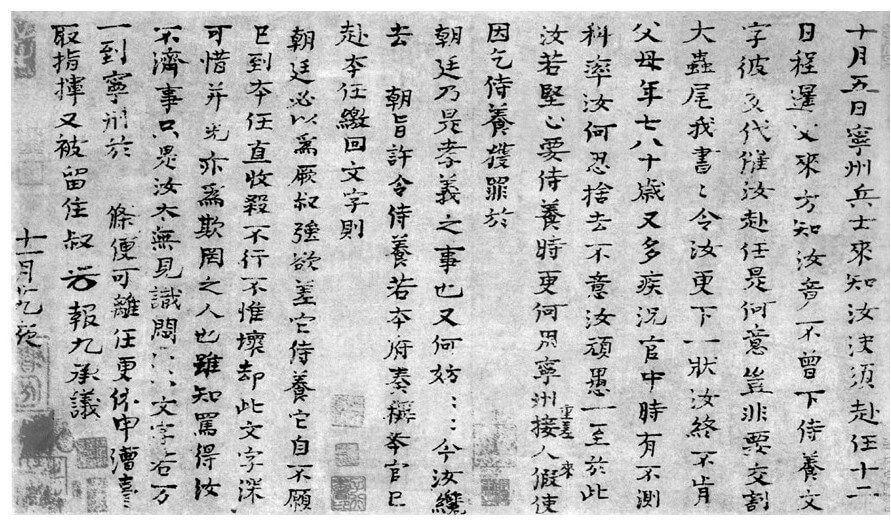
Sima Guang was extremely incorruptible as an official. During Emperor Renzong's reign, the emperor once planned to bestow upon him a large amount of gold, silver, and treasure, but Sima Guang refused the gift. While compiling the Zizhi Tongjian in Luoyang, he lived in very straitened circumstances. When his wife, Lady Zhang, passed away, he could not even afford the funeral expenses. To give her a dignified burial, he pawned all the small amount of land he owned. Later, a friend, seeing that he was old and alone, wanted to give him a maidservant to attend to his daily needs. Though this was a kind gesture from the friend, Sima Guang politely declined.
Sima Guang was a true gentleman, whose entire life was marked by openness and integrity, leaving him with no shame before heaven and earth. Neither his contemporaries nor later generations could find the slightest flaw in his character. Even Wang Anshi, who held opposing political views and was at odds with him, had to praise him, saying: "Sima Junshi is a man of virtue!" "Junshi" was Sima Guang's courtesy name.
Sima Guang was deeply learned in poetry and classical texts, possessing outstanding talent, and at the age of nineteen he passed the imperial examination to become a jinshi, thus beginning his political career. Some say that Sima Guang accomplished two great deeds in his lifetime, one of which was naturally the compilation of the Zizhi Tongjian (Comprehensive Mirror for Aid in Government).
During his fifteen years in Luoyang, Sima Guang devoted all his energy to compiling the Comprehensive Mirror for Aid in Government. Although the editorial office had many assistants helping him, and his son Sima Kang also joined to proofread, Sima Guang never delegated the actual writing to others—every single word and sentence of the work was his own painstaking effort. Later, in his Memorial on Presenting the Comprehensive Mirror for Aid in Government, he described himself as "emaciated in body, dim-sighted, with few teeth left, and his mind and spirit worn out." To complete this book, he endured nineteen long years of diligent, heart-wrenching labor. The prolonged toil completely broke his health; less than two years after finishing the work, Sima Guang fell ill and passed away.
The Comprehensive Mirror for Aid in Government totals over three million characters, divided into 294 volumes, structured chronologically with events as the main focus, beginning from the early Warring States period and continuing until the late Five Dynasties period when Emperor Shizong Chai Rong of the Later Zhou campaigned in Huainan, spanning a time frame of 1,362 years.
The Comprehensive Mirror for Aid in Government (Zizhi Tongjian) covers the history of sixteen dynasties, with greater detail on recent periods and less on ancient ones. Forty percent of the entire work describes the history of the Sui, Tang, and Five Dynasties, with the Tang Dynasty occupying the most space, spanning eighty-one volumes. Sima Guang provided particularly detailed accounts of prosperous eras, making the Rule of Wen and Jing and the Reign of Zhenguan key focuses. He always liked to add relevant commentary after narrating historical events. Most of these comments were written by him, beginning with "Your servant Guang says," while the rest came from various renowned scholars, making the Comprehensive Mirror for Aid in Government an immortal masterpiece that "reflects on the rise and fall of past ages to examine the successes and failures of the present."
Zizhi Tongjian (Comprehensive Mirror for Aid in Government) is considered a textbook for ancient Chinese monarchs, and throughout China's ancient history, only Sima Qian's monumental work Shiji (Records of the Grand Historian) can rival it, earning Sima Guang and his predecessor Sima Qian the joint title of "The Two Simas of Historiography." Wang Yinglin, a historian of the Southern Song Dynasty, once said, "Since the invention of writing, there has never been a work like the Tongjian." Wang Mingsheng, a historian of the Qing Dynasty, also remarked, "This is an indispensable book in the world, and a must-read for scholars."
In addition to compiling the Comprehensive Mirror for Aid in Government, Sima Guang also undertook a major endeavor: opposing Wang Anshi's reforms. Wang Anshi was a pioneer of the reformist faction in the Northern Song court, while Sima Guang stood as a pillar of the conservative faction. The two held vastly different political views, but this does not mean one was loyal and the other treacherous. In fact, both Wang Anshi and Sima Guang were utterly devoted to the Northern Song court, and everything they did stemmed from a genuine desire to serve the country and its people.
At that time, the Northern Song Dynasty faced internal turmoil and external threats, urgently needing to change the situation. Wang Anshi believed that only through sweeping reforms could the country become prosperous and its military strong, while Sima Guang argued that such reform measures were too radical and might go too far, so he advocated for gradual and orderly adjustments. Although Sima Guang's political stance was somewhat conservative, in practice it proved more feasible than Wang Anshi's drastic and swift transformations.
The political struggle between Sima Guang and Wang Anshi was entirely a conflict among gentlemen. In the early stages of the struggle, Wang Anshi's reformist faction gained the upper hand, forcing Sima Guang to leave the capital and retreat to Luoyang. However, Sima Guang did not harbor resentment against Wang Anshi because of this; when someone once urged him to submit a memorial slandering Wang Anshi, Sima Guang sternly refused. Although they were political adversaries, Sima Guang and Wang Anshi held mutual respect and admiration for each other.
After Emperor Zhezong of the Song Dynasty ascended the throne, Sima Guang returned to the capital to oversee state affairs. However, the compilation of the "Comprehensive Mirror for Aid in Government" had already exhausted his life's energy, and the aging, frail Sima Guang died of illness less than two years into his governance. The people of the capital wept bitterly at the news, with tens of thousands attending his funeral. Emperor Zhezong ordered a grand burial for him, bestowed the posthumous title "Wenzheng," and personally inscribed six large characters on his tombstone: "Stele of Loyalty, Purity, and Virtue."