
During the early Southern Song Dynasty, the iron hooves of the Jin army trampled across the Central Plains and continuously invaded southward. Although the Southern Song rulers were extremely weak, many renowned anti-Jin generals emerged within the court, the most celebrated by later generations being Yue Fei, who served his country with utmost loyalty.
Yue Fei was born during the reign of Emperor Huizong of the Song Dynasty. At the age of twenty, Yue Fei began studying martial arts under Chen Guang. With great talent and exceptional diligence, he quickly became the top martial arts expert in his county. Soon after, when the imperial court recruited brave warriors, Yue Fei enlisted in the army. Unfortunately, not long after, his father fell ill and passed away, forcing Yue Fei to return to his hometown to observe the mourning period for his father.
By the time of the Jingkang era, Yue Fei joined Liu Hao's forces in Xiangzhou. At twenty-four years old, Yue Fei officially began his journey of fighting across the land. Throughout his life, Yue Fei launched four northern expeditions, and in battles against the Jin army, he successively recaptured Yingzhou, the six prefectures of Xiangyang, Shangzhou, and Guozhou, among other territories. The army he led was respectfully called the "Yue Family Army," and a saying spread among the Jin forces: "It is easier to shake a mountain than to shake the Yue Family Army." Wherever the Yue Family Army went, the Jin troops trembled with fear.
Because of his outstanding military achievements, Yue Fei was appointed as the Military Commissioner of Qingyuan Army at the age of thirty-two, making him the youngest person to hold such a position during the Northern and Southern Song dynasties. Subsequently, Yue Fei received continuous promotions and honors, with his final promotion occurring in 1142 when he was thirty-nine years old. The imperial court issued twelve golden plaques in rapid succession, summoning him back to the capital from the battlefield against the Jin dynasty, and then granted him the position of Vice Commissioner of the Privy Council. Though ostensibly a promotion, it was actually a move to strip him of military power. In the same year, Yue Fei was falsely accused and imprisoned by the treacherous minister Qin Hui on the fabricated charge of "perhaps having" treason. On the twenty-ninth day of the twelfth lunar month, Yue Fei was poisoned to death at the Fengbo Pavilion in Lin'an, and his son Yue Yun was executed by waist-cutting.
Before Yue Fei was recalled to the capital, he was in the midst of his fourth Northern Expedition. At that time, the Yue family army was unstoppable, sweeping through the Central Plains, and Yue Fei himself led his troops to a major victory at Zhuxian Town over the Jin army commanded by Wuzhu, driving them out of Kaifeng. Unexpectedly, at this very moment, the imperial court suddenly ordered Yue Fei to return to the capital. Yue Fei submitted a memorial to Emperor Gaozong of Song, stating that the Song army held a strategic advantage in the war against the Jin and should press the attack; otherwise, if this opportunity was lost, regret would be too late.
However, Emperor Gaozong of Song turned a blind eye to Yue Fei's brilliant military achievements, issuing twelve golden plaques in a single day to order Yue Fei to immediately withdraw his troops back to the capital, while simultaneously pulling back all Song forces except for Yue Fei's own army. Filled with grief and indignation yet utterly helpless, Yue Fei could only shed tears and sigh, "Ten years of effort, destroyed in an instant!"
When the common people heard that the Yue Family Army was about to withdraw, they came weeping to Yue Fei, pouring out their grievances. Yue Fei understood that once the Song army withdrew, the Jin army would surely return and bring disaster to the people of the Central Plains. He decided to take the people south with him, so he planned to delay for another five days, publicly announcing that he intended to cross the Yellow River and continue attacking the Jin forces. Upon hearing this news, Wuzhu immediately led his army north in retreat. Yue Fei used this time to protect the local people as they migrated south. After the Yue Family Army withdrew, Wuzhu quickly led his forces back to recapture Kaifeng, and the beautiful lands of the Central Plains once again fell into the hands of the Jin.
When Yue Fei was framed and imprisoned by Qin Hui on charges of treason, Qin Hui could find no evidence of rebellion no matter how hard he tried, and ultimately had Yue Fei and his son executed under the absurd charge of "perhaps there is" (mo xu you). After Yue Fei's death, his body was secretly buried by a jailer named Kui Shun, a loyal and honest man who had long admired Yue Fei's reputation and could not bear to see his corpse desecrated. Kui Shun kept this secret until his dying day, when he finally revealed it to his son.
In 1162, the incompetent and fatuous Emperor Gaozong of Song abdicated the throne, and Emperor Xiaozong ascended. Xiaozong ordered the rehabilitation of Yue Fei, posthumously granting him the title of Wumu, and built a tomb for him by West Lake in Hangzhou, where his remains were buried.
Yue Fei dedicated his entire life to serving his country with utmost loyalty, earning deep admiration from both his soldiers and the common people. Whenever he won a battle, the imperial court would bestow generous rewards upon the generals, but Yue Fei always distributed all of these rewards among his troops. The famous saying, "Generals must not fear death, and civil officials must not love money," was first proposed by Yue Fei himself. During military campaigns, he ate and lived alongside his soldiers. In times of food shortages, he would share the same meals as the lowest-ranking troops. In every battle, he charged to the front lines. When the commander himself was so fearless and self-sacrificing, how could his subordinates ever think of retreating? This was a key reason why the Yue Family Army was invincible on the battlefield.
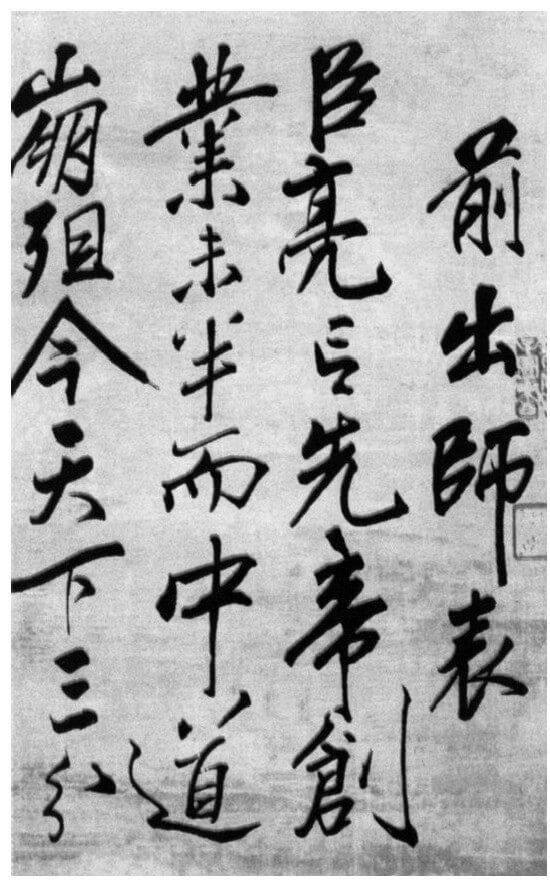
Yue Fei was not only an outstanding military general but also a remarkable poet; his lyric poem "Man Jiang Hong" (Red All Over the River) has become a timeless masterpiece passed down through the ages. Yue Fei was also highly accomplished in calligraphy, and his favorite practice was copying the calligraphy of Su Shi. In his daily life, Yue Fei greatly enjoyed reading, and many of his associates were renowned scholars of his time.
Yue Fei was strict with his subordinates and equally so with his own family. He required his children not only to study but also to personally work in the fields to experience the hardships of the common people. His eldest son, Yue Yun, repeatedly distinguished himself on the battlefield, yet Yue Fei refused to report his achievements to ensure he received due rewards. Zhang Jun believed this was unfair, but Yue Fei replied, "As a father, I absolutely cannot allow my child to become overly eager for quick success at such a young age!"
After Yue Fei's wife, Lady Li, married him, she wore silk clothing only once. When Yue Fei saw this, he became very angry and said, "The empress and all the consorts who were captured during the Jingkang Incident now wear only coarse cloth garments. How can we, as subjects, wear silk and satin?" From then on, Yue Fei's entire family wore only clothes made of coarse cloth every day, showing no difference from ordinary commoners.
In ancient Chinese society, it was very common for men to have multiple wives and concubines, especially among military generals of the Southern Song Dynasty, where almost none lacked a bevy of women. However, Yue Fei, who held a high position, insisted on monogamy. His first wife, Liu, abandoned him and their children to remarry a subordinate of Han Shizhong. Yue Fei not only voiced no complaints but also gave her five hundred strings of cash. Only afterward did he marry Li, who was two years his senior. Li was a virtuous and kind woman; after marrying Yue Fei, she never enjoyed a single day of wealth and luxury, yet she bore no resentment. She treated the two sons Liu had borne for Yue Fei as her own. After Yue Fei's death, she was exiled along with the rest of the Yue family. She used her strength to protect the remaining bloodline of the Yue family, until twenty years later, when Emperor Xiaozong of Song rehabilitated Yue Fei and ordered his relatives to return to the capital. Only then, thanks to Li's steadfast support, did Yue Fei's family finally see the light of day again.
Yue Fei led from the front on the battlefield and lived a frugal and simple life; dedicating himself entirely to his country and its people until his dying breath, he left an indelible mark on the history of the Northern and Southern Song dynasties, becoming a deeply beloved hero among the common people.