
Wang Bo, Yang Jiong, Lu Zhaolin, and Luo Binwang were famous early Tang Dynasty literary figures, collectively known as the "Four Greats of the Early Tang."
Wang Bo, courtesy name Zian, was born in Longmen, Jiangzhou (present-day Hejin, Shanxi). His grandfather Wang Tong was a renowned scholar in the late Sui Dynasty, and his father Wang Fuzhi served as an official in the imperial court for many years. Wang Bo showed extraordinary intelligence from a young age, excelling in poetry and prose, and was thus called a child prodigy. At the age of fifteen, taking advantage of the inspection tour by Right Chancellor Liu Xiang, he submitted a memorial opposing the campaign against Goguryeo and fiercely criticized the Tang Dynasty's military policies. Impressed by Wang Bo's writing, Liu Xiang recognized him as a rare talent and recommended him to the court. At seventeen, Wang Bo passed the imperial examinations and, due to his outstanding performance, was appointed as a Sanlang (a junior official). Subsequently, he gained the favor of Prince Li Xian of Pei and was recruited as a tutor in the prince's residence. Two years later, Wang Bo was expelled from the prince's estate for writing a piece titled "A Denunciation of Prince Ying's Rooster."
This incident dealt a heavy blow to Wang Bo, who had achieved fame at a young age, so he left Chang'an and traveled through the Shu region. The beautiful scenery of Shu lifted Wang Bo's spirits greatly, but he still could not forget the setbacks in his official career; he poured his inner feelings into poetry and prose, producing many works of lyrical reflection.
After three years of traveling in the Shu region, Wang Bo returned to Chang'an and later went to Guozhou to serve as a military advisor. In his role as a military advisor in Guozhou, Wang Bo, confident in his extraordinary talent, paid little regard to his colleagues, which led to trouble and resulted in a death sentence. Fortunately for him, a general amnesty occurred just in time, saving his life. The following year, the court allowed him to resume his official post. However, by then, Wang Bo had become disillusioned with his official career and decided to live as an ordinary citizen, refusing to hold any further office. He devoted himself to writing and, in just one year, composed eighteen chapters of "Baili Changyan," ten chapters of "Helun," and "Tangjia Qiansui Li."Book of ChangesFive volumes of "Fahui" were published, along with a large number of poems and essays, and he completed the sixteen missing chapters of his grandfather Wang Tong's "Xushu."
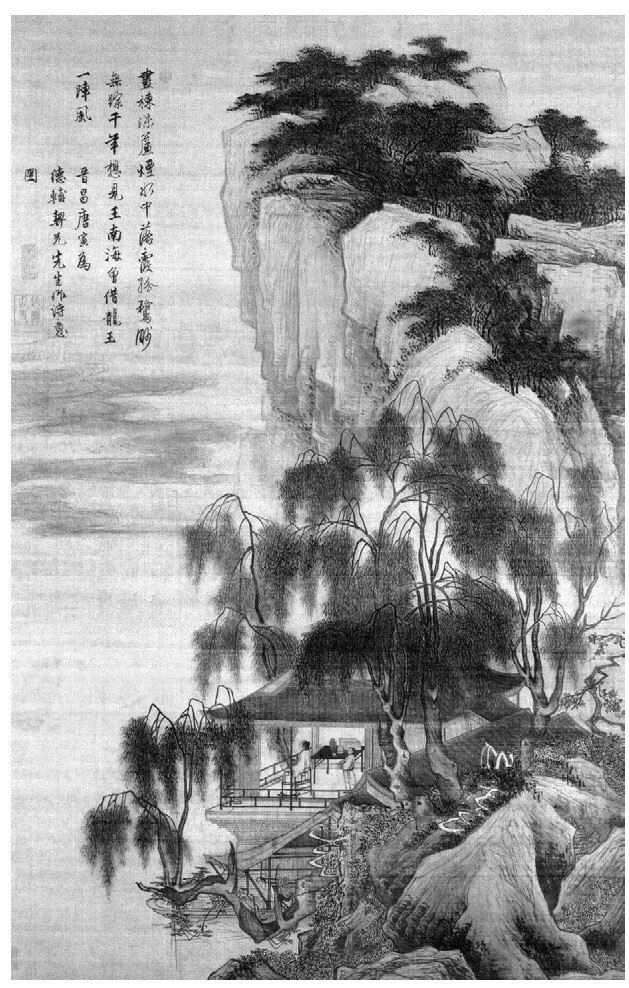
In the spring of 675 AD, Wang Bo traveled to Jiaozhi to visit his father. Upon arriving in Hongzhou, he happened to attend a banquet hosted by Yan Boyu, the governor of Hongzhou, after the restoration of the Prince Teng Pavilion. Wang Bo composed the celebrated masterpiece "Preface to the Farewell Feast at the Prince Teng Pavilion in Hongzhou on an Autumn Day," commonly known as the "Preface to the Prince Teng Pavilion," with the immortal line "A lone wild duck flies with the setting sun, the autumn river merges with the vast sky."
After attending the banquet at the Pavilion of Prince Teng, Wang Bo continued his journey southward, and in the autumn of the following year, he set sail from Guangzhou to cross the sea to Jiaozhi. Just as he was looking forward to reuniting with his father, he tragically drowned.
Yang Jiong was a native of Huayin, Hongyi (present-day Shaanxi Province). In 676 AD, he passed the imperial examination and began his official career due to his outstanding performance. In 685 AD, together with his cousin Yang Shenrang, he participated in the rebellion led by Xu Jingye against Empress Wu Zetian. In 690 AD, he taught at the Xiyi Hall in the Luoyang Palace, and two years later, he was appointed as the magistrate of Yingchuan, where he died in office. Throughout his life, Yang Jiong wrote many poems about frontier battles, expressing his desire to achieve merit and establish his reputation.
Lu Zhaolin, courtesy name Shengzhi and self-styled Master Youyou, was born in Fanyang, Youzhou (modern-day Zhuozhou, Hebei). From a young age, he studied philology and classical history under Cao Xian and Wang Yifang, acquiring extensive knowledge. In 654 AD, he served as the royal secretary to Prince Li Yuanyu of Deng, who greatly valued him and compared him to the famous Western Han writer Sima Xiangru. In early 667 AD, Lu Zhaolin became the county magistrate of Xindu, Yizhou (near present-day Chengdu, Sichuan). After leaving Sichuan, he settled in Luoyang but later contracted a wind ailment and moved to live in the Taibai Mountains near Chang'an. Soon after, he became disabled in his hands and feet due to poisoning from taking alchemical elixirs. Prolonged suffering from illness and disappointment in his official career led Lu Zhaolin to eventually drown himself. He excelled in regulated verse and made outstanding contributions to the development of seven-character ancient poetry, with his representative work including "The Ancient Meaning of Chang'an."
Luo Binwang, courtesy name Guanguang, was born in Wuzhou Yiwu (present-day Yiwu, Zhejiang). Known as a child prodigy, he wrote the widely acclaimed poem "Ode to the Goose" at the age of seven. As an adult, he served as an aide in the mansion of Prince Li Yuanqing of Dao. When the prince asked him to boast about his talents, Luo considered it shameful to show off and refused. Later, he was appointed as a ceremonial official and then joined the military, spending a long time stationed on the western frontier. In 678 AD, he successively held positions such as magistrate of Wugong, magistrate of Chang'an, and imperial censor. After Wu Zetian took control of the government, Luo repeatedly submitted memorials satirizing her, leading to his imprisonment. In 684 AD, Wu Zetian deposed Emperor Zhongzong Li Xian and declared herself emperor. Xu Jingye raised an army in Yangzhou to oppose her. Luo Binwang's fate became unknown; it is said he drafted the "Proclamation Against Wu Zetian" for Xu Jingye, harshly condemning her. After Xu Jingye's defeat, Luo vanished, with legends claiming he became a Buddhist monk and lived until the age of ninety-three.
During the early Tang Dynasty, the formalist poetic style of the Qi and Liang dynasties dominated the literary scene. The "Four Great Poets of the Early Tang" boldly reformed this ornate and superficial style, expanding the range of poetic subjects, enriching the content of poetry, and advancing the development of Tang Dynasty poetry.