
During the Tang Dynasty, the Tubo regime rose to power on the southwestern plateau. The Tubo people led a nomadic lifestyle, raising camels, horses, pigs, and yaks, and occasionally cultivating buckwheat and highland barley. After Songtsen Gampo ascended to the throne as the Tsenpo (king) of Tubo, he unified the various tribes on the Qinghai-Tibet Plateau and established a powerful kingdom.
In 638 AD, Songtsen Gampo led the Tibetan army to attack Songzhou (present-day Songpan, Sichuan) on the Tang Dynasty's southwestern border, breaching the city.
After learning of this incident, Emperor Taizong of the Tang Dynasty, Li Shimin, was furious and immediately sent the great general Hou Junji with a large army to Songzhou. Upon arriving at Songzhou, Hou Junji dealt a devastating blow to the Tibetan army beneath the city walls, forcing Songtsen Gampo to send envoys to Chang'an to sue for peace. Impressed by the Tang Dynasty's strength, Songtsen Gampo developed a deep admiration for it. In addition to submitting a formal apology to Emperor Taizong, he also requested a marriage alliance with the Tang court.
In fact, Songtsen Gampo was not the first ethnic minority leader to actively seek a marriage alliance with the Tang Dynasty; before him, many other minority leaders had requested such unions to strengthen ties with the Tang and ease ethnic tensions, and to prevent border incursions, Emperor Taizong of Tang was also willing to agree to these marriage alliances.
This time, facing Songtsen Gampo's marriage proposal, Emperor Taizong of Tang considered it and agreed to his request. He selected a dignified, noble, and highly cultured royal girl, bestowed upon her the title "Princess Wencheng," and sent her to Tubo to marry Songtsen Gampo as a diplomatic alliance.
In the winter of 641 AD, Princess Wencheng, escorted by Li Daozong, the Minister of Rites and Prince of Jiangxia Commandery, set out for Tubo (ancient Tibet) for a marriage alliance. The departure was scheduled in winter because the journey from Chang'an to Tibet required crossing several rivers with swift currents, which flowed more gently in winter, making travel easier. This marriage procession included not only accompanying maids but also a group of musicians, agricultural technicians, and scholars; along with dowries such as silk brocades, gold, silver, and jewels, they also carried large quantities of musical instruments, silk fabrics, grain seeds, as well as books on Confucian classics, music, astronomy, and medicine.
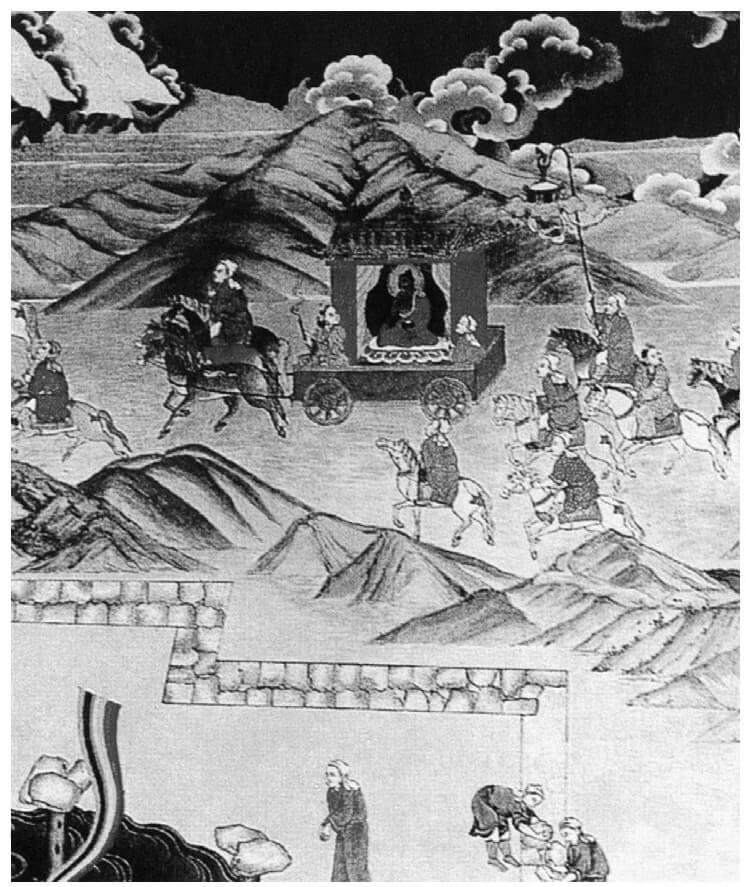
After traveling against wind and snow for over a month, when spring arrived, this peace-marriage entourage reached the source of the Yellow River at Heyuan. The climate there was pleasant, covered with abundant green vegetation, and herds of cattle and sheep roamed in groups. Upon seeing this scene, Princess Wencheng felt greatly relieved. She had originally been worried about the harsh climate and environment of Tubo (ancient Tibet) and whether she could adapt, but only then did she set her mind at ease.
Songtsen Gampo, following Tang Dynasty etiquette, personally traveled from the Tibetan capital of Lhasa (present-day Lhasa in the Tibet Autonomous Region) to the source of the Yellow River to welcome Princess Wencheng. After meeting the Tang envoy Li Daozong, Songtsen Gampo knelt and bowed to him. This gesture showed that he regarded the Tang Dynasty as a supreme celestial empire.
Afterwards, Songtsen Gampo, accompanied by the marriage envoy team, brought Princess Wencheng back to the city of Lhasa. On the fifteenth day of the fourth month in the Tibetan calendar, under the auspices of Li Daozong, Songtsen Gampo and Princess Wencheng held a grand wedding ceremony. Notably, the ceremony followed the rites of the Tang Dynasty, demonstrating Songtsen Gampo's respect for Princess Wencheng and his reverence for the Tang Empire. The people of Lhasa celebrated like a festival, singing and dancing, offering their best wishes to the newlyweds. Songtsen Gampo said with great emotion, "Neither my people nor my ancestors have ever had the precedent of marrying into the great celestial dynasty. Today, I am wedded to the princess of the Tang Empire—truly a great fortune. I will build a magnificent palace for the princess, so that future generations may remember this event."
Soon after, Songtsen Gampo had a magnificent palace built for Princess Wencheng in Lhasa, modeled after Tang Dynasty palaces—the Potala Palace.
To better communicate with Princess Wencheng, Songtsen Gampo diligently learned Chinese from her, took off the fur garments he was accustomed to wearing, and put on the Tang-style clothes she had sewn for him with her own hands. Although they came from different ethnic groups, they lived together harmoniously, respecting and loving each other, which made their life very happy. In 650 AD, Songtsen Gampo passed away, but Princess Wencheng remained in Tibet, striving to promote cultural exchange between the Han and Tibetan peoples. She requested the Tang court to send skilled craftsmen to help build infrastructure for the Tibetan people, had her attendants teach local residents farming methods, and warmly received many Tibetan monks who traveled to India to study Buddhism.
Princess Wencheng's marriage to Songtsen Gampo fostered exchanges between the Han and Tibetan peoples, bringing advanced Han production techniques such as architecture, papermaking, metallurgy, textiles, and pottery, as well as medical methods, to Tibetan regions. At the same time, many aspects of Tibetan culture were absorbed into Han culture. To this day, statues of Princess Wencheng and Songtsen Gampo are still enshrined in the Potala Palace and Jokhang Temple in Lhasa.