
Wu Zetian was born in 624 in Wenshui, Bingzhou (present-day east of Wenshui, Shanxi), into a wealthy family. Her father, Wu Shihuo, was a wealthy landowner in Bingzhou. When Li Yuan served as an official in Hedong and Taiyuan, Wu Shihuo often hosted him in his home. Later, Wu Shihuo generously supported Li Yuan's uprising against the Sui Dynasty. After Li Yuan established the Tang Dynasty, Wu Shihuo became a court official and was granted the title of Duke of Ying. By her teenage years, Wu Zetian had grown into a strikingly beautiful and captivating young woman. When Emperor Taizong of Tang, Li Shimin, heard of her, he summoned her to the palace, appointed her as a fifth-rank talent, and bestowed upon her the title "Wu Mei" (meaning "charming Wu"). On the day she entered the palace, her mother was reluctant to part with her, but Wu Zetian said, "I am going to serve a wise emperor—how do you know this isn't a good thing? Why cry like a child?"
Wu Zetian entered the imperial palace with beautiful fantasies, but she did not gain the favor of Emperor Taizong of Tang. Unwilling to live an obscure life in the palace, she aspired to rise above others, so she placed her hopes on Crown Prince Li Zhi. During Li Shimin's illness, she and Li Zhi developed mutual feelings, which made Li Zhi fond of her.
In 649 AD, Emperor Taizong of the Tang Dynasty, Li Shimin, passed away, and Crown Prince Li Zhi smoothly ascended the throne, becoming Emperor Gaozong of Tang. According to custom, Wu Zetian and other concubines of Emperor Taizong were sent to Ganye Temple to become nuns. Wu Zetian understood in her heart that her future days would likely be spent in Ganye Temple, but she did not completely lose hope, silently waiting for an opportunity.
The opportunity soon arrived. One day, Emperor Gaozong of Tang went to Ganye Temple to burn incense and worship Buddha. Wu Zetian knelt before him, her face streaming with tears of sorrow. The emperor had never been able to forget her, and seeing her so distressed, he felt deeply uneasy and decided to find a way to bring her back to the palace.
Empress Wang of Emperor Gaozong was steady in character but not skilled at winning favor. After many years of marriage to Gaozong, she had not borne any children. As a result, Gaozong greatly disliked her, kept her at a distance, and doted on Consort Xiao. Seeing Gaozong neglect her and favor Consort Xiao, Empress Wang felt deeply distressed. At that time, rumors spread in the palace that Gaozong was involved with a nun from Ganye Temple. When Empress Wang heard this news, she was naturally very angry, but then she thought: if she brought that nun into the palace to occupy Gaozong's attention, then Gaozong would no longer favor Consort Xiao. Blinded by her rivalry with Consort Xiao for Gaozong's affection, Empress Wang had lost all reason. She only thought of defeating Consort Xiao, without considering the consequences of her actions. She sent someone to Ganye Temple, ordering Wu Zetian to let her hair grow back in preparation for entering the palace. Afterwards, Empress Wang took the initiative to suggest that Gaozong bring Wu Zetian into the palace. Gaozong was overjoyed and immediately agreed. In fact, he had long wanted to do this, but since Empress Wang was the head of the harem, this matter required her consent, and Gaozong had never known how to bring it up with her. Now that Empress Wang had raised the matter herself, Gaozong was naturally delighted beyond measure.
Thus, after spending some time as a nun at Ganye Temple, Wu Zetian re-entered the imperial palace. Emperor Gaozong was deeply fond of her and granted her the title of Zhaoyi. After serving as Zhaoyi for a while, she grew dissatisfied with her position and developed ambitions to become empress. Wu Zetian was a cunning and ruthless individual; to secure the position of empress, she planted many spies around Empress Wang, hoping to find evidence to bring her down. However, Empress Wang was composed and left no openings. Wu Zetian would not give up easily due to a small setback. After much deliberation, she finally devised a clever plan.
At that time, Wu Zetian had just given birth to a lovely daughter. When the daughter was one month old, Empress Wang came to visit. Shortly after Empress Wang left, Wu Zetian killed her own daughter with her own hands and framed Empress Wang for the murder. After Emperor Gaozong learned of this, he did not hesitate to confine Empress Wang to the cold palace.
Wu Zetian finally became empress at the cost of sacrificing her own biological child. Afterwards, she seized an opportunity to cruelly kill Empress Wang and Consort Xiao, thereby solidifying her position.
After 660 AD, Emperor Gaozong's health deteriorated to the point where he could no longer manage state affairs. Wu Zetian, who had a strong passion for politics and an intense desire for power, frequently handled court matters on his behalf. Displeased with her excessive control, Gaozong consulted Chancellor Shangguan Yi, who suggested deposing her for monopolizing power. Someone immediately reported this to Wu Zetian. Upon hearing the news, she rushed to Gaozong, tearfully reminding him of their deep bond as husband and wife over many years. She then sternly demanded to know what wrong she had done to warrant deposition. Overwhelmed by her aggressive demeanor, Gaozong stammered in fear, "I never intended to depose you—it was all Shangguan Yi's idea!" Fierce and unforgiving, Wu Zetian could not tolerate Shangguan Yi's actions and soon had him executed on false charges of treason.
Wu Zetian said to Emperor Gaozong: "Your Majesty is a very capable emperor. Under your rule, the country is peaceful and the people live in contentment. However, Your Majesty has one weakness—you are too easily swayed and influenced by others. You originally had no intention of deposing me, but as soon as Shangguan Yi spoke, you listened to his words and planned to do so. If this had actually happened, your mistake would have been extremely serious. To prevent similar issues from occurring again, I request that Your Majesty allow me to attend court sessions with you. In this way, I can help you analyze the words of your ministers, so that you will no longer make such errors."
Emperor Gaozong was already regretting his decision to depose Wu Zetian and was looking for an opportunity to apologize to her, so he agreed to her request. From then on, Wu Zetian attended court and listened to political affairs alongside Emperor Gaozong. Although Gaozong sat in the main hall of the court while Wu Zetian sat behind a screen in the rear hall, all major state affairs were entirely decided by Wu Zetian alone.
In 683 AD, Emperor Gaozong of the Tang Dynasty died of illness, and his son Li Xian, who became Emperor Zhongzong, succeeded him. Zhongzong was a weak and incompetent ruler; although he ascended the throne, he held no real power. Unwilling to remain a puppet under his mother Wu Zetian's control, he sought to appoint his father-in-law Wei Xuanzhen as Prime Minister to build his own influence. However, this appointment was opposed by Pei Yan, the regent prime minister appointed by Gaozong on his deathbed. Enraged and arrogant, Zhongzong declared, "I am the sovereign of this nation—I can make anyone Prime Minister as I please. Even if I were to hand over the entire realm to him, no one has the right to interfere."
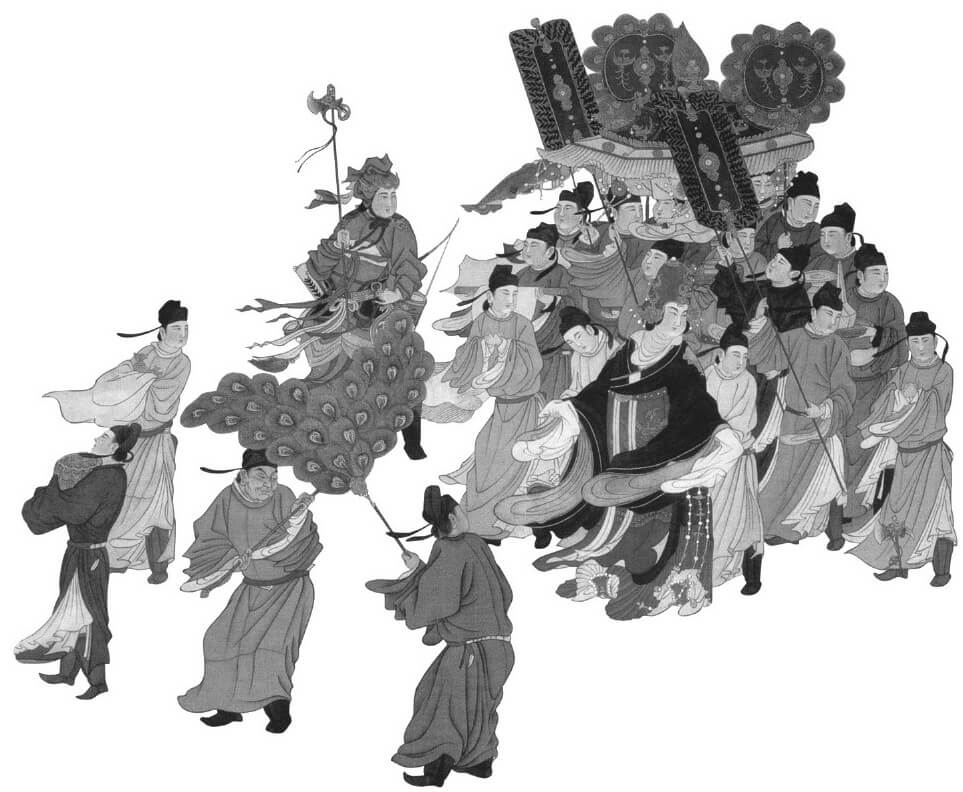
Wu Zetian quickly learned of this matter and became extremely angry. She demoted Emperor Zhongzong to the Prince of Luling and placed him under house arrest. Afterwards, she installed her youngest son, Li Dan, as emperor. Li Dan became Emperor Ruizong of the Tang Dynasty. Wu Zetian did not allow Ruizong to handle state affairs, so all major governmental matters were managed by her alone.
After this, Wu Zetian's desire for power grew increasingly intense, and she conceived the idea of becoming a female emperor. To this end, she carried out a series of preparatory measures. She renamed the eastern capital Luoyang as "Divine Capital" and changed the names of civil and military officials to ones with feminine characteristics.
After witnessing Wu Zetian's actions, some court officials speculated that she harbored ambitions to become emperor, and opposition against her began to emerge. Xu Jingye gathered 100,000 troops in Yangzhou and openly rebelled against Wu Zetian. She promptly mobilized 300,000 soldiers to counter the rebellion and quickly suppressed Xu Jingye's uprising.
In 690 AD, at the age of sixty-seven, Wu Zetian changed the dynasty's name to Zhou in Luoyang, proclaimed herself "Holy and Divine Emperor," and changed the era name to Tian Shou. Wu Zetian finally ascended the imperial throne, becoming the only woman in Chinese history to sit on the dragon throne.