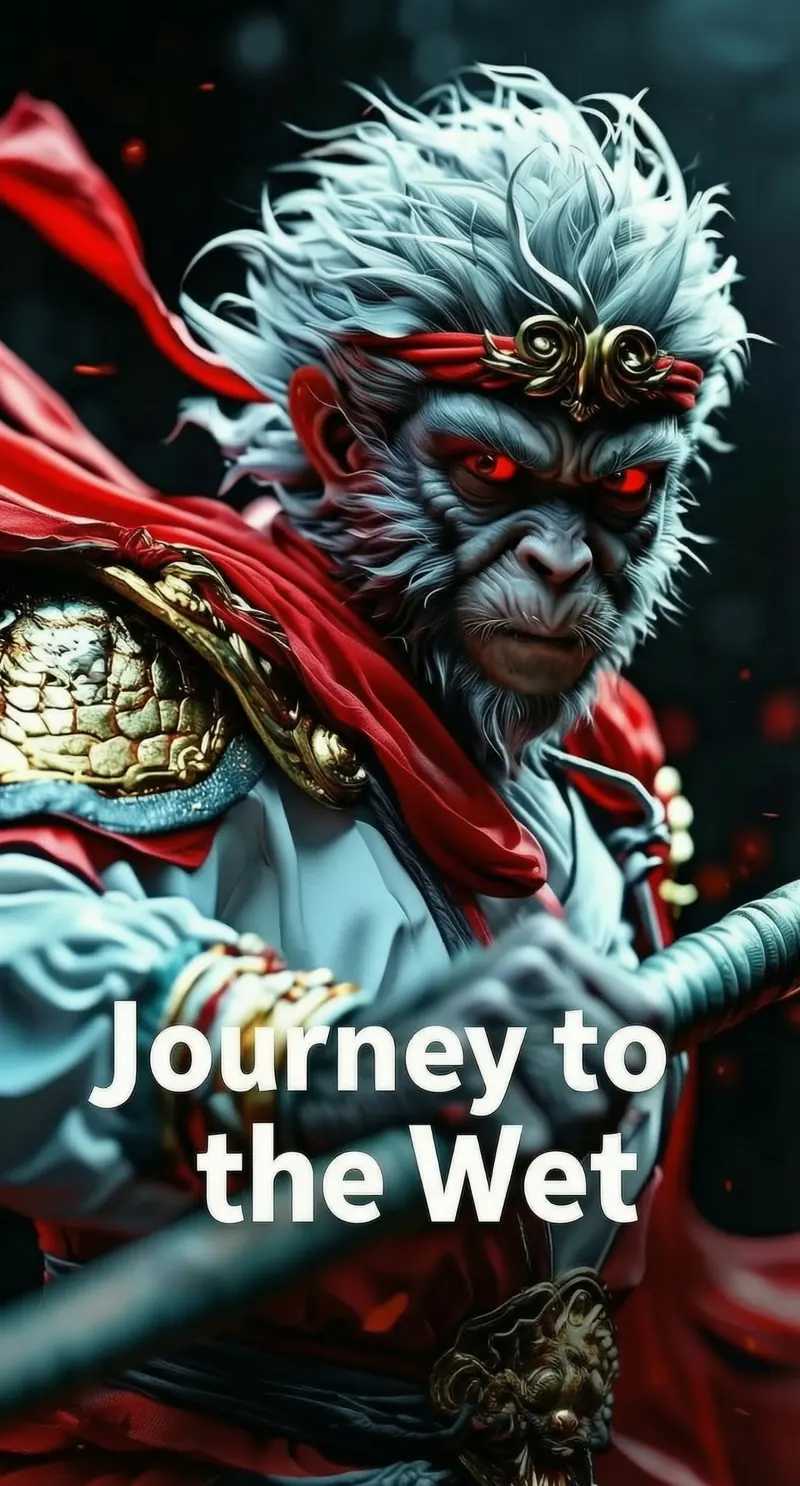
As soon as a single thought stirs, a hundred demons are born; the most bitter hardship of cultivation is how to deal with them. One must rely on cleansing to remove all filth , and also use restraint to refine oneself. Sweep away all worldly attachments and return to stillness ; expel a thousand monsters and do not waste time. Only then can one break free from the cage of delusion , and when the pilgrimage is complete, ascend to the highest heavens .
Having exhausted his wits and invited Tathagata to subdue the horde of demons, the Great Sage Sun Wukong had finally resolved the crisis for his master and disciples. They left the Lion and Camel Kingdom and continued their journey westward. Several months passed, and soon winter arrived. Before them lay a landscape of stark beauty: the plum blossoms on the ridges were about to bloom like jade; the waters of the ponds were slowly turning to ice. All the red leaves had fallen, while the green pines appeared even more verdant. Wispy clouds drifted as if to herald snow, and withered grass lay flat on the ground. Everywhere was a scene of bitter cold, a chill that pierced the bones and made one shiver.
The master and his disciples braved the biting wind and bitter frost, enduring the elements as they hurried along the road. As they walked, they saw another city in the distance. Sanzang asked, "Wukong, what place is that ahead?" The Pilgrim replied, "We'll know when we get there. If it's the territory of a western king , we'll need to exchange our travel documents; if it's just an ordinary prefecture or county , we can pass straight through." Before they had finished speaking, they had already arrived at the city gate.
Sanzang dismounted, and the four of them entered the outer gate . They saw an old soldier dozing against a sun-warmed wall to escape the wind. The Pilgrim stepped forward and shook him, calling out, "Officer!" The old soldier woke with a start, blinking in confusion. When he saw the Pilgrim, he fell to his knees in terror, kowtowing and crying, "Grandfather!"
The Pilgrim said, "Don't panic. I'm no vicious demon or evil god. Why are you calling me 'Grandfather'?" The old soldier kowtowed and replied, "Are you the Grandfather Thunder God?" The Pilgrim said, "Nonsense! I am a monk from the East, traveling to the West to fetch scriptures. I've just arrived and don't know the name of this place. I'm asking you." When the old soldier heard this, he finally calmed down. He yawned, got to his feet, stretched his back, and said, " Venerable Sir , Venerable Sir, forgive my rudeness. This place was originally called Bhikshu Kingdom , but now it's been renamed Children-Snatching Kingdom ."
The Pilgrim asked, "Does the kingdom have a king?" The old soldier replied, "Yes! Yes! Yes!" The Pilgrim turned to Sanzang and said, "Master, this place was once called Bhikshu Kingdom, but now it's called Children-Snatching Kingdom. I wonder why the name changed." Sanzang asked, puzzled, "Since it's called Bhikshu Kingdom, why would it change to Children-Snatching Kingdom?" Bajie said, "It must be that the old king of Bhikshu died, and the new king is a young man, so they call it the Children's City." Sanzang said, "That makes no sense! That makes no sense! Let's enter the city and ask on the streets." Sha Wujing said, "Right, right, let's hurry in and make inquiries. That old soldier either doesn't know, or he's been scared witless by our senior brother."
The four of them passed through three more city gates and arrived at a bustling main street. The people there were well-dressed and handsome, and the scene was one of great prosperity: taverns and singing halls were filled with lively noise; colorful shops and tea houses all had their curtains drawn. Thousands of households were thriving; every street and alley was a source of wealth. Men buying gold and selling brocade swarmed like ants, all scrambling for fame and fortune. The people were polite and dignified, and the scenery was magnificent—truly a time of great peace and prosperity.
The four masters and disciples, leading the horse and carrying the luggage, wandered through the streets for some time, unable to take in all the splendor. But a strange sight caught their attention: in front of every house stood a goose cage . Sanzang said, "Disciples, why do all these people place goose cages at their doorsteps?" When Bajie heard this, he looked left and right and saw that goose cages were indeed everywhere, covered with colorful silk satin. The Fool laughed and said, "Master, today must be an auspicious day for weddings and social gatherings. Everyone is displaying their cages for the ceremonies."
The Pilgrim said, "Nonsense! There's no custom where every household holds a ceremony! There must be a reason for this. I'll go and have a look." Sanzang grabbed him and said, "Don't go. Your appearance is too ugly; people might take offense." The Pilgrim said, "I'll change my form." The Great Sage was resourceful. He made a hand seal, recited a spell , and shook his body, transforming himself into a bee. Spreading his wings, he flew to the side of a goose cage and slipped through the silk curtain to look inside. To his surprise, a small child sat within the cage. He went to the second cage and looked—another child. After examining eight or nine cages, he found they all contained children, all boys, none of them girls. Some were playing, some were crying, some were eating fruit, and some were sleeping.
After his inspection, the Pilgrim returned to his original form and reported to Sanzang, "The cages are all filled with children, the oldest no more than seven, the youngest only five. I don't know why this is being done." When Sanzang heard this, his heart was filled with doubt and unease.
Turning a corner, they saw a government building with a sign that read " Golden Pavilion Post Station ." The elder was delighted and said, "Disciples, let's enter this post station first. Firstly, we can ask about the situation here; secondly, we can let the horse rest; and thirdly, since night is falling, we can find lodging." Sha Wujing agreed, "Yes, yes, let's go in quickly!" The four of them happily entered the station, and the officials inside immediately reported to the stationmaster. The stationmaster came out to greet them. After exchanging courtesies, they sat down. The stationmaster asked, "Venerable Sir, where have you come from?"
Sanzang replied, "I am a poor monk sent by the Great Tang in the East to fetch scriptures from the Western Heaven. Having arrived in your esteemed land, I must present my travel documents for inspection according to the rules. I humbly request to rest for a while in your post station." The stationmaster immediately ordered tea to be served. After tea, he instructed his staff to prepare food and lodging. Sanzang expressed his thanks and asked, "Could I enter the palace today to see the king and have my documents inspected?" The stationmaster said, "Not today. You will have to wait for the morning court session tomorrow. Please stay here in my station for tonight."
After a while, the food and lodging were ready. The stationmaster invited the four of them to share a vegetarian meal, and then had the guest rooms cleaned for their rest. Sanzang was deeply grateful. After they sat down, the elder said, "There is something I do not understand, and I wish to ask for your guidance. Please be so kind as to enlighten me. In your esteemed land, how do people raise their children?" The stationmaster replied, "There is no second sun in the sky, and no second principle for men. Raising children is the same everywhere: they are conceived from the blood and essence of their parents , carried for ten months , born, and then nursed for three years before they slowly grow up. What is there to not understand about this!"
Sanzang said, "If that's the case, it is the same as in my country. But when I entered the city, I saw goose cages placed in front of every house, with small children hidden inside. This is what I do not understand, and so I dared to ask." The stationmaster leaned close to the elder's ear and whispered, "Venerable Sir, do not concern yourself with this matter. Do not ask, do not meddle, do not speak of it. Rest now, and be on your way at first light." When the elder heard this, he grabbed the stationmaster and would not let him go, insisting on an explanation. The stationmaster shook his head and waved his hands, saying only, "Do not speak of it!" Sanzang held on even tighter, demanding to know the truth. With no other choice, the stationmaster ordered all his staff to withdraw. Then, alone in the lamplight, he whispered, "The matter of the goose cages you ask about is the work of our present king's unrighteous rule. Why must you meddle in it!"
Sanzang said, "What unrighteous rule? You must tell me clearly, so that I may be at ease." The stationmaster said, "This kingdom was originally called Bhikshu Kingdom, but recently a folk song has renamed it Children-Snatching Kingdom. Three years ago, an old man disguised as a Taoist brought a sixteen-year-old girl—a girl of extraordinary beauty, like the Bodhisattva Guanyin herself—as a tribute to the king. The king was captivated by her beauty and kept her in the palace, making her his beloved queen. From that day on, the king did not so much as glance at any of his other consorts or concubines. He indulged in pleasure day and night, and now his spirit is exhausted, his body emaciated. He cannot eat, and he is on the verge of death. The physicians of the Imperial Hospital have exhausted their best remedies, but none can cure him.
"That Taoist who presented the girl was appointed as the National Father by the king. The National Father possesses a secret formula from overseas that can grant great longevity. Some days ago, he went to the Ten Continents and Three Isles to gather the ingredients, and now he has everything prepared. But the medicinal catalyst is truly terrifying: he needs the hearts and livers of one thousand one hundred and eleven children to be boiled in soup and taken as medicine. Taking this, he claims, will allow the king to live for a thousand years. The children in those goose cages are the ones who have been selected and raised for this purpose. Their parents, fearing to defy the king's decree, dare not even weep. This is why the rumors have spread, and the place is now called Children-Snatching Kingdom. Is this not unrighteous rule? Venerable Sir, when you attend the morning court tomorrow, just exchange your documents and say nothing of this matter." Having spoken, the stationmaster withdrew.
Sanzang was so terrified that his whole body went limp. Tears streamed down his face uncontrollably, and he suddenly burst into sobs. "O blind king! O blind king! For the sake of indulging in pleasure and loving beauty, you have brought sickness upon yourself. But how can you harm the lives of so many children! Bitter! Bitter! It breaks my heart!" A poem bears witness to this:
The wicked ruler, ignorant, lost the true and right, Indulging in pleasure, unaware he harmed his own life. To seek eternal life, he slaughters the innocent young, To avert heaven's wrath, he kills his humble subjects. The monk, filled with compassion, cannot bear to let it pass, The official speaks of dangers too dreadful to hear. Before the lamp, he sheds tears and heaves long sighs, Pain overwhelms the one who meditates and seeks the Buddha.
Bajie stepped forward and said, "Master, what's wrong with you? You're always crying over other people's coffins! Don't worry! As the saying goes, 'If the ruler wants his minister to die, the minister must die to be loyal; if the father wants his son to die, the son must die to be filial.' He is harming his own people. What does it have to do with you? Take off your clothes and go to sleep. Stop worrying about the troubles of the ancients." Sanzang wiped his tears and said, "Disciple, you have no compassion! We who have left the family cultivate virtue and do good deeds. The most important thing is to help others. How can this blind king be so reckless! I have never heard that eating human hearts and livers can grant long life. This is a crime against heaven and reason. How can I not be grieved!"
Sha Wujing said, "Master, do not grieve. Tomorrow, when you exchange your documents, you can speak to the king face to face. If he does not listen, then we will see if that National Father is a demon. Perhaps a demon has devised this scheme to eat human hearts and livers. It's possible." The Pilgrim said, "Wujing is right. Master, go to sleep now. Tomorrow, I will go with you to the palace and see whether that National Father is good or evil. If he is a mortal, he may simply have strayed from the right path and does not understand the true way, thinking that gathering herbs can grant long life. I will use the true principles of immortality to persuade him to turn back. If he is a demon, I will capture him and show him to the king, so that the king may reform his lustful ways and take care of his health. I will not let him harm those children."
When Sanzang heard this, he quickly rose and bowed to the Pilgrim, saying, "Disciple, this is an excellent plan! An excellent plan! But if I see the blind king, I cannot directly mention this matter. I'm afraid he will not distinguish right from wrong and will punish us as slanderers. What then?" The Pilgrim laughed and said, "I have a plan. First, we will move all the children in the goose cages outside the city, so that tomorrow they will find no children to take their hearts and livers. The local officials will surely report this to the king. The blind king will then consult with the National Father, and they may come up with another scheme. That will be our chance to speak of the matter, and we will certainly not be punished!"
Sanzang was overjoyed and said, "But how can we move the children out of the city now? If we can save them, it will be a tremendous act of merit, worthy of a worthy disciple! Act quickly, lest it be too late." The Pilgrim roused his spirit, stood up, and instructed Bajie and Sha Wujing, "You two sit here with Master and wait. When I set things in motion, if you see a dark wind arise, it will mean the children are being moved out of the city." The three of them together chanted, "Homage to the Medicine Buddha who saves life! Homage to the Medicine Buddha who saves life!"
The Great Sage left the gate of the post station, gave a whistle, and flew up into the air. He made a hand seal, recited the true incantation, and shouted, "Om, purify the Dharma realm!" He summoned the City God, the Earth God, the local spirits, the true officials, as well as the Five Directions Revealers, the Four Duty Gods, the Six Ding and Six Jia spirits, and the Guardian Vajra spirits, all of whom gathered in the sky. The multitude of spirits bowed to him and asked, "Great Sage, why have you summoned us in the middle of the night? What urgent matter is there?"
The Pilgrim said, "We are now passing through Bhikshu Kingdom. The king is unrighteous and has heeded the words of a demon. He intends to take the hearts and livers of children as a medicinal catalyst to achieve immortality. My master is greatly distressed by this and wishes to save the children and eliminate the demon. Therefore, I ask all of you to use your divine powers to take the goose cages containing the children from every street and household in the city, and hide them together with the cages in the mountain hollows or deep forests outside the city. Hide them for a day or two. Give them some fruit to eat so they do not starve, and secretly protect them so they do not become frightened and cry. After I have eliminated the demon and reformed the king, I will return them before we leave."
Having received the order, the multitude of spirits immediately used their divine powers and descended from the clouds. A rolling dark wind swept through the entire city, accompanied by a pervasive, mournful mist. The dark wind dimmed the light of the stars, and the mournful mist veiled the bright moon. At first, it moved slowly, but soon it grew fierce and powerful. As it swirled, the spirits each sought out the houses to rescue the children; as it raged, they surrounded the goose cages to save these young lives. The chilling air forced people to lower their heads; the piercing cold made their clothes stiff as iron plates. Parents were filled with panic, brothers and sisters were overcome with grief. The dark wind blew everywhere, and all the goose cages were carried away by the spirits. Though the night was lonely and pitiful, the morning would dawn with joy and gladness.
A poem says:
The Buddhist school has been compassionate since ancient times, Their righteous success is spoken of as the great vehicle. All the saints and sages accumulate virtue, The three refuges and five precepts must be followed in harmony. The chaos in Bhikshu Kingdom is not the king's alone, The fate of a thousand children was wrongly decreed. The Pilgrim, following his master, came to their rescue, This hidden merit surpasses even the perfection of wisdom.
By the third watch of the night, the multitude of spirits had moved all the goose cages to various hiding places. The Pilgrim descended on his auspicious cloud and returned to the post station. He heard Bajie, Sha Wujing, and Sanzang still chanting, "Homage to the Medicine Buddha who saves life!" He was secretly pleased. He went forward and called out, "Master, I have returned. Did you see the dark wind just now?" Bajie said, "What a fierce dark wind!" Sanzang asked, "What of the rescue of the children?" The Pilgrim replied, "They have all been rescued. We will return them when we are ready to leave." The elder repeatedly expressed his thanks, and only then did he go to sleep.
Early the next morning, Sanzang awoke and packed his belongings, saying, "Wukong, I will go to the morning court to exchange the documents." The Pilgrim said, "Master, I'm afraid it's not a good idea for you to go alone. I will go with you and see whether that National Father is good or evil." Sanzang said, "If you come, you will refuse to bow, and the king may take offense." The Pilgrim said, "I will not show myself. I will follow you in secret, as your protector." Sanzang was delighted and instructed Bajie and Sha Wujing to guard the luggage and the horse. Just as he was about to set out, the stationmaster came to see them again. The elder's attire today was even more solemn than yesterday: he wore the golden cassock of the Buddha, adorned with rare treasures, and on his head was the golden Vairochana crown. In his hand, he held the nine-ring monastic staff, and a divine light was concealed within his chest. The travel documents were securely fastened on his person, wrapped in an embroidered case. As he walked, he resembled an Arhat descending to earth; his appearance was truly that of a living Buddha.
After exchanging courtesies, the stationmaster leaned close to the elder's ear and whispered a reminder not to meddle in affairs. Sanzang nodded in agreement. The Great Sage, concealed by the door, made a hand seal and recited a spell, transforming himself into a tiny cicada. With a buzz, he flew onto Sanzang's hat. The two of them left the post station and headed straight for the palace.
When they reached the outer court, Sanzang saw the eunuch gatekeepers and bowed, saying, "I am a poor monk sent by the Great Tang in the East to fetch scriptures from the Western Heaven. Having arrived in your esteemed land, I must present my travel documents for inspection according to the rules. I wish to pay my respects to the king. I beg you to announce my arrival." The eunuch gatekeepers did indeed go to announce him. The king was delighted and said, "A monk from a distant land must surely possess the Way." He ordered that the monk be invited in. The eunuch, following the king's decree, invited the elder into the palace. After the elder had paid his respects to the king at the foot of the steps, the king invited him to come up to the hall and sit down. The elder thanked him and sat. He saw that the king's appearance was emaciated and his spirit exhausted; even his gestures were unnatural, and his voice was weak and faltering.
The elder presented the travel documents. The king's vision was blurred, but he looked at them again and again before taking the royal seal and stamping them. He then handed them back to the elder, who received them. Just as the king was about to ask about the scripture-fetching mission, an attending official announced, "His Majesty, the National Father has arrived!" The king immediately leaned on a nearby eunuch, forced himself to rise from his dragon throne, and bowed in welcome. The elder quickly stood up and moved to the side. Turning his head, he saw an old Taoist, who was swaggering in from the jade steps.
This old Taoist wore a pale goose-yellow silk turban of ninefold cloud brocade on his head, and a crane-feather cloak of fine silk and cotton, patterned with plum blossoms and fragrant with aloeswood, on his body. His waist was bound with a three-ply azure cord, and on his feet were cloud-patterned shoes woven from hemp and kudzu. In his hand, he held a nine-jointed dragon-coiling staff of withered rattan, and on his chest hung a richly embroidered brocade pouch. His complexion was radiant, and a white beard flowed from his chin. His golden eyes seemed to contain flames, and his long eyebrows extended past the corners of his eyes. As he walked, clouds and mists followed his steps, and a fragrant scent surrounded him. The officials below the steps all saluted him with clasped hands and shouted in unison, "The National Father enters the court."
The National Father reached the throne hall without performing any bow at all. He swaggered directly to the center of the hall. The king leaned forward and said, "Immortal Lord National Father, you have come early today." He invited him to sit on an embroidered stool to the left. Sanzang stepped forward, bowed, and said, "Lord National Father, the poor monk greets you." The National Father sat upright on his stool, not returning the bow. He turned his head to the king and asked, "Where does this monk come from?" The king replied, "He is from the Tang Dynasty in the East, on his way to the Western Heaven to fetch scriptures. He has come today to exchange his travel documents." The National Father laughed and said, "The road to the West is dark and boundless. What good is there in it?"
Sanzang said, "Since ancient times, the West has been the ultimate land of bliss. How can it not be good?" The king asked, "I have heard an ancient saying: 'Monks are disciples of the Buddha.' I would like to know if becoming a monk can prevent death, and if believing in the Buddha can grant eternal life." Upon hearing this, Sanzang quickly placed his palms together and answered, "One who becomes a monk must let go of all attachments; one who awakens to his true nature must understand that all is empty. Those with great wisdom are calm and detached, dwelling in a state beyond birth and death; those who have realized the truth practice in silence, roaming freely in the realm of stillness. When the three realms are empty, all matters can be set in order; when the six senses are pure, all afflictions can be eliminated. If one wishes to firmly cultivate enlightenment, one must first recognize one's own mind: when the mind is pure, one can see through all things; when the mind is clouded with thoughts, one will be disturbed by external influences. The true nature lacks nothing and has too much; one can see it while alive. The illusory appearance has form but will ultimately perish; there is no need to seek anything beyond it.
"Sitting in meditation is the foundation of entering stillness; performing good deeds and giving alms is the basis of cultivation. True skill appears clumsy; one must know that all things follow their natural course. Good strategies are not calculated; one must let go of all attachments. As long as the mind does not waver, all cultivation can be completed. If one speaks of yin-yang methods of absorbing and replenishing, those are all falsehoods. Relying on medicines to prolong life is also empty talk. Only by letting go of all worldly concerns, seeing through all phenomena, maintaining purity and reducing desires, can one naturally attain boundless longevity."
When the National Father heard this, he laughed and pointed at Sanzang, saying, "Ha! Ha! Ha! You monk are full of nonsense! In the teaching of stillness and extinction, one should speak of recognizing one's true nature, but you do not even know how that nature becomes still and extinct! All you can do is sit and meditate, which is nothing but blind practice and chaotic cultivation. As the saying goes, 'Sit, sit, sit! You'll wear out your backside! Suffering like being roasted on a fire, you'll only bring trouble upon yourself.'
"You do not understand the principles of my immortal cultivation: Those who cultivate immortality must have solid and clear bones; those who awaken to the Dao must have the most luminous spirit. Carrying a gourd for food, I visit friends in the mountains; gathering a hundred herbs, I cure the sick and save lives. I pick immortal flowers to make a hat, and break fragrant grass to spread as a mat. I sing songs and clap my hands; after dancing, I sleep on the clouds. I expound the Dharma and promote the true teachings of the Grand Supreme Elderly Lord; I cast spells and use talismans to eliminate demons and monsters from the world. I absorb the vital energy of heaven and earth, and gather the essence of the sun and moon. I use the forces of yin and yang to refine the golden elixir, and follow the principles of water and fire to conceive the immortal embryo. When the yin energy recedes at sixteen, it is faint and elusive; when the yang energy grows at twenty-seven, it is indistinct and obscure. I gather medicinal herbs in accordance with the four seasons, and refine the ninefold elixir to completion. Riding the azure phoenix, I fly to the Purple Mansion; mounting the white crane, I ascend to the Jasper Capital. I comprehend the essence of the entire sky, and express my sincere intention in cultivating the Dao. Compared to your Buddhist practice of sitting in meditation and seeking stillness, which extinguishes the spirit and leaves only a stinking leather bag after death, you cannot escape the mortal realm! Among the three teachings, the Daoist path is the most exalted; since ancient times, only the Dao has been honored!"
The king was overjoyed when he heard this. All the officials in the court applauded and shouted, "Well said! 'Only the Dao is honored!' 'Only the Dao is honored!'" The elder felt deeply ashamed when he saw everyone praising the National Father. The king then ordered the Imperial Kitchen to prepare a vegetarian meal for the monk from afar, and after he had eaten, he was to leave the city. Sanzang thanked the king and withdrew from the hall. As he was descending the steps and walking out, the Pilgrim flew down from his hat and whispered in his ear, "Master, this National Father is a demon. The king is possessed by demonic energy. You go back to the post station and wait for the meal. I will stay here and listen to their plans."
Sanzang understood and left the court alone. We will leave him for now. Let us return to the Pilgrim. He flew up and landed on the emerald screen of the throne hall, where he stuck fast. Presently, the Five Walls Military Commander stepped forward from among the officials and reported, "Your Majesty, last night a cold wind blew, and the children in the goose cages on every street, cages and all, were carried away. They are nowhere to be found." When the king heard this, he was both shocked and angry. He said to the National Father, "This is heaven's will to destroy me! I have been ill for so long, and the imperial physicians cannot cure me. Thanks to you, National Father, for granting me an immortal formula, I was waiting for noon today to cut open the children and take their hearts and livers as a medicinal catalyst. But now they have been blown away by a cold wind. Is this not heaven's will to destroy me?"
The National Father laughed and said, "Your Majesty, do not worry. The children being blown away is precisely heaven's way of granting you eternal life!" The king said, "The children in the cages have been blown away. How can you say that heaven is granting me eternal life?" The National Father said, "When I entered the court just now, I saw a medicinal catalyst that is far superior to the hearts and livers of one thousand one hundred and eleven children. Those children's hearts and livers could only give Your Majesty a thousand years of life. But this catalyst, when taken with my immortal medicine, will allow Your Majesty to live for ten thousand years!"
The king did not understand what catalyst he meant and asked several times. Finally, the National Father said, "That monk from the East who has come to fetch scriptures—I saw that his bearing is pure and clear, his appearance is neat and orderly. He is a true body that has cultivated for ten lifetimes. He has been a monk since childhood, and his primordial yang has never been leaked. He is ten thousand times better than those children. If you take his heart and liver, boil them in soup, and take them with my immortal medicine, I guarantee that Your Majesty will live for ten thousand years."
The blind king believed this completely and said to the National Father, "Why didn't you say so earlier? If it is truly so effective, I should have kept him here just now and not let him go." The National Father said, "What is so difficult about that? I have already ordered the Imperial Kitchen to prepare a vegetarian meal. He will surely eat it before leaving the city. Now, quickly issue a decree to close all the city gates, send soldiers to surround the Golden Pavilion Post Station, arrest that monk, and first politely ask him to offer his heart. If he agrees, cut him open immediately and take it. Then, according to imperial rites, bury his body and even build a temple for him. If he does not agree, use force. Tie him up and cut him open to take his heart. What is so difficult about that?"
The blind king followed the National Father's words and immediately issued a decree to close all the city gates and sent the Imperial Guard to surround the post station. When the Pilgrim heard this news, he immediately flew back to the station, returned to his original form, and said to Sanzang, "Master, disaster! Disaster!" Sanzang had just received the imperial vegetarian meal with Bajie and Sha Wujing. When he heard this, he was so terrified that his three souls fled and his seven spirits scattered. He fell to the ground, drenched in sweat, his eyes staring blankly, unable to speak. Sha Wujing quickly stepped forward to support him, calling out, "Master, wake up! Master, wake up!"
Bajie said, "What disaster? What disaster? Can't you speak more slowly? You've scared Master half to death!" The Pilgrim said, "After Master left the court, I stayed in the palace to observe. That National Father is a demon. Not long after, the Five Walls Military Commander reported the children being blown away by the cold wind. The king was furious, but that demon cheered him up by saying, 'This is heaven granting you eternal life.' He also said that he wanted to use Master's heart and liver as a medicinal catalyst, which would grant ten thousand years of life. That blind king believed his devilish talk and has sent elite troops to surround the post station. He will also send an imperial commissioner to 'invite' Master to offer his heart!"
Bajie laughed and said, "Well, good deeds bring good rewards! Saving the children was a good deed! Creating a dark wind was a good deed! And now it's brought disaster upon us!" Sanzang, trembling all over, struggled to his feet and grabbed the Pilgrim, pleading, "Worthy disciple! What are we to do?" The Pilgrim said, "If you want to avoid trouble, we must 'make the great small'." Sha Wujing asked, "What do you mean by 'making the great small'?" The Pilgrim said, "To save your life, the master must become the disciple, and the disciple must become the master. Only then can we get through this."
Sanzang said, "If you can save my life, I am willing to become your disciple, or even your disciple's disciple!" The Pilgrim said, "Since that's the case, let's not hesitate. Bajie, quickly mix some mud!" The Fool immediately used his rake to dig up some earth. Not daring to go out to fetch water, he took off his clothes and urinated on the earth, mixing a lump of foul-smelling mud, which he handed to the Pilgrim. The Pilgrim had no choice. He spread the mud into a flat piece, stuck it onto his own face, and took on the appearance of a monkey. He then told Sanzang to stand still and not speak. Then he stuck the mud onto Sanzang's face, recited the true incantation, blew a mouthful of immortal breath, and shouted, "Change!" The elder immediately took on the appearance of the Pilgrim. The Pilgrim took off his own clothes and dressed Sanzang in them. Then he put on his master's clothes, made a hand seal, recited a spell, and shook his body, transforming into the likeness of Sanzang. Even Bajie and Sha Wujing could not tell who was real.
No sooner had they finished their transformation than they heard the clamor of gongs and drums outside, and saw a forest of spears and swords approaching. It was the Imperial Guard, leading three thousand soldiers, who had surrounded the post station. Then an imperial commissioner entered the station and asked, "Where is the elder from the Great Tang in the East?" The stationmaster, trembling with fear, knelt down and pointed, saying, "He is in the guest room inside." The commissioner went to the guest room and said, "Venerable Sir of Tang, our king invites you." Bajie and Sha Wujing stood guard on either side of the false Sanzang. The false Sanzang went out and bowed, saying, "Lord Commissioner, what business does His Majesty have in summoning this poor monk?" The commissioner stepped forward, grabbed him, and said, "I am taking you to the court. There must be some use for you there."
Alas! This is truly:
Good deeds and kindness bring disaster instead; The demon, doing evil, finds favor and grace.
Whether this journey would lead to life or death remains to be seen. Let us listen to the explanation in the next chapter.