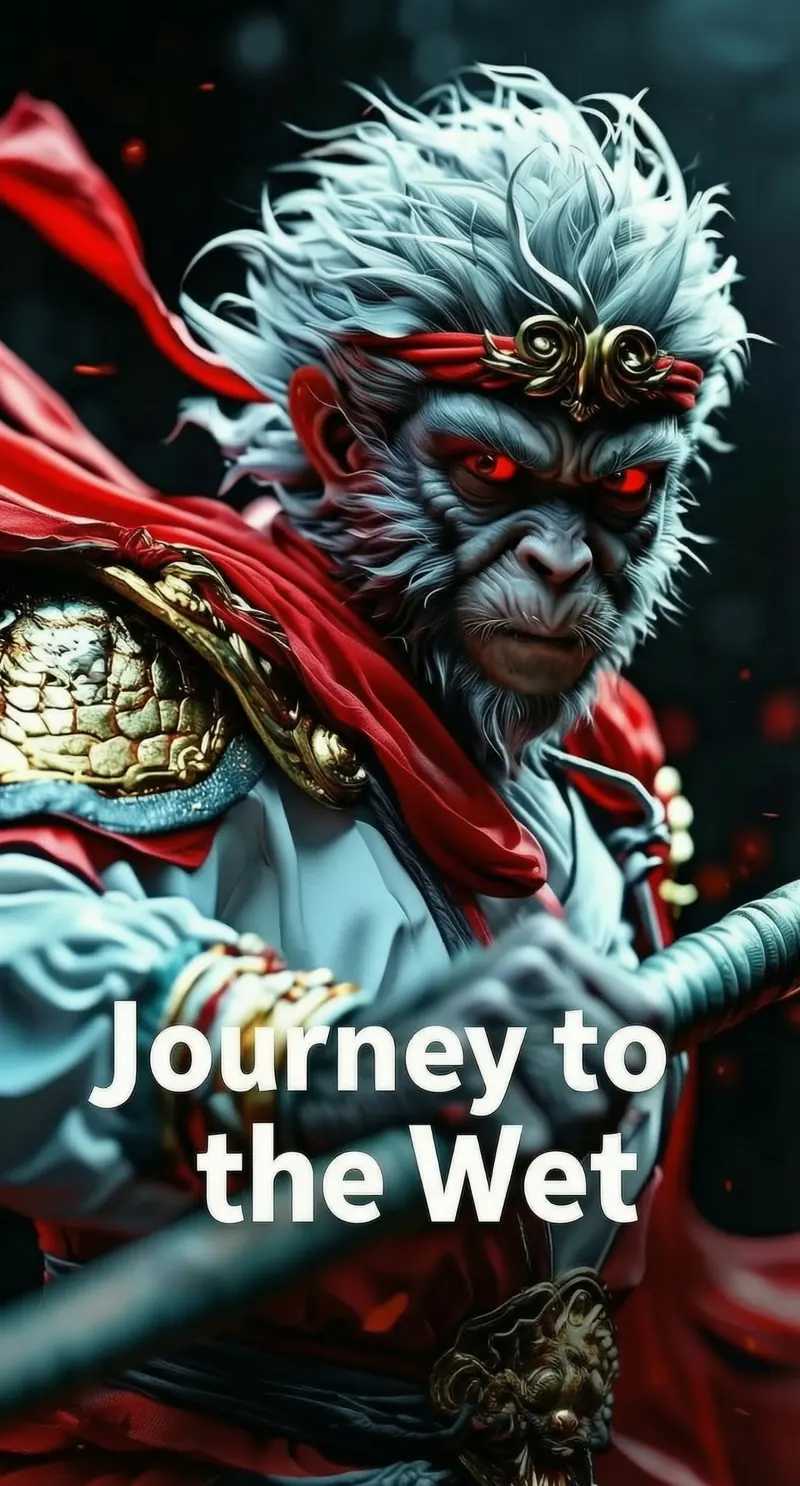
Sun Wukong and his two companions followed the palace summoner to the Meridian Gate . The eunuch-in-charge immediately announced their arrival and ordered them into the court. The three stood in a neat row but made no gesture of kneeling or bowing. The king asked, “Which of you are the holy monk ’s disciples? What are your names? Where do you live? Why did you leave home to become monks? Which scriptures do you seek?” The Pilgrim stepped forward at once, intending to climb the main hall steps. The guards beside the throne shouted, “Do not advance! Say whatever you have to say from where you stand!” The Pilgrim laughed, “We monks consider every step forward a step gained.” Then Zhu Bajie and Sha Wujing also moved forward. The elder, fearing their roughness might frighten the king, rose and called out, “Disciples! His Majesty asks about your origins. Answer him quickly.” Seeing his master standing there in attendance, the Pilgrim could not hold back his words. “Your Majesty,” he said loudly, “you dishonor yourself by dishonoring others! Since you have chosen my master as your son-in-law, how can you make him stand in attendance? In this world, a son-in-law is called the ‘Honored Guest’—and what honored guest ever has to stand?” The king’s face turned pale with fright. He wanted to retreat from the hall but feared losing face. Summoning his courage, he ordered his attendants to bring an embroidered stool and invited Tang Sanzang to sit. Only then did the Pilgrim give his account. “Old Sun hails from the Water Curtain Cave on Flower-Fruit Mountain, in the Nation of Aolai , Eastern Continent of Superior Body. My father is Heaven, my mother is Earth—I was born from a stone. I once studied under a great master and mastered the Great Dao. I returned to my immortal home , gathered my companions in the cave paradise , subdued dragons in the sea, and captured beasts on the mountains. I erased my name from the Book of Death and was enshrined as the Great Sage, Equal of Heaven. I roamed the jeweled towers and toured the precious pavilions, feasting with celestial immortals and singing joyfully day and night, dwelling in holy realms and living in bliss. But because I disrupted the Peach Banquet and rebelled against Heaven, the Buddha captured me and crushed me under the Five Elements Mountain. For five hundred years I ate only iron pellets when hungry and drank molten copper when thirsty, never tasting tea or rice. Thanks to my master, who came from the East to worship Buddha in the West, and to Bodhisattva Guanyin, who freed me from calamity, I submitted to the teachings of Yoga . My former name was Sun Wukong—Awakened to Emptiness—and now I am called the Pilgrim.” When the king heard these titles, he was so frightened that he stepped down from his dragon throne, approached the elder, and grasped his hand. “Son-in-law,” he said, “this is truly my destiny, to have an immortal relative like you!” Sanzang quickly thanked him and invited the king back to his throne. The king then asked, “Which of you is the second disciple?” Zhu Bajie puffed out his lips and put on a fierce air. “Old Pig was a man in my previous life,” he said, “but I loved only pleasure and idleness. I lived in a daze, my mind confused and my heart lost. I knew neither the height of Heaven nor the depth of Earth. While I was loafing, I met a true immortal. With half a sentence, he untangled the net that bound me to worldly dust; with two or three words, he split open the gate of calamity. I woke at once and took him as my master. I diligently cultivated the ‘two-eight’ inner arts and reverently refined the ‘three-three’ true method. When my cultivation was complete, I ascended to Heaven and received a post in the Celestial Court. By the Jade Emperor’s great grace, I was made Marshal Tianpeng, commanding the heavenly soldiers of the Celestial River. I roamed freely in Heaven. But at the Peach Banquet, I got drunk and molested the Moon Goddess . I was stripped of my rank and banished to the mortal world. I fell into the wrong womb and was reborn as a pig. I lived on Fu-Ling Mountain and committed countless sins. Then I met Bodhisattva Guanyin, who showed me the path of goodness. I submitted to Buddhism and now protect Tang Sanzang on his journey to the West to fetch the true scriptures. My dharma name is Zhu Wuneng—Pig, Awakened to Power—but everyone calls me Zhu Bajie—Pig of the Eight Precepts .” The king listened, trembling with fear, and dared not even look at him. The fool, however, grew bolder, shaking his head, pursing his lips, and flapping his ears with a loud laugh. Sanzang, afraid he would frighten the king, scolded, “Bajie, restrain yourself!” Only then did the fool clasp his hands together and stand with a pretense of refinement. The king asked again, “And the third disciple—why did he submit to Buddhism?” Sha Wujing pressed his palms together. “Old Monk was once a mortal,” he said, “who feared the cycle of reincarnation and sought the Dao. I roamed to the ends of the earth and wandered across the four seas. I carried my robe and alms bowl with me always, cultivating my mind and spirit day after day. Through this devotion, I met an immortal master. I refined the true yang of the ‘child’ and matched it with the true yin of the ‘maiden.’ When my merits reached three thousand, I fused the ‘ four forms ’ and ascended to the Celestial Realm. I was granted an audience with the Jade Emperor and made the Curtain-Lifting General, attending the imperial phoenix chariot and dragon carriage. But at the Peach Banquet, I accidentally dropped and shattered a crystal cup. I was banished to the Flowing-Sand River , my form changed, and I committed sins by killing living beings. Fortunately, Bodhisattva Guanyin, on her way to the East, persuaded me to reform and await the holy monk from Tang. I now follow him to the West to fetch the true scriptures and attain the right fruit . I took the character ‘Sha’—Sand—as my surname, and my dharma name is Sha Wujing—Sand, Awakened to Purity—but I am called Sha Seng—Sand Monk.” The king listened, both startled and delighted. He was delighted that his daughter had married a living Buddha, but startled that these three disciples were clearly demon gods. Just as he was caught between these feelings, the court astrologer announced, “The auspicious date for the wedding falls on the twelfth day of this month, at the hour of Renzi . The union will be harmonious and fortunate, perfect for the ceremony.” The king asked, “What day is today?” The astrologer replied, “Today is the eighth day, the day of Wushen , like a monkey offering fruit —an excellent day for recruiting talent and holding affairs.” Overjoyed, the king ordered the palace steward to prepare the imperial garden’s pavilions and towers for the son-in-law and his three disciples to rest, pending the wedding feast that would unite the princess and the monk. All followed the decree. The king retired from court, and the officials dispersed. No more details are needed here. Meanwhile, the master and his disciples arrived at the imperial garden as dusk fell. Servants brought out vegetarian dishes. Bajie said happily, “After a whole day, it’s time to eat!” The food stewards carried in loads of plain rice and noodles. Bajie ate and ate, refilling his bowl again and again until his belly was stuffed full. Only then did he stop. Soon, lamps were lit, beds were made, and everyone retired for the night. When the elder saw no one else nearby, he scolded the Pilgrim angrily. “Wukong! You monkey! You keep harming me! I told you we only needed to exchange the travel documents and not go near the colorful tower—why did you drag me there? Now look what you’ve done! How are we to handle this mess?” The Pilgrim smiled apologetically. “Master, you yourself once said, ‘My mother also threw an embroidered ball and met her predestined match, becoming husband and wife.’ You sounded like you admired the old tales, so Old Sun pulled you along. I also wanted to check on what the elder at the Golden Light Temple said and see if there was any truth to it. I noticed the king’s face looked a bit dark, but I haven’t seen the princess yet. I don’t know what she’s like.” The elder asked, “What good would seeing the princess do?” The Pilgrim replied, “Old Sun’s fiery golden eyes can tell truth from falsehood, good from evil, wealth from poverty, just by looking at someone. That way, I can figure out how to distinguish right from wrong.” Sha Wujing and Bajie laughed. “Brother, have you recently learned fortune-telling?” The Pilgrim said, “Those fortune-tellers aren’t even fit to be my grandchildren.” Sanzang scolded, “Stop your idle chatter! Now he insists on making me his son-in-law—what are we to do?” The Pilgrim said, “When the wedding comes on the twelfth, the princess will surely come out to pay respects to her parents. Old Sun will be watching. If she’s a real woman, then you can be the son-in-law and enjoy the kingdom’s wealth and glory. What’s the harm?” Sanzang grew angrier. “You wretched monkey! You’re still trying to harm me! As Bajie said, this affair is nearly settled, and you’re still feeding me sweet talk! Shut your mouth and stop your nonsense! If you dare be rude again, I’ll recite the Tight-Band Spell and make you suffer!” At the mention of the spell, the Pilgrim fell to his knees. “Don’t recite it! Don’t recite it! If she’s a real woman, we’ll cause a ruckus in the palace during the ceremony and take you away!” As the master and disciples talked, the night deepened. Truly: The palace water-clock dripped slowly, and fragrant shadows grew thick. Embroidered curtains hung with pearl screens; the quiet courtyard held no torchlight. The swing’s rope hung cold, leaving only a shadow; the Qiang flute’s sound faded, silencing the four directions. Around the house, flowers cloaked the bright moon; beyond the sky, no trees hid the starlight. The cuckoo ceased its song; the butterfly dreamed long. The Silver River stretched across the heavens; white clouds returned to their homeland. This was the moment of a traveler’s deep longing—the wind shook the tender willow, making it even more desolate. Bajie said, “Master, it’s late. Let’s talk about this tomorrow morning. Sleep now! Sleep now!” The master and disciples thus retired. The night passed, and at dawn the golden rooster crowed. At the fifth watch, the king ascended his throne. Behold: The palace gates opened to a purple aura rising high; the wind carried imperial music through the azure sky. Clouds shifted the leopard-tail banners; sunlight struck the dragon-head jade pendants, making them sway. Fragrant mist gently added to the palace willow’s green; dewdrops moistened the garden flowers’ delicate beauty. A thousand officials lined up, bowing and chanting “Long live the king!”—a unified reign of peace and harmony. After the morning audience, the king decreed, “The Imperial Banquet Office will prepare the wedding feast for the twelfth. Today, prepare a spring banquet and invite the son-in-law to tour the imperial garden.” He also ordered the Ceremonial Office to take the three honored relatives to the Guest House for a brief rest, while the Imperial Banquet Office prepared three vegetarian tables to accompany them. In both places, the Music Bureau was to play and entertain them as they enjoyed the spring scenery. Bajie immediately answered, “Your Majesty, we master and disciples have never been separated since we met. Since we’re dining in the imperial garden today, take us along to play for a couple of days. That way, my master can rest easy and become your son-in-law. Otherwise, this won’t work.” The king, seeing his ugly face and coarse speech, and how he twisted his head, grinned, and flapped his ears like a madman, feared he might ruin the wedding. So he agreed. “Arrange two tables in the Ever-Pacifying Hall of China and Barbarians,” he said. “I will sit with the son-in-law. In the Spring-Retaining Pavilion, set three tables for the three of you to sit separately, so the master and disciples won’t crowd each other.” The fool then bowed to the king and shouted, “Many thanks!” Everyone withdrew. The king also ordered the inner palace officials to prepare the banquet and instructed the three palaces and six courtyards to accompany the princess in dressing and preparing her dowry, awaiting the auspicious twelfth day. Around mid-morning, the king set out and invited Tang Sanzang to tour the imperial garden. This imperial garden was truly a splendid place: The paths were paved with colored stones, the railings carved with intricate patterns. By the colored stone paths, rare flowers grew on both sides; by the carved railings, exotic grasses bloomed beyond. The brilliant peach blossoms enchanted the kingfisher; beneath the tender willow branches, orioles darted. A few steps filled one’s sleeves with hidden fragrance; a few more steps left scent clinging to robes. There were phoenix terraces and dragon pools, bamboo pavilions and pine studios. On the phoenix terrace, playing the flute could summon the phoenix; in the dragon pool, raising fish could turn them into dragons. The bamboo pavilion held poems, all polished and refined; the pine studio contained essays, all beautifully crafted. The rockery was delicate and green; the winding streams were deep and blue. Peony pavilions and rose trellises looked like piled brocade and velvet; jasmine beds and begonia plots seemed like heaped clouds and jade. The peony’s fragrance was unique; the hollyhock’s color was brilliant. White pears and red apricots vied in beauty; purple orchids and golden daylilies competed in splendor. Spring-blooming flowers, woodbrush flowers, and azaleas bloomed in lively profusion; smiling flowers, balsam, and jade hairpin flowers stood gracefully. Everywhere, red was as rich as rouge; clusters of fragrance surrounded like embroidery. The east wind warmed the air, and all the garden’s flowers showed off their beauty. The king and Tang Sanzang admired the scene for a long time. Soon, officials from the Ceremonial Office invited the Pilgrim, Bajie, and Sha Wujing to the Spring-Retaining Pavilion, while the king led Tang Sanzang up to the Ever-Pacifying Hall. The feasting began. The songs, dances, and decorations were truly: The majestic palace gates shone with the light of dawn; phoenix towers and dragon pavilions were veiled in auspicious mist. Spring colors spread like fine embroidery over flowers and grass; heaven’s light shone on bright embroidered robes. Flute songs swirled like a celestial feast; cups and goblets flew, filled with clear jade wine. The king rejoiced, his ministers were happy, all sharing in the pleasure—the land forever pacified, the world at peace. The elder, seeing the king’s deep respect, had no choice but to force a cheerful demeanor, though his heart was full of sorrow. As he sat, he noticed four golden screens on the wall, each painted with a scene of one of the four seasons. Each scene bore a poem, composed by famous Hanlin scholars. The Spring Scene Poem read: The cycle of heaven turns the great pivot; the earth is peaceful, all things renewed. Peach and plum compete in brilliant bloom; swallows come to the painted beams, raising fragrant dust. The Summer Scene Poem read: The warm breeze blows softly, thoughts linger long; in the palace courtyard, pomegranates and hollyhocks shine in the sun. The jade flute’s melody startles the noon dream; the scent of lotus spreads to the courtyard curtains. The Autumn Scene Poem read: By the golden well, a single plane leaf turns yellow; the pearl curtain is not rolled up against the night’s frost. Swallows know the day of the autumn sacrifice and leave their nests; wild geese break through the reed flowers, crossing to other lands. The Winter Scene Poem read: Heaven rains flying clouds, dim and cold; the north wind blows snow, piling on a thousand mountains. Deep in the palace, a red stove warms; news comes that the plum blossoms have opened, jade filling the balustrade. The king saw Tang Sanzang staring intently at the poems and said, “Son-in-law, you seem to savor the meaning of these verses. You must be skilled in poetry yourself. If you don’t mind, why not compose a matching poem for each, following the same rhymes?” The elder, easily moved by what he saw and sensitive to the poetic spirit, found the king’s request hard to refuse. He spoke a line without thinking: “The sun warms, the ice melts, the great earth turns.” The king was overjoyed and immediately summoned an attendant. “Bring brush, ink, paper, and inkstone! Let the son-in-law complete his poem and write it down, so I may savor it slowly.” The elder gladly agreed, took up the brush, and composed his matching poems. Matching the Spring Scene Poem: The sun warms, the ice melts, the great earth turns; the imperial garden’s flowers and plants are renewed. Gentle winds and timely rains bless the people; the sea is calm, the river clear, free of worldly dust. Matching the Summer Scene Poem: The Dipper points south, the days grow long; locust clouds and pomegranate fires compete in brilliance. Yellow orioles and purple swallows sing among the palace willows; their sweet double notes enter the crimson curtains. Matching the Autumn Scene Poem: Fragrance wafts from green oranges and yellow oranges; pines and cypresses stay green, rejoicing in the frost. Chrysanthemums by the fence half bloom, forming a brocade; flute songs resound through the watery, cloudy land. Matching the Winter Scene Poem: The auspicious snow has just cleared, the air is cold; strange peaks and clever rocks form jade mountains. The stove burns charcoal, warming the creamy cheese; I fold my sleeves and sing loudly, leaning on the emerald balustrade. The king was delighted by the poems. “Excellent line,” he exclaimed, “‘I fold my sleeves and sing loudly, leaning on the emerald balustrade’!” He ordered the Music Bureau to set the new poems to music and play them. The feast lasted until dusk. The Pilgrim, Bajie, and Sha Wujing had also feasted heartily in the Spring-Retaining Pavilion, each drinking a few cups and growing slightly tipsy. Just as they were about to look for the elder, they saw him descending the pavilion with the king. Bajie’s foolish nature flared up again. “What joy! What freedom!” he shouted. “We’ve had a fine day! Time to sleep off this full belly!” Sha Wujing laughed. “Second Brother, you have no manners at all. Just finished eating and drinking, and already thinking of sleep?” Bajie said, “You don’t understand! As the saying goes, ‘If you don’t lie down after eating, you won’t grow any belly fat’!” Tang Sanzang bade farewell to the king. “Take care, take care!” he said softly. When he reached the pavilion, he scolded the three. “You’re getting more and more rude! What place is this, and you dare to shout and holler! If you anger the king, we’ll lose our lives!” Bajie said, “No problem! No problem! We’re his in-laws now. He won’t really blame us. As they say, ‘A broken bone still connects to the sinew; a scolded neighbor doesn’t stay angry.’ We’re all having fun—what’s there to fear?” The elder scolded, “Drag that fool over here and give him twenty strokes with the staff!” The Pilgrim actually grabbed Bajie and threw him to the ground. The elder raised his staff to strike. Bajie shouted, “Son-in-law, Grandfather! Spare me! Spare me!” The attending officials quickly intervened. Bajie got up, muttering, “Fine noble! Fine son-in-law! The wedding hasn’t even happened, and you’re already using the law on me!” The Pilgrim covered his mouth. “Stop your nonsense! Stop your nonsense! Go to sleep!” They stayed another night in the Spring-Retaining Pavilion, feasting and enjoying themselves the next day as well. Three or four days passed in pleasure. On the twelfth day, the auspicious date arrived. Three officials from the Imperial Banquet Office reported, “We have followed Your Majesty’s decree since the eighth. The son-in-law’s mansion is complete, awaiting only the dowry. The wedding feast is also prepared—over five hundred tables, both vegetarian and meat.” The king was overjoyed and was about to invite the son-in-law to the feast when an inner palace official announced, “Your Majesty, the empress requests your presence.” The king retired to the inner palace. There, the three empresses, the six consorts, and the princess were all gathered in the Zhaoyang Palace, laughing and chatting—a scene of flowers and brocade! The rich, enchanting sight surpassed even the moon palace of Heaven and rivaled the jade halls of the immortals. A new composition of four poems, titled “Joyful Union,” bears witness. The “Joy” Poem: Joy! Joy! Joy! Heartfelt happiness! The marriage brings love and beauty. In exquisite palace dress, how can the Moon Goddess compare? Dragon hairpins and phoenix hairpins, shimmering with golden threads. Cherry lips, white teeth, rosy face—a graceful, flower-like form. Amid piles of brocade in five colors, fragrant in a thousand-strong company. The “Union” Poem: Union! Union! Union! Enchanting and charming. Surpassing Mao Qiang, outshining the beauties of Chu. A beauty to topple kingdoms, comparable to flowers and jade. Her adornment is even more fresh and bright; her hairpins and rings are many and splendid. Orchid heart and spirit-nature, pure and lofty; powder face and ice-skin, noble and rich. A single line of dark brow like a distant mountain; a graceful figure among the gathered brocade. The “Good” Poem: Good! Good! Good! A jade maiden, a celestial child. Deeply lovable, truly praiseworthy. A rare fragrance fills the air; rouge and powder mingle. The distant paradise of Tiantai—how can it compare to the king’s home? Laughter and talk, all delicate charm; flute songs swirl in clamor. Flowers piled and brocade heaped, a thousand beauties—surveying the mortal world, how can it match this? The “Marriage” Poem: Marriage! Marriage! Marriage! Orchid and musk fragrance bursts forth. A formation of immortals, a crowd of beauties. The consorts change their finery; the princess dons new dress. Cloud-like hair piled in a raven’s nest; rainbow robes over phoenix skirts. A strain of celestial music rings out; two rows of crimson and purple are colorful. Long ago, she tied the knot of the phoenix’s promise; today, she is fortunate to meet this good marriage. When the king arrived at the Zhaoyang Palace, the empresses and consorts, along with the princess, palace maidens, and attendants, all came to greet him. The king entered with a smile and sat down. After the empresses and consorts had paid their respects, the king said, “Princess, my good daughter, since the eighth day, when you tied the colored silk and threw the embroidered ball, you were fortunate to meet the holy monk. I trust you have gotten your wish. All the officials have carried out my wishes, and everything is prepared. Today is the auspicious day. Go quickly to the wedding feast—do not miss the hour.” The princess stepped forward, knelt, and kowtowed. “Father, I beg you to forgive your daughter’s great offense. I have something to tell you: In the past few days, I have heard from the palace officials that the holy monk from Tang has three disciples who are exceedingly ugly. Your daughter dares not see them, for fear of being frightened. I beg you, Father, to send them out of the city. Otherwise, they might frighten my frail body, and that would not be good.” The king said, “Daughter, if you hadn’t spoken, I would have almost forgotten. They are indeed somewhat ugly. These past few days, I have had them staying in the Spring-Retaining Pavilion in the imperial garden. Today, I will summon them to the court, give them their travel documents, and send them out of the city. That will make it convenient for the feast.” The princess kowtowed in thanks. The king immediately left the inner palace and ascended his throne. He decreed, “Summon the son-in-law and his three disciples.” Now, Tang Sanzang had been counting the days on his fingers, enduring until the twelfth. Before dawn, he consulted with his three disciples. “Today is the twelfth. What are we to do?” The Pilgrim said, “I saw that the king has some ill fortune, but it hasn’t yet fallen on him—nothing major. The trouble is I haven’t seen the princess. If I could see her, Old Sun would know at a glance whether she’s real or false. Then we can act. Don’t worry. They will surely come to summon us soon, probably to send us out of the city. Just agree and don’t be afraid. I’ll hide myself, return at once, and stay close to protect you.” As the master and disciples were talking, the palace summoner and the Ceremonial Office officials indeed arrived. The Pilgrim laughed. “Let’s go! Let’s go! They must be sending us off so the master can stay here for the wedding.” Bajie said, “They’ll surely give us a thousand ounces of gold and silver as a farewell gift. We can buy some presents. Then I can go visit my own father-in-law and have some fun!” Sha Wujing said, “Second Brother, shut your mouth and stop your nonsense. Just listen to Big Brother.” They gathered their luggage and horse and followed the officials to the foot of the main hall’s steps. When the king saw them, he called the Pilgrim, Bajie, and Sha Wujing forward. “Bring me your travel documents,” he said. “I will stamp and sign them. I will also give you traveling expenses and send you three on your way to see the Buddha at Spirit Mountain. When you return with the scriptures, I will reward you heavily. Leave the son-in-law here—do not worry about him.” The Pilgrim thanked him and had Sha Wujing bring out the travel documents. The king examined them, stamped and signed them, and then took out ten ingots of gold and twenty ingots of silver as a gift from the in-laws. Bajie, greedy for wealth, immediately stepped forward and took them. The Pilgrim bowed to the king and said, “We have troubled you! We have troubled you!” Then he turned to leave. Tang Sanzang, panicked, jumped up and grabbed the Pilgrim. “Are you all abandoning me and leaving?” he said through clenched teeth. The Pilgrim squeezed the elder’s hand and gave him a meaningful look. “Rest easy here, Master. We’ll fetch the scriptures and come back for you.” The elder, half-believing and half-doubting, would not let go. The officials all saw this and thought they were truly saying goodbye. Soon, the king invited the son-in-law back to the hall and ordered the officials to see the three out of the city. The elder finally let go and ascended the hall. The Pilgrim, Bajie, and Sha Wujing followed the crowd out of the palace gate and said their farewells. Bajie asked, “Are we really leaving?” The Pilgrim said nothing but walked on. When they reached the courier station, the stationmaster received them and served tea and food. The Pilgrim said to Bajie and Sha Wujing, “You two stay here. Don’t show yourselves. If the stationmaster asks anything, answer vaguely. Don’t talk to me. I’m going to protect the master.” The Great Sage then plucked a hair from his body, blew on it with immortal breath, and said, “Change!” It immediately transformed into a replica of himself, sitting with Bajie and Sha Wujing in the station. His true form, however, flickered and leaped into midair, turning into a tiny, delicate bee. Behold this bee: Yellow-winged, sweet-mouthed, with a sharp tail, it danced wildly in the wind. Best at plucking stamens and stealing fragrance, it swayed through willows and flowers. After much labor and toil, it flew and flew, busy to no avail. The rich honey it brewed—how could it ever taste it? It only leaves behind its name and form. Watch it fly lightly into the palace. From afar, it saw Tang Sanzang sitting on an embroidered stool to the king’s left, his brow furrowed in worry and his heart anxious. The bee flew straight to the elder’s Vairocana hat and crawled quietly to his ear. “Master,” it whispered, “I am here. Do not worry.” Only Tang Sanzang heard this; the mortals noticed nothing. Only then did the elder relax. Not long after, a palace official announced, “Your Majesty, the wedding feast is prepared in the Que Palace. The empress and the princess are waiting within. Please come, Your Majesty and the Honored Guest, to meet the family.” The king was overjoyed and entered the palace with the son-in-law. Truly: The evil lord loved flowers, and flowers brought disaster; the meditative mind stirred thoughts, and thoughts gave birth to sorrow. We do not yet know how Tang Sanzang will escape from the inner palace. Listen to the next chapter for the resolution.