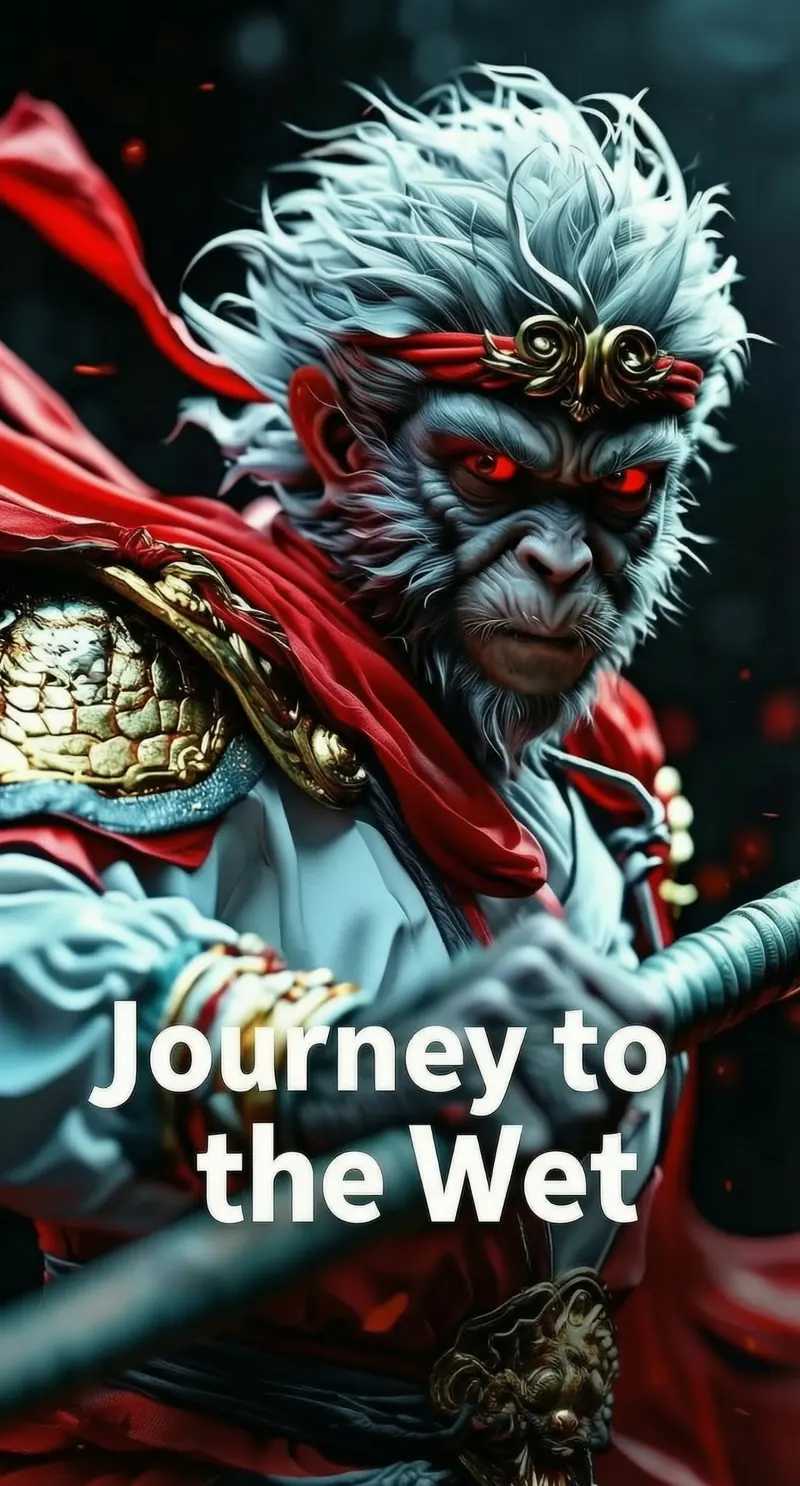
As the story unfolds, Sun the Pilgrim descended from his cloud and gave his master a detailed account of how the Bodhisattva Guanyin had borrowed the boy and the Grand Supreme Elderly Lord had reclaimed his treasure. Tang Sanzang repeatedly expressed his gratitude, and from that moment on, his resolve to journey to the Western Heaven was stronger than ever. With utter devotion, he was determined to press westward, even if it cost him his life. He mounted his horse and sat steady, while Zhu Bajie shouldered the luggage, Sha Wujing led the horse, and Sun Wukong, wielding his golden-banded staff, cleared the path. The group descended the high mountain and continued on their way.
Along the road, they endured the hardships of wind and dew, sleeping in the open and braving the frost. Their toil was beyond words. After traveling for some time, another mountain loomed before them, blocking their path. From his saddle, Tang Sanzang called out loudly, “Disciples, look at how perilous that mountain is! We must be extremely cautious. There might be demons lurking, ready to harm people!”
The Pilgrim said, “Master, stop your wild fancies. Just steady your mind and heart, and nothing will happen.”
Tang Sanzang replied, “Disciple, why is the journey to the Western Heaven so difficult? I recall that after leaving Chang’an, spring gave way to summer, autumn ended in winter, and four or five years have already passed. How is it that we still haven’t arrived?”
Hearing this, the Pilgrim laughed heartily. “We’re still far off! Far off! We haven’t even stepped out of the main gate yet!”
Bajie said, “Elder Brother, stop your boasting. In the mortal world, where would you find a gate that big?”
The Pilgrim replied, “Brother, we’re still wandering around in the main hall!”
Sha Wujing chuckled and said, “Elder Brother, don’t exaggerate to frighten me. Where would you find a hall that huge? Even if you could, you’d never find a roof beam big enough!”
The Pilgrim said, “Brother, in Old Sun’s view, the blue sky is our roof tile, the sun and moon are our window lattices, the four mountains and five sacred peaks are our pillars, and the entire earth is just one vast hall!”
Hearing this, Bajie said, “Forget it, forget it! Let’s just turn around and head back.”
The Pilgrim retorted, “Stop your nonsense. Just follow me.”
What a Great Sage! He slung his golden-banded staff across his shoulders and led Tang Sanzang, cleaving a path through the mountain as they marched forward. From his horse, Tang Sanzang gazed into the distance. The scenery of this mountain was truly magnificent. Indeed:
The mountain peaks, jagged and towering, seemed to brush against the handle of the Northern Dipper . The treetops appeared to touch the very clouds. Amidst the thick green smoke, the cries of apes could be heard from the valley. Within the dense shadows, the calls of cranes echoed from the pines. Mountain spirits, whistling in the wind, stood by the streams, teasing woodcutters . Crafty foxes sat on the cliffs, startling hunters. What a mountain! Look at its eight-sided majesty, its four-sided peril. Strange, ancient pines spread their emerald canopies, while withered old trees were draped with vines. Springs cascaded down, their chill seeping through one’s hair and bones. The towering peaks stood firm, their clear winds stabbing the eyes and stirring the soul in dreams. At times, the roar of tigers was heard; often, the calls of mountain birds filled the air. Deer and goats roamed in herds through the brambles, leaping to and fro. Badgers and roe deer gathered to forage, running back and forth. Standing on the grassy slopes, one saw no travelers at all. Walking into the deep hollows, jackals and wolves were everywhere. This was no place for a Buddha to cultivate; it was a realm of birds and beasts.
Tang Sanzang trembled with fear as he entered this deep mountain. His heart was filled with terror and sorrow. Reining in his horse, he cried out, “Wukong! Ever since I made my vow to climb the mountain of wisdom , The king saw me off from the city without a backward glance. On the road, I encountered the sharp-edged ones, And on the journey, the horse-bell urged me on. I sought the thorns across slopes and ravines, Crossed the peaks to pay homage to the sacred herb . I guarded my body like bamboo shavings , When will I return to pay court to the court?”
Hearing this, Sun the Great Sage gave a cold laugh. “Master, don’t worry and don’t fret. Just set your mind at ease and move forward. I guarantee that ‘when the work is done, success will come naturally.’”
The master and his disciples admired the mountain scenery as they walked, and before they knew it, the sun had set. Indeed:
At the ten-mile pavilion , no travelers stirred; In the nine-layered heavens , the stars appeared. The boats on the eight rivers all returned to port; The gates of seven thousand counties were all shut. The officials of the six palaces and five mansions had retired; The fishing lines of the four seas and three rivers were put away. The bells and drums sounded from the two towers ; A single round moon filled the entire universe.
From his horse, Tang Sanzang looked into the distance and saw tiered towers and layered halls within a mountain hollow. He said, “Disciples, it’s growing late. Fortunately, there are buildings over there, likely a temple or monastery . Let’s go there to beg for a night’s lodging and continue on our way tomorrow.”
The Pilgrim said, “Master, you are right. Don’t be impatient. Let me first see if the place is suitable.”
The Great Sage leaped into the air and looked carefully. It was indeed a temple. He saw:
Brick walls with eight characters, painted with red powder; On both sides, the gates were studded with golden nails. Tiered towers were hidden among the mountain ridges; Layered palaces were concealed within the peaks. The Hall of Ten Thousand Buddhas faced the Tathagata Hall; The Morning Sun Tower corresponded to the Great Hero Gate. A seven-story pagoda gathered clouds and mist; Three statues of Buddhas radiated glorious light. The Manjushri Terrace faced the Sangharama Quarters; The Maitreya Hall leaned against the Great Compassion Chamber. Beyond the Mountain-Viewing Tower, green light danced; Above the Cloud-Treading Pavilion, purple mist arose. The pine gate and bamboo courtyard were lushly green; The abbot’s quarters and meditation hall were everywhere pure and clear. Elegant and secluded, they offered joyful pleasures; Every path and stream welcomed the visitor with delight. In the meditation hall, Chan monks expounded the dharma; In the music room, many instruments played their tunes. On the Sublime Height Terrace, the udumbara flower fell; Before the Dharma-Expounding Altar, pattra leaves grew. Truly, the forest sheltered the land of the Three Jewels; The mountains embraced the palace of the Brahma King. Half the wall glowed with lamplight and incense; A trail of fragrant smoke hung in a hazy mist.
Sun the Great Sage descended from his cloud and reported to Tang Sanzang, “Master, it is indeed a temple, perfect for lodging. Let us go over there.”
Tang Sanzang gave his horse its head and rode straight to the main gate. The Pilgrim asked, “Master, what temple is this?”
Tang Sanzang said, “My horse has barely stopped, and my feet haven’t even left the stirrups, yet you ask me what temple this is. You have no sense of propriety!”
The Pilgrim said, “You, Venerable Sir, have been a monk since childhood. You must have studied the Confucian classics before you began to expound the sutras. Your literary understanding is thorough, and you have received the favor of the Tang Emperor. There are such large characters on the gate. How can you not recognize them?”
The elder scolded him, “You insolent ape! Your speech is utterly disrespectful! I was just facing west as I urged my horse forward, and the sunlight was so bright I couldn’t open my eyes. Even if there were words on the gate, they were covered with dust and hard to read. That’s why I didn’t see them.”
Hearing this, the Pilgrim bent down and suddenly grew to over twenty feet tall. He used his hand to wipe the dust from the gate and said, “Master, look.” On the gate were five large characters, reading “By Imperial Decree, Built Treasure Forest Temple.”
The Pilgrim returned to his original size and asked, “Master, who among us should go inside to beg for lodging?”
Tang Sanzang said, “I will go in. The rest of you are ugly in appearance, coarse in speech, and quick-tempered. If you were to offend the monks here and they refused us lodging, that would be unfortunate.”
The Pilgrim said, “If that’s the case, then you go in, Master. Say no more.”
The elder put down his monastic staff, removed his traveling cloak, straightened his robes, pressed his palms together, and entered the main gate. On both sides, within red lacquered railings, sat a pair of guardian deities, towering high. They were sculpted to be both majestic and ferocious:
One had an iron face and a steel beard, as if alive; the other had bristly brows and round eyes, appearing exquisitely formed. The left one’s fist was knobby, like raw iron; the right one’s palm was rugged, vying with red copper. Their golden armor, linked in shining rows, gleamed brightly; their bright helmets and embroidered sashes fluttered in the wind. Truly, the Western Lands had many offerings to the Buddha; in the stone tripod, the incense fire burned red.
Seeing this, Tang Sanzang nodded and sighed, “If only in our Eastern Land we had people who would sculpt such great Bodhisattvas out of clay, burn incense, and make offerings, then I wouldn’t have to go to the Western Heaven.”
As he was sighing, he walked into the second gate. There he saw the statues of the Four Heavenly Kings: Dhritarashtra, Vaishravana, Virudhaka, and Virupaksha, representing the four directions of northeast, southwest, east, and west, symbolizing favorable winds and rains. Entering the second gate, he saw four pine trees, each with branches and leaves spreading like green umbrellas. Looking up, he saw the Great Hero Hall. The elder pressed his palms together, knelt, and kowtowed. After finishing his worship, he stood up, walked past the Buddha altar, and reached the back door. There he saw a statue of Guanyin in her reclining form, depicted as she ferries beings across the Southern Sea. On the walls, skilled artisans had sculpted fish, shrimp, crabs, and turtles, some showing their heads, some their tails, playing amidst the water waves.
The elder nodded his head several times again and sighed, “How pitiful! Even the scaly creatures in the water worship the Buddha. Why then do humans still refuse to cultivate themselves?”
As he was expressing his admiration, a Daoist attendant came out from the third gate. Seeing Tang Sanzang’s extraordinary appearance and noble bearing, the attendant quickly stepped forward and bowed, asking, “Reverend Sir, where do you come from?”
Tang Sanzang said, “I have been sent by the Great Tang Emperor in the East to go to the Western Heaven to worship the Buddha and seek the sutras. I have arrived here, and as night is falling, I wish to beg for a night’s lodging.”
The Daoist said, “Reverend Sir, please do not take offense, but I cannot make the decision. I am merely a servant here, sweeping the floors, striking the bells, and doing odd jobs. There is an elder monk in charge inside. I will go in and inform him. If he is willing to keep you, I will come out and invite you in. If he is not willing, I dare not keep you myself.”
Tang Sanzang said, “I trouble you, then.”
The Daoist hurried to the abbot’s quarters to report, “Your Reverence, someone has come from outside.”
The monastic official immediately stood up, changed his robes, adjusted his Vairocana hat, draped his kasaya, and hurriedly opened the door to welcome the visitor. He asked the Daoist, “Where is this person from?”
The Daoist pointed with his finger and said, “Isn’t there a man behind the main hall?”
Tang Sanzang, bare-headed, wearing a patched robe of twenty-five strips, and with a pair of shoes stained with mud and water, was leaning against the back door. When the monastic official saw him, he flew into a rage and said, “You Daoist, stop your mischief! Don’t you know that I am the monastic official? I only come out to welcome officials from the city who come to burn incense. How dare you give me a false report about such a monk, making me come out to greet him! Look at his appearance—he doesn’t look like an honest man. He’s probably just a wandering monk who wants lodging for the night. How can we allow our abbot’s quarters to be disturbed by the likes of him? Tell him to go and squat in the front corridor. Why did you have to report this to me?” With that, he turned around and went back inside.
Hearing this, the elder’s eyes filled with tears. “How pitiful! How pitiful! Truly, ‘When a man leaves his home, he is looked down upon!’ I became a monk in my childhood and have never done any evil—I have never performed false repentance rites, never eaten meat, never harbored wicked thoughts, never lost my meditative mind out of anger while reading sutras. I have never thrown tiles or bricks to damage the Buddha hall, nor have I stripped the gold from Buddha statues. Alas! How pitiful! I wonder in which past life I offended Heaven and Earth, that I should always encounter wicked people in this life! Monk, if you refuse us lodging, so be it. But why do you have to speak such harsh words, telling me to go and squat in the front corridor? If the Pilgrim hears this, that monkey will come in with his staff and break your legs!” Then he thought, “Forget it, forget it. As the saying goes, ‘A man must be polite.’ I’ll go in and ask him once more, and see what he says.”
The elder followed the Daoist into the abbot’s gate. There he saw the monastic official, who had taken off his kasaya, sitting in a huff. He seemed to be either reciting sutras or performing a ritual for someone, with a pile of paper on his table. Tang Sanzang dared not go further inside. He stood in the courtyard, bowed, and called out in a loud voice, “Venerable Abbot, I pay my respects to you!”
The monk, who was already irritated by the elder’s intrusion, returned the greeting perfunctorily and asked, “Where do you come from?”
Tang Sanzang said, “I have been sent by the Great Tang Emperor in the East to go to the Western Heaven to worship the living Buddha and seek the sutras. I am passing through here, and as night is falling, I wish to beg for a night’s lodging. I will leave at the crack of dawn tomorrow. I beg the Venerable Abbot to grant me this convenience.”
The monastic official then reluctantly rose a little and said, “So you are the Tang Sanzang?”
Tang Sanzang said, “I dare not claim such a title. I am he.”
The monastic official said, “If you are going to the Western Heaven to fetch the sutras, how is it that you don’t even know the way?”
Tang Sanzang said, “I have never traveled this road of yours before.”
The monastic official said, “If you go straight west for only four or five miles, there is a place called Thirty-Mile Inn. There are people there who sell food and offer lodging. It is inconvenient here. I cannot keep you wandering monks from afar.”
Tang Sanzang pressed his palms together and said, “Venerable Abbot, the ancients said, ‘Monasteries, nunneries, temples, and abbeys are all the dwellings of us who have left the householder’s life. Upon seeing a temple gate, one should be entitled to three pints of rice.’ Why do you refuse to keep me? What is the reason for this?”
The monastic official shouted angrily, “You wandering monk, you’re just a smooth talker!”
Tang Sanzang said, “What do you mean by ‘smooth talker’?”
The monastic official said, “The ancients said, ‘When a tiger enters the city, every household closes its door. Though it may not bite, it has tarnished its name in days past.’”
Tang Sanzang said, “How has it ‘tarnished its name in days past’?”
The monastic official said, “Some years ago, a few wandering monks sat at our mountain gate. I took pity on them. Their clothes were torn, they had no shoes, and they were bare-headed and barefoot. I felt sorry for their poverty and quickly invited them into the abbot’s quarters. I seated them in the places of honor, fed them vegetarian meals, and even lent them some old clothes to wear. I kept them for a few days. But instead of being grateful, they grew fond of the comfort and the food, and didn’t want to leave. They ended up staying for seven or eight years. And while they stayed, they committed many evil deeds.”
Tang Sanzang said, “What evil deeds?”
The monastic official said, “Listen to me: In their leisure, they threw tiles against the walls; when bored, they pried nails from the walls. On cold days, they broke the window lattices to make a fire; in summer, they tore down doors and blocked the paths. They tore up the temple banners to use as foot bindings, and stole the tooth incense to exchange for turnips. They often tipped over the oil lamps, and competed in grabbing bowls and pots to see who could be the most aggressive.”
Hearing this, Tang Sanzang thought to himself, “How pitiful! How could I be such a spineless monk?” He wanted to cry but was afraid the old monk would laugh at him. So he secretly wiped his tears with his sleeve, swallowed his anger, and quickly walked out. He went to see his three disciples.
The Pilgrim saw that his master’s face was full of anger, so he stepped forward and asked, “Master, did the monks in the temple beat you?”
Tang Sanzang said, “No.”
Bajie said, “They must have beaten you. Otherwise, why does your voice sound like you’ve been crying?”
The Pilgrim said, “Then did they curse you?”
Tang Sanzang said, “No, not that either.”
The Pilgrim said, “Since they neither beat nor cursed you, why are you so distressed? Could it be that you are homesick?”
Tang Sanzang said, “Disciples, the people here are not willing to accommodate us.”
The Pilgrim laughed and said, “Is this place a Daoist temple, then?”
Tang Sanzang said angrily, “Only Daoist temples have Daoists! A Buddhist temple has only monks!”
The Pilgrim said, “You are so useless! They are all monks, just like us. As the saying goes, ‘Since we all believe in the Buddha, we are bound by fate.’ You sit here and wait. I’ll go in and have a look.”
What a Pilgrim! He adjusted the golden fillet on his head, tightened the skirt around his waist, picked up his golden-banded staff, and walked straight into the Great Hero Hall. Pointing at the three Buddha statues, he said, “You are nothing but false images made of clay and gilded with gold. Is there no spiritual power within you? Old Sun is protecting the Great Tang’s holy monk as he goes to the Western Heaven to worship the Buddha and seek the sutras. Tonight, we have come specially to beg for lodging. Quickly go and announce this! If you refuse to keep us, I will smash your golden bodies to pieces with one blow of my staff and turn you back into lumps of clay!”
Just as the Great Sage was making his threats and boasts in front of the hall, a Daoist attendant, who had come to light the evening incense, was placing several sticks of incense into the burner before the Buddha. Startled by a loud shout from Wukong, the Daoist fell to the ground. When he got up and saw Wukong’s face, he fell down again. Terrified, he scrambled and crawled into the abbot’s quarters, reporting, “Your Reverence! A monk has come from outside!”
The monastic official said, “You Daoists are always causing trouble! I just told you to tell him to go and squat in the front corridor, and now you come to report again! If you speak nonsense again, I’ll have you beaten twenty strokes!”
The Daoist said, “Your Reverence, this monk is different from the one just now. He has a fierce appearance and no manners.”
The monastic official said, “What does he look like?”
The Daoist said, “He has round eyes, big ears that stick out, a face full of hair, and a mouth like a thunder god’s beak. He’s holding a staff in his hand, grinding his teeth in a fury, and looks like he’s looking for a fight!”
The monastic official said, “Wait for me to go out and see.”
As soon as he opened the door, he saw the Pilgrim charging in. The Pilgrim was truly ugly: his face was pitted and bumpy, with two yellow eyes, a protruding forehead, and fangs sticking out. He looked like a crab, with his flesh on the inside and his bones on the outside. The old monk was so frightened that he quickly slammed the abbot’s door shut.
The Pilgrim chased after him and, with a loud “bang,” smashed the door panels to pieces. “Quickly sweep out a thousand clean rooms,” he said. “Old Sun wants to sleep!”
The monastic official, hiding in his room, said to the Daoist, “No wonder he’s so ugly! It’s all from his big talk. Even if I add up all the rooms in this place—the abbot’s quarters, the Buddha hall, the bell and drum towers, and the two corridors—it doesn’t come to three hundred. Yet he wants a thousand rooms to sleep in. Where would we get so many rooms?”
The Daoist said, “Master, I’m already scared out of my wits. Just agree to whatever he says.”
The monastic official, trembling with fear, called out in a loud voice, “Venerable monk who seeks lodging, this humble, desolate mountain temple is not convenient. I dare not keep you. Please go and stay somewhere else.”
The Pilgrim made his golden-banded staff as thick as a basin and stood it upright in the courtyard. “Monk,” he said, “if you say it’s not convenient to keep us, then you can move out!”
The monastic official said, “This temple is where we have lived since we were children. It was passed down from our grand-teacher to our teacher, and from our teacher to us. We must pass it on to our disciples and their descendants. Who is this wild monk from nowhere, coming here so rashly and telling us to move out!”
The Daoist said, “Your Reverence, this is a very awkward situation. We might as well move out—he’s already brought his big staff to the door!”
The monastic official said, “Don’t talk nonsense! Our temple, old and young together, has four or five hundred monks. Where would we move to? Even if we moved, we’d have no place to live!”
The Pilgrim heard this and said, “Monk, no place to move, you say? Then send one person out to take a blow from my staff as an example!”
The old monk quickly called out, “Daoist, you go out and take a blow for me as an example!”
The Daoist panicked and said, “Heavens! That staff is so thick, and you want me to be the example?”
The old monk said, “‘Feed the army for a thousand days, use them for one hour.’ How can you refuse to go?”
The Daoist said, “Even if that staff doesn’t come down, if it just topples over, it could crush me into a pulp!”
The old monk said, “Forget about being crushed to death! Just having it standing upright in the courtyard, if someone walks into it in the dark, they’ll knock a big hole in their head!”
The Daoist said, “Master, you know how terrifying the staff is, and yet you still want me to go out and be an example?” The two of them argued back and forth in the room.
The Pilgrim heard them and thought, “I can’t really kill anyone. Otherwise, my master will blame me for my violent behavior again. I’d better think of another way to scare them.” He looked up and saw a stone lion outside the abbot’s gate. He raised his golden-banded staff and, with a “crack,” smashed the stone lion to pieces.
Seeing this through the crack in the window, the monk was so terrified that his legs gave way, and he scrambled under the bed. The Daoist, meanwhile, hid in the stove, shouting incessantly, “Grandfather! The staff is too powerful! I can’t bear it! Please have mercy!”
The Pilgrim said, “Monk, I won’t hit you. Let me ask you, how many monks are there in this temple?”
The monastic official, trembling, said, “In total, there are two hundred and eighty-five rooms and five hundred officially registered monks.”
The Pilgrim said, “You go quickly and gather all five hundred monks. Have them put on their formal long robes and come out to welcome my master, who has come from the Tang Court, inside. Then I won’t hit you.”
The monastic official said, “Grandfather, as long as you don’t hit us, I’ll have your master carried in if I have to!”
The Pilgrim said, “Go quickly!”
The monastic official said to the Daoist, “Don’t just be scared out of your wits. Even if your heart is scared to pieces, you still have to go and call everyone together to welcome the venerable master Tang!”
The Daoist had no choice but to risk his life. He didn’t dare go out through the main gate, so he crawled out through a dog hole in the back courtyard and ran straight to the main hall. There he beat the drum on the east side and struck the bell on the west side. The sound of the bell and drum together startled all the monks, young and old, in the two corridors. They all ran to the hall and asked, “It’s not time yet. Why are you striking the bell and beating the drum?”
The Daoist said, “Quickly change your clothes! Follow the old master and line up to go outside the mountain gate to welcome the venerable lord from the Tang Court!”
The monks quickly arranged themselves in an orderly file and went out to welcome him. Some draped on their kasayas, some put on their side robes. Those who had no formal robes wore a single long gown. The truly destitute ones, who had no long clothes at all, sewed two waist skirts together and draped them over their shoulders.
The Pilgrim saw this and asked, “Monk, what kind of clothes are you wearing?”
The monk, seeing his fierce appearance, quickly said, “Grandfather, don’t hit me. I’ll tell you—this is cloth we begged for in the city. There are no tailors in this place, so we made these ourselves. We call them ‘All-in-One Poverty’.”
The Pilgrim snickered to himself and escorted the crowd of monks to kneel down before the mountain gate. The monastic official kowtowed and shouted, “Venerable Lord Tang, please enter the abbot’s quarters and be seated!”
Bajie saw this and said, “Master, you are really too useless! When you went in, you were sniveling and your mouth was pursed up so tight you could hang an oil bottle from it. How is it that Elder Brother has such a way with things, making them kowtow to welcome him?”
Tang Sanzang said, “You fool, you don’t understand anything! As the saying goes, ‘Even ghosts are afraid of vicious people.’”
Seeing the monks kowtowing and bowing, Tang Sanzang felt ill at ease. He stepped forward and said, “Everyone, please rise.”
The crowd of monks kowtowed and said, “Venerable Lord, if only you would put in a good word for us with your disciple, and tell him not to hit us with his staff, we would be willing to kneel for a month.”
Tang Sanzang called out, “Wukong, don’t hit them.”
The Pilgrim said, “I haven’t hit them. If I had, their bones would be broken by now.”
Only then did the monks dare to get up. Some led the horse, some carried the luggage. They lifted Tang Sanzang, carried Bajie on their backs, and supported Sha Wujing as they all entered the mountain gate. They went to the elder’s room in the back and took their seats in order.
The crowd of monks came forward again to bow. Tang Sanzang said, “Venerable Abbot, please rise. Don’t bow anymore. You are overwhelming me with such courtesy. We are all disciples of the Buddha.”
The monastic official said, “Venerable Lord is an imperial envoy from a superior country. This humble monk failed to welcome you from afar. Today, your arrival at this humble, desolate mountain of ours is like having eyes but failing to recognize Mount Tai. We are fortunate to meet you. May I ask the Venerable Lord: Do you eat vegetarian or meat on your journey? I will have the food prepared accordingly.”
Tang Sanzang said, “We eat vegetarian.”
The monastic official quickly said to his disciples, “This venerable lord likes vegetarian food.”
The Pilgrim said, “We all eat vegetarian. We have been vegetarian since we were born.”
The monks exclaimed in surprise, “Grandfather! You have such a fierce appearance, and yet you are a vegetarian!”
A bold monk stepped forward and asked, “Since the Venerable Lord eats vegetarian, how many pints of rice should we cook to be enough?”
Bajie said, “You stingy monk! What’s the point of asking! Just cook a full bushel of rice for each household!”
The monks were all flustered. They hurriedly scrubbed the pots and washed the bowls. In every room, they prepared tea and rice, lit bright lamps, and set out tables and chairs to entertain Tang Sanzang and his disciples.
After the master and his disciples had finished their evening meal, the monks cleared away the dishes. Tang Sanzang expressed his thanks, saying, “Venerable Abbot, we have troubled your noble temple.”
The monastic official said, “I dare not accept such thanks. It is we who have been remiss in our hospitality.”
Tang Sanzang asked, “Where shall we, master and disciples, rest?”
The monastic official said, “Venerable Lord, do not be anxious. This humble monk has already made arrangements.” He said to the Daoist, “Are there some attendants available?”
The Daoist said, “Master, there are.”
The monastic official instructed them, “Send two men to prepare fodder for the Venerable Lord Tang’s horse. Then send a few more men to the front to sweep out the three meditation halls, make up the beds and curtains, and quickly invite the Venerable Lord to rest.”
The Daoists received their orders and soon had everything ready. They came to invite Tang Sanzang to rest. The master and his disciples led the horse and carried the luggage out of the abbot’s quarters. When they reached the door of the meditation hall, they saw it brightly lit with lamps, and in the side rooms were four rattan-framed beds.
The Pilgrim called over the Daoists who had prepared the fodder and told them to bring the hay into the meditation hall. He tethered the white horse, then told all the Daoists to leave. Tang Sanzang sat down under the lamp in the center. On both sides stood the five hundred monks, all in attendance, not daring to leave.
Tang Sanzang half rose and said, “Everyone, please go back, so that I may rest in peace.”
The crowd of monks firmly refused to withdraw. The monastic official stepped forward and said, “We will wait until the Venerable Lord is settled before we leave.”
Tang Sanzang said, “I am settled now. Everyone, please go back.” Only then did the crowd of monks dare to disperse.
Tang Sanzang went outside to relieve himself and saw the bright moon hanging in the sky. He called out, “Disciples.” The Pilgrim, Bajie, and Sha Wujing all came out and stood by his side. Moved by the pure, bright moonlight, Tang Sanzang’s thoughts turned to his homeland, and he spontaneously recited a long poem:
The bright soul hung in the sky like a precious mirror; The shadows of the mountains and rivers were fully reflected. The jade towers and crystal palaces were filled with clear light; The ice mirror and silver plate radiated a cool aura. At this moment, ten thousand miles shared the same pure brightness; On this night of the year, it was the most fresh and brilliant. It was like a frosty cake emerging from the blue sea; It was like an ice wheel hanging in the azure sky. In the lonely inn, by the cold window, a solitary traveler felt melancholy