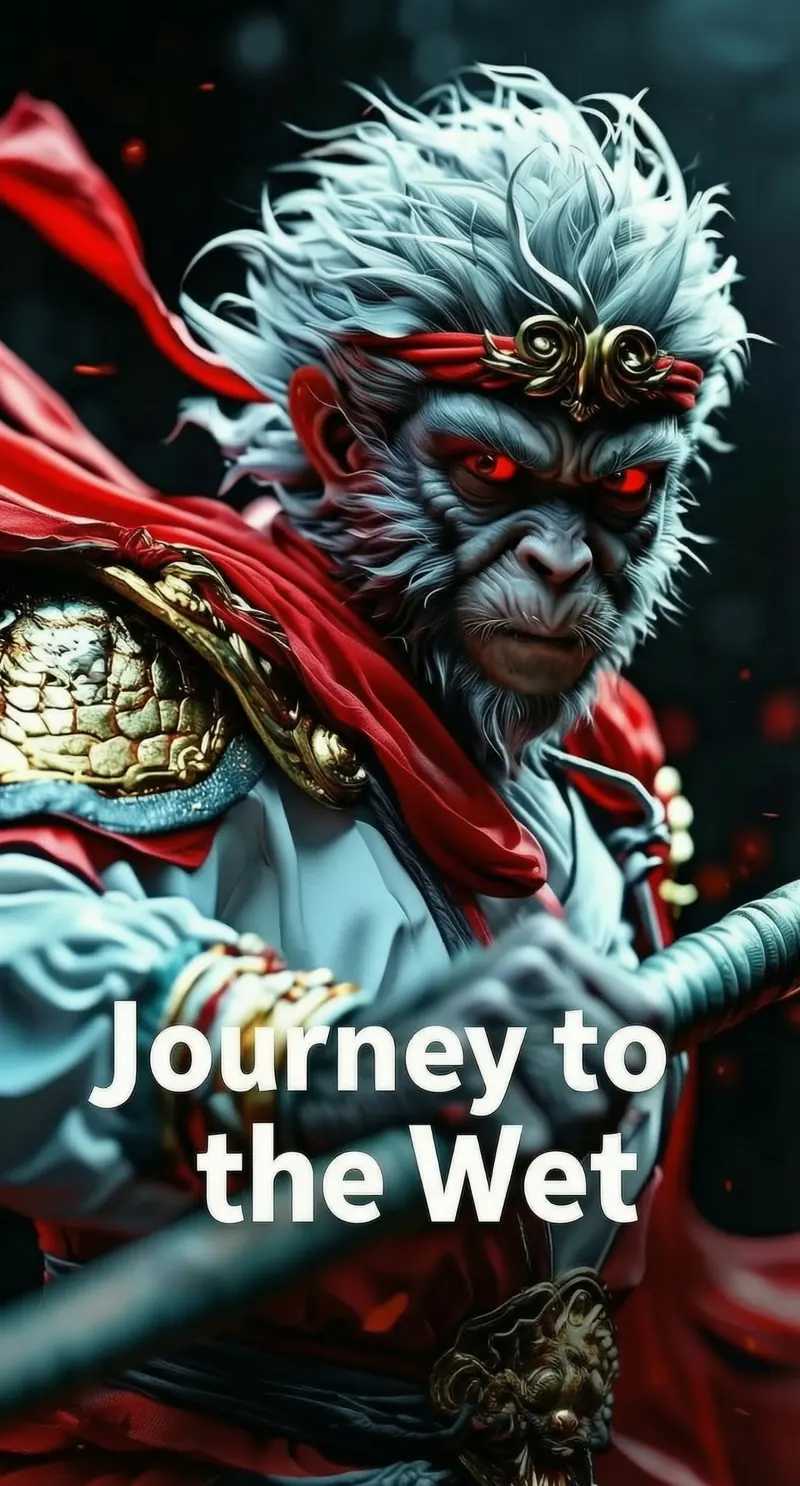
Where does one find the effort in cultivating meditation ? The frenzied horse and the wild ape must swiftly be subdued. They must be firmly grasped and tethered to produce the five colors ; if one pauses or rests even briefly, they will fall into the three evil paths . If one allows the spirit elixir to leak out freely, then the jade-like nature will wither away. Joy, anger, worry, and longing must be swept clean; only then can one attain the mysterious and the subtle , which are as if they were nothing.
We were saying how the Tang Monk and his three disciples left Jade Flower City , traveling smoothly and peacefully along a road that could truly be called a land of ultimate bliss . After five or six days, they saw another city in the distance. The Tang Monk asked Wukong, "Where is this place?" Wukong replied, "It is a city, but the flagpole on the gate tower has no banner hanging from it. I do not know what place it is. Let us wait until we are closer and then ask."
When they reached the eastern outskirts, they saw teahouses and taverns on both sides bustling with noise, and rice markets and oil workshops bustling with activity. On the street were a few idle young men who, upon seeing Bajie’s long snout, Sha Seng’s dark face, and Wukong’s red eyes, gathered around to gawk at the novelty, though none dared to step forward and speak. The Tang Monk was sweating with anxiety, afraid that his disciples would cause trouble.
After passing through a few more lanes, before they even entered the city proper, they suddenly saw the gate of a temple, upon which was written the three large characters " Compassionate Clouds Temple ." The Tang Monk said, "Let us go in and rest our feet and have a vegetarian meal. What do you think?" Wukong said, "Good! Good!" The master and his three disciples entered the temple together. Inside the temple, they saw:
Precious towers were magnificent, and jeweled thrones were lofty and imposing. The Buddha hall soared high above the clouds, while the monks’ quarters were serene in the moonlight. Rosy clouds drifted ethereally around the towering pagoda, and the deep green trees shaded the revolving sutra library , which was clear and cool. It was a true pure land, a false dragon palace ; a purple cloud hung over the Great Hero Hall . On the two corridors, idle people played without cease; a single pagoda was always open for guests to climb. Incense and fire in the censers were always burning; lamp flowers on the altar shone every night. Suddenly, the golden chime of the abbot’s quarters rang out, and monks, responding to the Buddha, chanted the sutras.
As the four of them were looking around, a monk came out from the corridor and bowed to the Tang Monk, asking, "Master, where have you come from?" The Tang Monk said, "I am a humble monk from the Tang court in the East." The monk immediately knelt and kowtowed. The Tang Monk quickly helped him up and said, "Abbot, why do you show me such great courtesy?" The monk pressed his palms together and said, "The people here who perform good deeds, chant sutras, and worship the Buddha all hope to be reborn in your Eastern lands . Just now, seeing your appearance and your robes, it is clear that you have cultivated blessings in a past life to have such fortune. That is why I knelt to pay my respects."
The Tang Monk smiled and said, "I dare not accept such praise! I dare not! I am merely a wandering monk; what fortune do I have! If you, Abbot, can cultivate in peace and leisure here, that is true happiness." The monk led the Tang Monk into the main hall, where they bowed before the Buddha statue. Only then did the Tang Monk call out, "Disciples, come here."
It turned out that Wukong and the other two, while the monk was speaking with their master, had been standing with their backs to him, holding the horse and guarding the luggage off to one side, and the monk had not noticed them. When they heard the Tang Monk call "disciples," the three of them turned around. The monk took one look and cried out in fright, "Heavens! How can your disciples be so ugly?" The Tang Monk said, "They are ugly, indeed, but their abilities are considerable. I rely on them entirely for protection on my journey."
As they were speaking, several more monks came out from within and bowed. The monk who had first come out said to the others, "This master has come from the great Tang of the East, and these three are his disciples." The monks were both delighted and frightened, and asked, "Master, coming from a great Eastern nation, what business do you have here?"
The Tang Monk said, "I am under the sacred decree of the Great Tang Emperor to go to Vulture Peak to worship the Buddha and seek the scriptures. Passing through your esteemed region , I have specially come to your temple, first to ask what place this is, and second to have a vegetarian meal before continuing on my way." The monks were overjoyed and invited him into the abbot’s quarters. In the abbot’s quarters, there were also several monks who were assisting with a vegetarian feast. The monk who had first come out called out again, "Come, all of you, and see the people from the East! It turns out that people from the East are both handsome and ugly. The handsome ones are beyond description, but the ugly ones are truly strange."
A great many monks and the hosts of the vegetarian feast all came to meet them. After they had met, everyone sat down to drink tea. The Tang Monk asked, "What is the name of your esteemed region?" The monks said, "This is an outer prefecture of the Heavenly Kingdom, called Golden Peace Prefecture ." The Tang Monk asked again, "How far is it from your prefecture to Vulture Peak?" The monks replied, "From here to the Heavenly Kingdom itself is two thousand miles, a distance we have traveled. As for going west to Vulture Peak, we have never been there and do not know how much further it is, so we dare not speak rashly." The Tang Monk thanked them, and before long, a vegetarian meal was set before them.
After finishing the meal, the Tang Monk prepared to set out, but he was detained by the monks and the feast hosts, who said, "Master, stay for a day or two. After the Lantern Festival has passed, it will not matter if you play a while before leaving." The Tang Monk asked in surprise, "On the road, I only think about climbing mountains and crossing rivers, afraid of meeting monsters and delaying my journey. I have completely forgotten what day the Lantern Festival falls on!"
The monks smiled and said, "Master, with your whole heart set on worshipping the Buddha and cultivating meditation, it is no wonder you do not remember these things. Today is the thirteenth day of the first month . The trial lighting of the lanterns will begin tonight. The day after tomorrow, the fifteenth, is the First Full Moon Festival, and the lanterns will not be taken down until the eighteenth or nineteenth. The people here all love excitement. Our Prefectural Magistrate, being considerate of the people, has lanterns hung everywhere, with music and singing going on all night. There is also a 'Golden Lamp Bridge,' a tradition handed down from the elders, which is still very lively to this day. Master, stay for a few more days; our temple can certainly afford to host you." The Tang Monk had no choice but to stay.
That evening, they heard the bells and drums on the Buddha hall sounding without cease. It was the faithful from the streets bringing lanterns to offer to the Buddha. The Tang Monk and his disciples all came out of the abbot’s quarters to look at the lanterns, after which each returned to his room to rest.
The next day, the temple monks again set out a vegetarian meal. After eating, the four of them went together to the back garden for a leisurely stroll. That back garden was truly a fine place:
It was the season of the first month, the year having just entered the new spring. The garden grove was quiet and elegant, the scenery lush and splendid. Flowers and trees of all four seasons vied for splendor; a range of layered peaks piled up their emerald green. Fragrant grass sprouted at the foot of the steps; old plum branches gave forth their fragrance. Red entered the tender peach blossoms; green returned to the fresh willow hues. Let no one boast of the splendor of the Golden Valley Garden; let no one speak of the elegance of the Wangchuan River painting. A stream of water flowed, wild ducks appearing and disappearing unpredictably; a thousand stalks of bamboo stood, poets pondering their verses, unable to decide. Peonies, tree peonies, crape myrtle, and smile flowers were just awakening to the heavenly mechanism; camellias, red plums, winter jasmines, and daphne flowers opened their brilliant forms first. Snow still clung to the icy ravines, while distant trees, veiled in mist, already carried the spring. They also saw deer by the pond gazing at their own reflections, and cranes coming under the pines to listen to the zither. To the east were several buildings, to the west several pavilions, where guests could stay when they came; to the south were several halls, to the north several pagodas, where monks in stillness practiced meditation. Among the flowers and plants stood one or two towers for nurturing one’s nature, with multiple eaves soaring high; within the hills and waters were three or four chambers for refining the demonic mind, with quiet tables and bright windows. Truly, it was a natural place for seclusion and reclusion; why would one need to seek the Penglai Isles elsewhere?
The master and disciples enjoyed themselves for the whole day. Come evening, the lanterns on the Buddha hall were lit, and they went out again to see the lanterns and amuse themselves. They saw:
A city of agate flowers, a fairy cave of colored glaze, palaces of crystal and mica: it was like layer upon layer of brocade and embroidery, tier upon tier of exquisite intricacy. The shadows of the star bridge swayed, moving heaven and earth; they watched several fiery trees shake their red light. On the six main streets, flutes and drums played; at a thousand gates, the moon shone like jade; from ten thousand homes, fragrant breezes blew. In several places, giant turtle-shaped lantern mountains rose high; there were fish and dragons leaping from the sea, and phoenixes and simurghs soaring into the sky. They admired the lantern light and the moonlight, the harmonious and gentle atmosphere. Amidst the crowds in silk and satin, everyone delighted in listening to the songs and music; carriages and horses rumbled past: they could not see enough of the flower-like faces and jade-like beauty, the elegant and heroic wanderers, the endless wonderful scenery.
After viewing the lanterns at the temple, they also strolled along the streets of the eastern outskirts. It was not until the second watch of the night that they returned to the temple to rest.
On the third day, the Tang Monk said to the monks, "I have long had a wish to sweep a pagoda. Today being the First Full Moon Festival, I ask the Abbot to open the pagoda gate so that I may fulfill this wish." The monks immediately opened the gate. Sha Seng took the cassock and followed the Tang Monk into the pagoda.
When they reached the first level, the Tang Monk put on the cassock, bowed to the Buddha, and after making his prayer, he took the broom and swept the first level. Then he took off the cassock and handed it to Sha Seng. Next, he swept the second level, and so on, level by level, all the way to the top of the pagoda. Every level of the pagoda had Buddha statues, and there were windows everywhere. As he swept each level, the Tang Monk would admire and praise it. By the time he had finished sweeping and come down, the sky was already dark, and the lanterns in the temple were being lit again.
This night was exactly the fifteenth night of the first month, the Lantern Festival night. The monks said, "Master, the previous two nights we only watched the lanterns at the temple and on the eastern outskirts. Tonight is the main festival. How about we go into the city to see the lanterns on the Golden Lamp Bridge?" The Tang Monk was very pleased and agreed. He, along with Wukong and the other two, and a good many monks from the temple, all entered the city to see the lanterns. Truly:
On this fine night of the fifteenth, the spring colors of the First Full Moon Festival were harmonious. Flower lanterns hung in the bustling market, and everyone sang songs of peace and prosperity.
They saw that all six main streets and three marketplaces in the city were lit with lanterns, and a bright moon had just risen in the sky. That moon was like a silver platter pushed up by the River God Feng Yi; the lantern light was like brocade woven by the Weaving Maid, spread upon the ground. The lanterns reflected the moonlight, making the light even brighter; the moon shone on the lanterns, making them even more brilliant. They could not see enough of the iron-lock chain bridges, nor tire of admiring the fiery trees and lantern flowers.
There were snowflake lanterns and plum blossom lanterns, like spring ice cut into shapes; embroidered screen lanterns and painted screen lanterns, made by gathering together five-colored silk threads. Walnut lanterns and lotus lanterns hung high on the lantern towers; green lion lanterns and white elephant lanterns were set high on the lantern racks. Shrimp lanterns and turtle lanterns frolicked before the awnings; sheep lanterns and rabbit lanterns showed their spirit beneath the eaves. Hawk lanterns and phoenix lanterns stood side by side; tiger lanterns and horse lanterns walked in pairs. Crane lanterns and white deer lanterns carried the God of Longevity on their backs; goldfish lanterns and whale lanterns resembled Li Bai’s boat of old. On the giant turtle-shaped lantern mountains, immortals gathered together; in the revolving horse lanterns, military generals were in battle.
Tens of thousands of households displayed their lantern-lit towers; for ten miles or more, clouds and mists swirled. Over there, jade-adorned saddles came galloping with a jingling sound; over here, fragrant carriages rolled by with a rumbling noise. Look at the red towers, where young ladies leaned on the railings, behind the curtains, shoulder to shoulder, hand in hand, pairs of them enjoying the excitement; by the green water bridge, there was a hubbub of voices, crowds of people huddled together, drunk and laughing, pairs of strollers playing. The entire city was filled with the sounds of flutes and drums and singing all through the night, never ceasing.
There is a poem as proof:
In the midst of the brocade and embroidery, they sang songs of picking lotus; within the land of peace and prosperity, crowds of people gathered. On this night of the lantern festival, with bright lamps and a clear moon, the winds and rains were timely, promising a year of great harvest.
At this time, it was the days when the capital city did not impose a curfew, and people were everywhere, bustling and lively. There were dancers, stilt-walkers, people dressed as ghosts, and riders on elephants—groups in the east, clusters in the west—there was too much to take in.
Just as they reached the Golden Lamp Bridge, the Tang Monk and the monks drew near and saw that three golden lamps were hanging on the bridge. Each lamp was as large as a vat. Above them shone a delicate, two-storied pavilion, all woven from fine gold wire, with thin sheets of colored glaze set inside. The lamp light could rival the moon, and the lamp oil gave off a fragrant scent.
The Tang Monk turned and asked the monks, "What oil is used in these lamps? Why is it so fragrant?" The monks said, "Master, you do not know. Behind this prefectural city there is a county called Min Tian County, which covers an area of two hundred and forty li. Every year, corvée labor is arranged, and there are specially designated two hundred and forty ‘Great Lamp Oil Households.’ The other corvée duties in the prefecture and county are manageable, but these Lamp Oil Households bear the heaviest burden: each family takes a turn for one year, spending over two hundred taels of silver. This is not ordinary oil; it is ghee-infused sesame oil. One tael of this oil is worth two taels of silver, and one catty costs thirty-two taels of silver. These three lamps each hold five hundred catties of oil, so the three vats hold a total of fifteen hundred catties. The cost of the oil alone amounts to forty-eight thousand taels of silver. With other miscellaneous expenses, it comes to over fifty thousand taels in total, and yet it only burns for three nights."
Wukong asked, "With so much oil, how can it be used up in just three nights?" The monks said, "Each vat has forty-nine large lamp wicks, each made from a bundle of rush pith wrapped in silk floss, as thick as an egg. They only burn through tonight. After the Buddha manifests his true form, by tomorrow night the oil will be gone, and the lamps will grow dim."
Bajie, standing nearby, laughed and said, "I think the Buddha takes the oil away!" The monks said, "That is exactly what is said. The people of the entire city, from ancient times to the present, have passed down this tradition. As soon as the oil is gone, everyone says that the Buddha has taken the lamps, and then the five grains will certainly be abundant; if in any year the oil is not used up, then the year’s harvest will be poor, and the winds and rains will not be timely. That is why everyone is willing to make this offering."
As they were speaking, they suddenly heard a "whoosh-whoosh" wind in midair, which frightened the lantern viewers into scattering in all directions. Even the monks could not keep their footing and said, "Master, hurry back! A wind is rising; it is the Buddha manifesting his presence to come and see the lanterns."
The Tang Monk asked, "How do you know it is the Buddha coming to see the lanterns?" The monks said, "It is like this every year. Before the third watch, a wind always rises, and everyone says that the various Buddhas are manifesting their presence, so everyone must take cover."
The Tang Monk said, "I am a man who recites the Buddha’s name and worships the Buddha. Now that I have encountered such a fine spectacle, if the various Buddhas are truly descending, it would be wonderful for me to pay my respects." No matter how much the monks urged him, the Tang Monk refused to go back.
Before long, three figures of Buddhas indeed appeared in the wind, flying toward the lamps. The Tang Monk rushed to the top of the bridge and knelt down to worship. Wukong quickly pulled him up and said, "Master, these are not good people; they are definitely monsters!"
Before he had even finished speaking, the lamp light dimmed, and with a "whoosh," the monsters snatched up the Tang Monk and rode off on the wind. Alas! Who knows from which mountain or which cave these true monsters came, disguising themselves as false Buddhas to come and see the golden lamps?
Bajie was so frightened he looked around, and Sha Seng called out from the side. Wukong said, "Brothers! Do not shout here. Master let joy turn to sorrow; he has been captured by monsters!"
The frightened monks asked, "Honored Sir, how do you know he was taken by monsters?" Wukong laughed and said, "So you common mortals have been deceived by monsters all these years, thinking it was the true Buddha manifesting his presence and receiving your offerings of lamp oil. The three figures of Buddhas that appeared just now when the wind rose were the three monsters. My master did not recognize them and ran to the top of the bridge to worship. The monsters then dimmed the lamps, took the oil, and captured my master as well. I was a little too slow, and the three of them turned into the wind and fled."
Sha Seng asked, "Elder Brother, what do we do now?" Wukong said, "Do not hesitate. The two of you and the others return to the temple and look after the horse and luggage. I will follow this wind and give chase."
Good Great Sage! He quickly mounted his somersault cloud, rose into midair, and, following the scent of the fishy wind, gave chase to the northeast. He pursued it until dawn, when the wind suddenly stopped. He saw a great mountain, extremely steep and perilous, towering majestically. What a mountain it was:
Layer upon layer of ravines and valleys, winding and twisting springs and streams. Creepers and vines hung from the sheer cliffs; pines and cypresses stood tall on the hollowed crags. Cranes called out in the morning mist; wild geese cried among the dawn clouds. Lofty and towering, the peaks stood like rows of halberds; jagged and uneven, the rocks formed a massive stone slab. The summit rose ten thousand fathoms high; the ridges and peaks twisted through a thousand bends. Wild flowers and fine trees knew the spring and burst forth; cuckoos and orioles responded to the season, splendid and beautiful. It was truly majestic and steep, rugged and perilous, dangerous and difficult. He stood and gazed for a long time in silence, only hearing the roar of tigers and leopards. Fragrant musk deer and white deer came and went freely; jade rabbits and green wolves departed and returned. Deep ravines held flowing water for thousands of miles; swirling rapids struck the rocks with a murmuring sound.
The Great Sage was on the mountain cliff searching for a path when he saw four people driving three sheep down from the western slope, shouting as they walked, "Open and prosper!" The Great Sage opened his fiery, golden eyes and looked carefully, recognizing them as the Four Duty Gods of the Year, Month, Day, and Hour, who had changed their forms and come.
The Great Sage immediately pulled out his golden-banded staff, shook it until it became as thick as a bowl and twelve feet long, then leaped down the cliff and shouted, "You lot, hiding your heads and shrinking your necks, where do you think you are going!" When the Four Duty Gods saw that he had seen through them, they quickly scattered the sheep, revealed their true forms, stepped back to the side of the road, and bowed, saying, "Great Sage, forgive us! Forgive us!"
Wukong said, "I have not needed you for a while, and seeing me idle, you have each become lazy, not even showing your faces to me. What is the meaning of this! You are not protecting my master in secret; where have you all gone?"
The Duty God said, "Your master’s meditation heart has recently relaxed. At the Compassionate Clouds Temple in Golden Peace Prefecture, he was greedy for excitement, and so joy turned to sorrow, and he was captured by monsters. However, he has the Guardian Deities by his side protecting him and has suffered no harm. We knew that the Great Sage had been pursuing them all night, and fearing that you might not know the mountain paths, we have come especially to report the news."
Wukong asked, "Since you have come to report the news, why are you hiding your names, driving three sheep, and shouting?" The Duty God said, "We set up these three sheep to correspond to the saying ‘Three Yangs Begin Prosperity’ and to help your master resolve this calamity."
Wukong had originally wanted to strike them, but after hearing this, he desisted. He put away his golden-banded staff, turned his anger to joy, and asked, "Is this mountain the territory of the monsters?" The Duty God said, "Yes! Yes! This mountain is called Blue Dragon Mountain, and there is a cave in it called Dark Abyss Cave. In the cave there are three monsters: the eldest is called King Cold-Expeller, the second is called King Heat-Expeller, and the third is called King Dust-Expeller. These monsters have lived here for over a thousand years. Since their youth, they have loved to eat ghee-infused sesame oil. After they became spirits years ago, they came here, disguised themselves as Buddha statues, and deceived the officials and people of Golden Peace Prefecture into setting up the golden lamps and using ghee-infused sesame oil as lamp oil. Every year on the fifteenth day of the first month, they transform into Buddhas to collect the oil. This year, they saw your master, recognized him as a holy monk, and captured him, taking him into the cave. In a few days, they plan to cut off your master’s flesh and fry it in ghee-infused sesame oil to eat. You must go quickly to rescue him!"
After hearing this, Wukong dismissed the Four Duty Gods, turned around the mountain cliff, and searched for the cave. After walking a few li, he saw a stone cliff by a stream, and beneath the cliff was a stone house. The stone house had two stone doors, half open and half closed. Beside the door stood a stone tablet, on which were carved six characters: "Blue Dragon Mountain, Dark Abyss Cave."
Wukong did not dare to enter recklessly. He stood still and shouted, "Monsters! Quickly return my master to me!" With a "clatter," the stone doors opened wide, and a crowd of ox-headed imps came running out. They asked blankly, "Who are you? How dare you make such a racket here!"
Wukong said, "I am the senior disciple of the holy monk Tang Sanzang, who is on a pilgrimage to fetch the scriptures from the Great Tang of the East. Passing through Golden Peace Prefecture to see the lanterns, my master was captured by your king. Return him immediately, and I will spare your lives! If not, I will overturn your nest and beat all you little fiends into bloody pulp!"
When the little imps heard this, they rushed into the cave to report: "Great King! It is terrible! It is terrible!" The three old monsters had just locked the Tang Monk deep inside the cave. Without any further thought, they had ordered the little imps to strip off the Tang Monk’s clothes, wash him clean with the clear water from the stream, and prepare to cut him into small pieces to fry in ghee-infused sesame oil.
Suddenly hearing the shouts of "terrible," the eldest monster was startled and asked what was the matter. The little imp said, "Outside the main gate, there is a hairy-faced, thunder-beaked monk shouting that the Great King has captured his master, and that we must quickly send him out to spare our lives; otherwise, he will overturn our nest and beat us all into bloody pulp!"
When the old monsters heard this, they were all alarmed. "We have just captured this monk and have not yet asked his name or where he comes from. Little ones, put his clothes back on him first and bring him here for questioning. Let us see exactly who he is and where he is from."
The mass of demons surged forward, untied the Tang Monk’s ropes, put his clothes back on him, and pushed him before the old monsters’ seats. The Tang Monk, trembling with fear, knelt on the ground and only cried out, "Great King, spare my life! Spare my life!"
The three monsters questioned him together, "Monk, where have you come from? How is it that when you saw the Buddha’s image, you did not flee, but instead blocked our path?"
The Tang Monk kowtowed and said, "I am a poor monk from the Great Tang of the East. I am under the emperor’s command to go to the Great Thunderclap Temple in the Heavenly Kingdom to worship the Buddha and seek the scriptures. Passing through the Compassionate Clouds Temple in Golden Peace Prefecture to have a vegetarian meal, the monks of the temple detained me to celebrate the Lantern Festival. On the Golden Lamp Bridge, I saw the Great King transform into the image of the Buddha. I am a common mortal; seeing the Buddha, I bowed, and unintentionally blocked the Great King’s path."
The monster said, "You have come a very long way from the East to here. How many people have come with you, and what are all their names? Speak out truthfully, and I will spare your life."
The Tang Monk said, "My secular name is Chen Xuanzang. I became a monk at the Golden Mountain Temple in my youth. Later, the Great Tang Emperor appointed me as a monastic official at the Hongfu Temple in Chang’an. Also, because the Minister Wei Zheng beheaded the Jing River Dragon King in a dream, and the Tang Emperor toured the underworld, after he returned to the world of the living, he held a Great Assembly of Land and Water to liberate the dead. The Emperor then chose me to be the altar master to preside over the Dharma assembly. Fortunately, the Bodhisattva Guanyin appeared and instructed me that on Vulture Peak in the West, at the Great Thunderclap Temple, there are three collections of true scriptures that can liberate the dead and allow them to ascend to heaven. She sent me to fetch them, also bestowed upon me the Dharma name ‘Tripitaka,’ and furthermore had me follow the surname ‘Tang’ of the Tang court, so everyone calls me Tang Sanzang. I have three disciples. The senior disciple’s surname is Sun, and his name is Sun Wukong. He is the Great Sage, Equal of Heaven, who has returned to the Buddhist faith. The second disciple’s surname is Zhu, and his name is Zhu Wuneng, with the Dharma name Bajie. He is the reincarnation of the Heavenly Marshal of the Canopy. The third disciple’s surname is Sha, and his name is Sha Wujing. He is the reincarnation of the General Who Curtains the Curtain."
When the three demon kings heard this, they were all alarmed. "It is a good thing we have not eaten him yet! Little ones, first lock the Tang Monk up in the back with iron chains. Wait until we have caught his three disciples, and then we will eat them all together!" After saying this, they mustered a troop of mountain ox spirits, water buffalo spirits, and yellow ox spirits. Each took a weapon and went out the door, blowing horns, waving flags, and beating drums.
The three monsters, fully armed and dressed, went outside the door and shouted, "Who dares to make such a racket here!" Wukong, hiding behind a stone cliff, carefully sized up the monsters. The monsters looked like this:
Their faces were painted, their eyes round; their two horns were prominent and lofty. Their four ears were pointed and sharp; their spiritual apertures flashed with light. Their bodies were covered with patterns like a painted picture, and their whole bodies were as splendid as flying flowers. The first wore a warm hat of fox fur on his head, and his face was covered with coarse hair from which hot air steamed; the second wore a light gauze garment that seemed to blaze with flames, and his four hooves were as bright and sparkling as jade; the third, whose majestic roar was like rolling thunder, had fangs as sharp as silver needles. Each was fierce and brave, holding three different kinds of weapons: one wielded a battle-axe, another a great broadsword; as for the third, across his shoulder he carried a knotted rattan staff.
They also saw the many large and small demons, tall and short, fat and thin, all ox-headed ghosts and fiends, each holding a spear or a club. There were also three large banners, on which were clearly written the words "King Cold-Expeller," "King Heat-Expeller," and "King Dust-Expeller."
After watching for a while, Sun the Pilgrim could not contain himself. He stepped forward and shouted, "You vile monsters! Do you recognize Old Sun?" The monsters roared, "So you are Sun Wukong, who once caused havoc in Heaven! Truly, ‘hearing of you is not as good as seeing you; seeing you would frighten even the gods!’ So you are just this monkey, and you still dare to boast!"
Wukong was enraged and cursed, "You thieving lamp-oil thieves! You oil-tongued monsters, spare me your nonsense! Return my master to me at once!" As he spoke, he rushed forward, swung his golden-banded staff, and struck. The three old monsters raised their three weapons and hastily parried. The battle that took place in that mountain hollow was intense:
The battle-axe, the great broadsword, and the knotted rattan staff met the Monkey King’s single cudgel as he dared to advance. The monsters Cold-Expeller, Heat-Expeller, and Dust-Expeller recognized the name of the Great Sage, Equal of Heaven. When the cudgel rose, it made gods and ghosts tremble; the axe came down and the blade chopped, flying and swirling wildly. A fine one, this master of the primal chaos and the Dharma, this embodiment of the Void! He held his own against the three monsters’ false Buddha forms. Those three, who moistened their noses with stolen oil, had committed an offense this year, resolved to seize the imperial envoy’s monk. This one, for his master, feared not the distance of the mountain paths; those, for their mouths, had for years set up the offered lanterns. With a clang, only the sound of blades and axes was heard; with a crack, only the sound of the cudgel was heard. They clashed and collided, three against one; they blocked and parried, each displaying his skill. They fought from morning until the sky was nearly dark, and no one knew who had lost and who had won.
Sun the Pilgrim fought with his single golden-banded staff against the three monsters for one hundred and fifty rounds. The sky was growing dark, and still no victor had emerged. Just then, King Dust-Expeller shook his knotted rattan staff, leaped to the front of the battle, and waved his banner. The herd of ox-headed fiends swarmed forward, surrounding Wukong, and each swung their weapons and struck wildly.
Seeing that the situation was unfavorable, Wukong with a "whoosh" mounted his somersault cloud and fled, defeated. The monsters did not pursue. They called back their demon troops and ordered the evening meal. After everyone had eaten, they told the little imps to take a bowl of rice to the Tang Monk. They planned to wait until they had captured Wukong and the other two to deal with them all together. The Tang Monk, being a vegetarian and also deeply worried, was crying and dared not eat.
Meanwhile, Wukong rode his cloud back to the Compassionate Clouds Temple and called out, "Brothers!" Bajie and Sha Seng had been anxiously waiting for his return, discussing what to do. When they heard his voice, they both came out to greet him. "Elder Brother, you have been gone for a whole day! Where exactly is Master?"
Wukong said,