A poem says:
Before the chaos parted, heaven and earth were one vast confusion, a boundless, misty expanse unseen by any eye. Si nce the time when Pangu split the primordial nebula, the pure and the impure have been distinguished, and from this division, all things were born. The heavens and the earth, in their supreme benevolence, nourish all living beings; they bring forth the myriad things, each in its own perfection. If you wish to understand the power of creation and the cycles of fate, you must read the Journey to the West, the Book of Deliverance .
Now, the fixed order of heaven and earth reckons one hundred twenty-nine thousand six hundred years as a single " Yuan ." Each Yuan is divided into twelve " Hui ," corresponding to the twelve Earthly Branches : Zi , Chou , Yin , Mao , Chen , Si, Wu , Wei , Shen , You , Xu , and Hai . Each Hui lasts exactly ten thousand eight hundred years.
Let us compare this to a single day: At the Hour of Zi (11 PM - 1 AM), the yang energy begins to stir; by the Hour of Chou (1 AM - 3 AM), the rooster crows. At the Hour of Yin (3 AM - 5 AM), the sky is still dark and unlit; at the Hour of Mao (5 AM - 7 AM), the sun rises. The Hour of Chen (7 AM - 9 AM) is after breakfast; the Hour of Si (9 AM - 11 AM) is mid-morning. At the Hour of Wu (11 AM - 1 PM), the sun hangs in the center of the sky; at the Hour of Wei (1 PM - 3 PM), it begins its slow descent westward. The Hour of Shen (3 PM - 5 PM) is dusk, approaching night; the Hour of You (5 PM - 7 PM) sees the sun set. The Hour of Xu (7 PM - 9 PM) is twilight, and at the Hour of Hai (9 PM - 11 PM), people should be in bed.
If we apply this to the grand cycles of heaven and earth, when the Hui of Xu is over, the universe becomes dim and hazy, and all things begin to decay. Another five thousand four hundred years pass, and at the beginning of the Hui of Hai, the world falls into utter darkness. All humans and all things vanish into nothingness, and this state is called " Chaos ."
After another five thousand four hundred years, as the Hui of Hai draws to a close, the primordial energy begins to stir and regenerate, slowly approaching the Hui of Zi. The world gradually becomes bright once more. The sage Shao Kangjie once said, "At the midpoint of the Zi of the winter solstice , the heart of heaven remains unchanged. At the first stirring of the single yang, the myriad things have not yet been born." At this moment, heaven truly establishes its foundation.
Another five thousand four hundred years pass, and it is exactly the Hui of Zi. The light, pure energy rises into the sky, and gradually the sun, moon, stars, and constellations come into being. The sun, moon, stars, and constellations are called the " Four Images ." Thus it is said, "Heaven was opened at the Hui of Zi."
After another five thousand four hundred years, as the Hui of Zi ends and the Hui of Chou approaches, heaven becomes firm and solid. The Book of Changes says, "Great is the primal power of Qian ! Supreme is the primal power of Kun ! The myriad things derive their life from it, and they all follow the way of heaven." At this point, earth truly condenses and takes form.
Another five thousand four hundred years pass, and it is exactly the Hui of Chou. The heavy, impure energy sinks into the earth, and gradually water, fire, mountains, rocks, and soil come into being. Water, fire, mountains, rocks, and soil are called the " Five Forms ." Thus it is said, "Earth was opened at the Hui of Chou."
After another five thousand four hundred years, the Hui of Chou ends and the Hui of Yin begins. The myriad things start to take root, sprout, and grow. The calendar says, "The energy of heaven descends, the energy of earth ascends; heaven and earth unite, and all living things are born." At this time, the sky becomes clear and bright, the earth becomes dry and firm, and the two primal forces of yin and yang merge and intermingle.
Another five thousand four hundred years pass, and it is exactly the Hui of Yin. Humans, beasts, and birds gradually appear. This is what is meant by the " Three Powers " of Heaven, Earth, and Man each taking their proper place. Thus it is said, "Man was born at the Hui of Yin."
Ever since Pangu parted heaven and earth, the Three Sovereigns ruled the world, and the Five Emperors established the moral order of human relationships, the world has been divided into four great continents: the Eastern Continent of Superior Body , the Western Continent of the Bull's Gift , the Southern Continent of Jambudvipa , and the Northern Continent of Kuru . This book is devoted to the affairs of the Eastern Continent of Superior Body.
Beyond the sea of the Eastern Continent of Superior Body, there was a country called Aolai . This country lay close to the sea, and in the sea there was a famous mountain called the Mountain of Flowers and Fruit . This mountain was the root of the Ten Continents and the source of the Three Islands. It had existed since the time when the pure and impure were first separated and the primordial nebula was first broken. Truly, it was a wondrous mountain! A rhapsodic poem bears witness to its beauty:
Its majesty commands the vast ocean, its power calms the jade-like sea. Its majesty commands the vast ocean, where the tides surge like silver mountains and fish enter their caves; its power calms the jade-like sea, where waves roll like snow and the mirage-beast leaves its abyss. In the southeastern corner, towering earth rises high; at the edge of the Eastern Sea, a lofty peak soars. Crimson cliffs and strange rocks, sheer precipices and fantastic peaks. On the crimson cliffs, a pair of phoenixes sing; before the sheer precipices, a single unicorn lies in repose. At the mountain's peak, one often hears the golden pheasant's call; in the rocky caverns, one often sees dragons emerging. In the forests are deer of long life and immortal foxes; in the trees are spirit birds and black cranes. Immortal herbs and wondrous flowers never wither; green pines and emerald cypresses are forever in spring. Immortal peaches always bear fruit; tall bamboos always hold the clouds. A single ravine is thick with vines and creepers; on all sides, the grass on the embankments is fresh and new. Truly, this is the pillar that supports heaven where the hundred rivers converge, the root of the earth that has never shifted through ten thousand kalpas.
At the very summit of that mountain, there was a celestial stone. This stone was three hundred and sixty-five feet high and two hundred and forty feet in circumference. The height of three hundred and sixty-five feet corresponded to the three hundred and sixty-five degrees of the celestial cycle; the circumference of two hundred and forty feet corresponded to the twenty-four solar terms of the calendar. The stone had nine orifices and eight cavities, corresponding to the Nine Palaces and the Eight Trigrams. On all four sides, there were no trees to block the sunlight, but to the left and right, it was flanked by magic fungi.
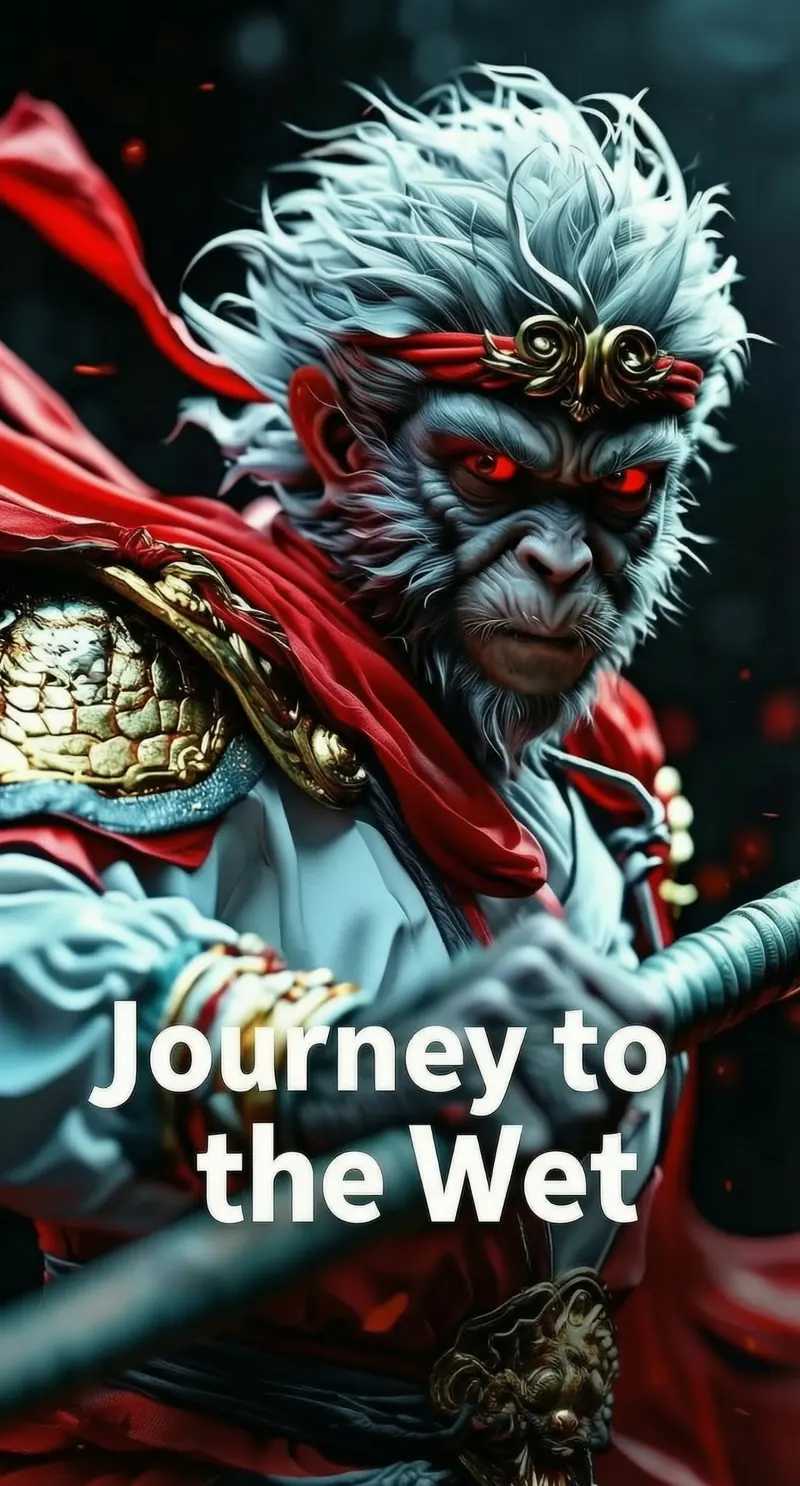
From the very day when heaven and earth were parted, this stone absorbed the essence of heaven and earth and the radiance of the sun and moon every day. After a long time of being nourished by these, it gradually gained spiritual intelligence. Within the stone, an immortal fetus was conceived. One day, it suddenly split open, producing a stone egg about the size of a ball. As soon as this stone egg met the wind, it transformed into a stone monkey. This stone monkey had all five senses complete and all four limbs intact. As soon as it was born, it learned to crawl and walk, and it bowed to the four cardinal directions.
A beam of golden light shot from its eyes, reaching all the way to the Palace of the Dipper in heaven. This commotion startled the holy one in heaven—the Great and Merciful Jade Emperor, the Most Honored and Exalted Deity of the Golden Palace. The Jade Emperor was sitting in the Hall of Spiritual Manifestation in the Golden Palace of the Cloud Palace, surrounded by his immortal ministers. Seeing the flashing golden light, he ordered the Thousand-Li Eye and the Wind-Attuned Ear to open the Southern Heavenly Gate and investigate.
These two deities, obeying the imperial command, went outside the Southern Heavenly Gate. They saw clearly and heard distinctly. After a short while, they returned and reported: "Your subjects, obeying the command, investigated the source of the golden light. It turns out to be in the territory of the small country of Aolai, east of the sea in the Eastern Continent of Superior Body. There is a mountain called the Mountain of Flowers and Fruit, and on that mountain is a celestial stone. From this celestial stone, a stone egg was produced, and the stone egg, meeting the wind, transformed into a stone monkey. The stone monkey is now bowing to the four directions, and the golden light from its eyes reached the Palace of the Dipper. Now that it has begun to drink water and eat food, the golden light will gradually fade."
The Jade Emperor, with great compassion, said, "These creatures of the lower world are nothing but the product of the essence of heaven and earth. There is nothing strange about it."
The stone monkey, in the mountains, spent its days leaping and bounding. When hungry, it ate the tender shoots of grass and trees; when thirsty, it drank from the mountain streams; when idle, it gathered wild flowers and sought fruits from the trees. It made companions of wolves and insects, formed a pack with tigers and leopards, befriended the deer, and became intimate with the gibbons and macaques. At night, it slept under the rocky cliffs; during the day, it roamed through the peaks and caves. Truly, it lived as the saying goes: "In the mountains, there is no calendar to mark the days; winter passes without knowing the year is done."
One day, the weather was extremely hot. The stone monkey, along with a troop of other monkeys, went to escape the heat, all playing in the shade of the pine trees. Watch them, each and every one—
Leaping through trees and climbing branches, picking flowers and seeking fruits; throwing pellets and playing with pebbles; running around sandpits and building pagodas; chasing dragonflies and catching cicadas; worshipping heaven and bowing to the Bodhisattva; pulling at vines and weaving grass mats; catching lice and biting and pinching; grooming their fur and picking their nails; some huddling together, some rubbing against each other; some pushing, some pressing; some pulling, some dragging. They frolicked freely under the green pine forest and bathed carelessly by the green water stream.
After playing for a while, the troop of monkeys went to bathe in the mountain stream. They saw the stream water rushing and tumbling endlessly, splashing like rolling melons. As the ancients said, "Birds have their bird language, and beasts have their beast speech." All the monkeys said, "We don't know where this water comes from. Since we have nothing to do today, let's follow the stream up to its source and play there for a while!"
With a shout, the monkeys, pulling their young and leading their daughters, calling their younger brothers and shouting for their elder brothers, all ran together, following the stream up the mountain until they reached the source of the water. It turned out to be a flying waterfall and cascading spring. Behold the waterfall:
A single white rainbow rose up, and a thousand fathoms of snow-white spray flew. The sea wind could not break it; the moon over the river still shone upon it. The cold air parted the green mountain peaks; the remaining water moistened the emerald slopes. Gurgling and murmuring, it was called a waterfall, truly like a hanging curtain.
The monkeys all clapped their hands and praised it: "Good water! Good water! So this is where it comes from, all the way down to the foot of the mountain, directly connecting to the waves of the great sea." Then they said, "Whoever has the skill to go in, find the source, and come out without being hurt, we will make him our king." They called out this challenge three times, when suddenly the stone monkey leaped out from among the grass and answered in a loud voice: "I'll go in! I'll go in!"
What a monkey! This was also the arrival of its good fortune:
Today its fame would be made known; when the time came, its great fortune would flow. By destiny, it was to dwell in this place; heaven had sent it to enter the immortal's palace.
Watch it close its eyes, crouch down, and with a single bound, leap straight into the waterfall spring. When it opened its eyes and looked up, there was no water and no waves inside, but a clear, bright, and shining bridge. It stopped its body, steadied its spirit, and looked more carefully. It turned out to be a bridge made of iron plates. The water under the bridge rushed through the holes in the rocks, flowing backwards and blocking the bridge's entrance.
The stone monkey then tiptoed to the head of the bridge, and walking forward, looked again. It seemed like a place where people lived. Truly, it was a fine spot! Behold the scene within:
Green moss piled up like indigo; white clouds floated like jade; light shimmered in patches of mist and clouds. Empty windows and quiet chambers; smooth benches and stone slabs seemed to bloom with flowers. A stalactite cave hung with dragon pearls; winding paths were carpeted with strange flowers. Near the stove by the cliff, traces of fire remained; on the table by the cups and goblets, remnants of food were seen. Stone seats and stone beds were truly lovely; stone basins and stone bowls were even more praiseworthy. And there were a few tall, slender bamboos, and here and there, a few blossoms of plum. Several green pines were ever moist with dew, making the whole place seem like a human dwelling.
The stone monkey looked for a long time, then leaped across the middle of the bridge. Looking left and right, it saw a stone tablet in the very center. On the stone tablet, there was a line of large characters in standard script, carved into the stone: "The Blessed Land of the Mountain of Flowers and Fruit, the Cave Heaven of the Water Curtain Cave." The stone monkey was overjoyed. It quickly turned around and withdrew, closing its eyes and crouching down again, leaping out of the water. Laughing, it said, "Great fortune! Great fortune!"
The other monkeys surrounded it and asked, "What's it like inside? How deep is the water?"
The stone monkey said, "There's no water! No water! It turns out to be a bridge made of iron plates. On the other side of the bridge is a naturally formed home."
The monkeys asked, "How can you tell it's a home?"
The stone monkey laughed and said, "This stream water rushes through the holes in the rocks under the bridge, falling backwards and blocking the doorway. Beside the bridge, there are flowers and trees, and a stone house. In the stone house, there are stone stoves, stone stoves, stone bowls, stone basins, stone beds, and stone stools. In the middle, there is a stone tablet with the words 'The Blessed Land of the Mountain of Flowers and Fruit, the Cave Heaven of the Water Curtain Cave' carved on it. This is truly a place for us to settle down! It's very spacious inside, enough to hold a thousand or even ten thousand of us, young and old. We can all go in and live there, and we won't have to suffer from the wind and rain of heaven. Look inside:
When the wind blows, there's a place to hide; when it rains, we can stay dry. We'll have no fear of frost or snow; we'll never hear the sound of thunder. Mist and clouds will always shine upon us; auspicious vapors will ever steam around us. The pines and bamboos will flourish year after year; the strange flowers will bloom anew each day.
When the monkeys heard this, they were all delighted. They said, "You go first and lead us in! Let's go in!"
The stone monkey again closed its eyes, crouched down, and leaped inside, shouting, "All of you, follow me in! Come in!"
Among the monkeys, the brave ones all jumped in. The timid ones, stretching their necks and shrinking their heads, scratching their ears and rubbing their cheeks, shouted loudly. After hesitating for a while, they all went in as well.
The monkeys leaped across the bridgehead, each one grabbing basins and snatching bowls, occupying stoves and fighting for stone beds. They moved things here and there. Such is the natural mischievousness of monkeys—there was not a moment of peace until they had exhausted themselves and finally stopped.
The stone monkey sat on the high seat and said, "My friends! The ancients said, 'A man without good faith does not know what he can do.' You all said just now that whoever had the skill to come in and go out without being hurt would be made king. I have now come in and gone out, and gone out and come in. I have found this cave heaven for all of you to sleep in peace and enjoy the blessings of a home. Why do you not bow to me as your king?"
When the monkeys heard this, they immediately folded their hands and prostrated themselves on the ground. Not one of them disobeyed. They all lined up in order of age, kowtowed to the stone monkey, and called him "Your Majesty, the King of a Thousand Years." From then on, the stone monkey ascended the throne. He removed the word "stone" from his name and called himself "the Handsome Monkey King." There is a poem to prove this:
The three yang forces, in harmony, give birth to all living things; the immortal stone contained the essence of the sun and moon. Borrowing an egg to transform into a monkey, it completed the Great Dao; using his name and title to match the perfected elixir. Inwardly, he could not be seen because he had no form; outwardly, he was known clearly as a tangible being. Throughout the ages, all creatures have been like this; they call themselves kings and sages, roaming freely and without restraint.
The Handsome Monkey King led a troop of macaques, gibbons, and rhesus monkeys, establishing the positions of lord, minister, and attendants. By day, they roamed the Mountain of Flowers and Fruit; by night, they slept in the Water Curtain Cave. They were all of one mind, not flocking with the birds, nor herding with the beasts. He ruled alone as king, and it was a time of great joy. Thus:
In spring, they gathered the hundred flowers for food and drink; in summer, they sought out all kinds of fruits to make their living. In autumn, they harvested taros and chestnuts to last through the season; in winter, they searched for yellow essence to pass the year.
The Handsome Monkey King enjoyed the happiness bestowed by heaven, and without realizing it, three to five hundred years passed. One day, while feasting joyfully with the other monkeys, he suddenly became sad and began to weep. The other monkeys hastily surrounded him and kowtowed, saying, "Why is Your Majesty so troubled?"
The Monkey King said, "Although I am happy now, I have a long-term worry in my heart, and that is why I am sad."
The other monkeys laughed and said, "Your Majesty is truly ungrateful! We feast and are happy together every day. We live in this immortal mountain, this blessed land, in this ancient cave and divine continent. We are not ruled by the unicorn, not governed by the phoenix, and not bound by any human king. We are free and at ease. This is a great blessing! Why must you worry about the future and be sad?"
The Monkey King said, "For now, we do not have to obey the laws of men or fear the threats of birds and beasts. But when we grow old, our blood and energy will weaken. In the shadows, King Yama rules over us. Once we die, will we not have lived in this world in vain? We cannot remain in heaven and earth forever."
When the other monkeys heard this, they all covered their faces and wept bitterly, all worried about the impermanence of life.
At that moment, from among the ranks of the monkeys, a long-armed gibbon suddenly leaped out and cried out in a loud voice, "If Your Majesty has such long-term worries, then you truly have the heart to seek the Dao! Among the five kinds of living beings in this world, there are only three kinds who are not subject to King Yama's rule."
The Monkey King said, "Do you know who these three kinds are?"
The gibbon said, "They are the Buddhas, the Immortals, and the Holy Sages. They have escaped the cycle of reincarnation and are neither born nor die. They are as long-lived as heaven, earth, and the mountains and rivers."
The Monkey King asked, "Where do these three live?"
The gibbon said, "They live only within the Jambudvipa world, within the ancient caves and immortal mountains."
When the Monkey King heard this, his heart was filled with joy. He said, "Tomorrow, I will take my leave of you and go down the mountain. I will roam to the corners of the sea and travel to the farthest reaches of the sky. I will surely seek out these three, learn the art of eternal life, and forever escape the calamity of King Yama."
Alas! These words caused him to leap out of the net of reincarnation and led to the making of the Great Sage, Equal of Heaven. The other monkeys clapped their hands and praised him, all saying, "Excellent! Excellent! Tomorrow we will cross the mountains and climb the peaks, gather a great abundance of fruits, and prepare a grand feast to see our king off."
The next day, the monkeys indeed went to gather immortal peaches and rare fruits, dig up mountain yams and yellow essence, as well as magic fungi, fragrant orchids, celestial herbs, and wondrous flowers. Each item was neatly prepared. They set out stone stools and stone tables and laid out immortal wine and immortal delicacies. Behold the food on the tables:
Golden pellets and pearl-like spheres, red and bursting, yellow and plump. Golden pellets and pearl-like spheres of wax cherries, bright in color and sweet in taste; ripe plums with red skins bursting open and plump flesh, fragrant and sour. Fresh longans, sweet in flesh and thin in skin; fiery red lychees, small in pit and red in pulp. Greenish apples offered on the branch, pale yellow loquats presented with leaves. Pear-shaped like rabbit heads, jujubes like chicken hearts, they could quench thirst, remove vexation, and dispel the effects of wine. Sweet peaches and ripe apricots, sweet as jade nectar and creamy ambrosia; crisp plums and waxberries, sour as lard and cheese curds. Ripe watermelons with red flesh and black seeds, large yellow-skinned persimmons cut in four. Pomegranates split open, their cinnabar seeds like fiery crystal beads; taros and chestnuts cut open, their hard flesh like golden agate. Walnuts and ginkgo nuts could be used to make tea; coconuts and grapes could be used to brew wine. Hazel nuts, pine nuts, torreya nuts, and crabapples filled the plates; tangerines, sugarcane, mandarins, and oranges covered the tables. There were also boiled mountain yams and stewed yellow essence, with poria cocos and Job's tears pounded and slowly cooked into a congee in a stone pot. Even if the human world had delicacies of the finest kind, they could not compare to the joyful peace of this troop of monkeys!
The monkeys invited the Handsome Monkey King to sit at the head of the table, and each one, according to their age, arranged themselves below in order. One by one, they came forward to offer wine, present flowers, and give fruit, drinking and feasting joyfully for the entire day.
The next day, the Handsome Monkey King rose early and gave his orders: "My little ones, help me break off some dead pine branches and weave them into a raft. Find a bamboo pole to use as a punt. Gather some fruits and such things for the journey. I am leaving." Having said this, he boarded the raft alone, pushed off with all his strength, and the raft drifted and floated, heading straight into the great sea, carried by the heavenly winds towards the Southern Continent of Jambudvipa. This journey was indeed in accordance with the following poem:
The heaven-born immortal monkey, his Dao-nature deep, left the mountain, riding his raft, catching the celestial wind. Crossing the ocean and traversing the seas, he sought the path of the immortals, setting his will on hidden cultivation to achieve a great deed. By destiny and by fate, he would abandon his worldly desires; carefree and without worry, he would meet the primal dragon. It was surely fated that he would meet one who understood him, who would explain the source of all things, and he would penetrate all the ten thousand arts.
It was also his good fortune that, from the moment he boarded the raft, a strong southeast wind blew for several days, carrying him to the northwestern shore. This was the territory of the Southern Continent of Jambudvipa. He took his bamboo pole and tested the depth of the water. Happening upon a shallow place, he abandoned the raft and leaped ashore. By the seashore, he saw people fishing, shooting wild geese, digging for clams, and refining sea salt. He approached them and, deliberately playing a trick, pretended to be a tiger. This frightened the people so much that they dropped their baskets and threw away their nets, scattering in all directions. He caught hold of one person who could not run away, stripped off his clothes, and also dressed himself in the human fashion. Then, swaying and swaggering, he passed through the prefectures and counties, learning human etiquette and speaking human language in the marketplaces. By day, he ate; by night, he slept. His heart was set on one thing only: to find the methods of cultivation used by Buddhas, Immortals, and Holy Sages, and to obtain a recipe for eternal life. But he saw that the people of this world were all chasing after fame and fortune, and not a single one was concerned with his own life. As a poem says:
When will the struggle for fame and the snatching of profit ever cease? Rising early and sleeping late, without a moment's freedom! Riding a donkey or a mule, one dreams of a fine horse; holding the post of a prime minister, one longs to be a prince. Worrying only about food and clothing, one toils and labors; why fear King Yama when he comes to take you away? Seeking wealth and rank for one's children and grandchildren, not a single one is willing to turn back!
The Handsome Monkey King searched for the path of the Immortals, but he had no luck in meeting them. In the Southern Continent of Jambudvipa, he passed through large cities and small towns, and without realizing it, eight or nine years went by. Suddenly, he came to the shore of the Western Great Sea. Thinking that there must be Immortals beyond the sea, he once again, as before, made a raft by himself and drifted across the Western Sea until he reached the territory of the Western Continent of the Bull's Gift.
After going ashore and searching for a long time, he suddenly saw a beautiful, tall mountain with deep, secluded forests. Fearless of wolves, tigers, or leopards, he climbed to the top of the mountain and looked around. It was indeed a fine mountain:
A thousand peaks stood like rows of halberds; ten thousand cliffs stretched out like unfolded screens. The sun shone on the mountain mists, lightly locking in the emerald green; after the rain, the dark blue crags exuded a clear, cold color. Withered vines coiled around old trees; ancient ferries lay across quiet paths. Strange flowers and immortal herbs were everywhere, as were tall bamboos and lofty pines. Tall bamboos and lofty pines, evergreen for ten thousand years, were better than any blessed land; strange flowers and immortal herbs, never withering through the four seasons, surpassed even the Penglai Isle. Close by, one could hear the calls of hidden birds and the crisp, clear sound of flowing springs. Every valley was filled with magic fungi; every steep cliff was covered with moss. The undulating peaks had a vigorous dragon vein; there must be a lofty recluse living here.
As he was looking, he suddenly heard someone speaking deep in the forest. He quickly strode into the woods and, listening intently, heard someone singing. The lyrics were:
Watching the chess game, the axe handle rots, cutting wood with a ding-dong sound, strolling slowly by the clouds at the valley's mouth. Selling firewood to buy wine, laughing wildly and indulging in feelings. On the autumn path, high in the sky, lying down with my head on a pine root, I sleep until dawn. Recognizing the old forest, I climb the cliffs and cross the ridges, holding my axe to cut dead vines. I gather them into one load, singing as I walk to the market, exchanging them for three measures of rice. There is no competition at all, the market price is always fair. I do not scheme or calculate, I have no honor or disgrace, living a simple and quiet life to prolong my years. Where I meet people, they are either Immortals or Daoists; we sit quietly and discuss the Yellow Court Classic .
When the Handsome Monkey King heard this song, his heart was filled with joy, and he said, "So this is where the Immortal is hiding!" He immediately leaped in and looked carefully. It turned out to be a woodcutter raising his axe to cut firewood. The woodcutter's attire was quite unusual: the bamboo hat on his head was made from the newly shed shell of a young bamboo shoot; the cloth coat on his body was woven from twisted kapok yarn; the sash around his waist was made from the silk of an old silkworm; the straw sandals on his feet were twisted from dried sedge; in his hand, he held a pure steel axe, and on his shoulder, he carried a hemp rope. Even a professional woodcutter could not have been as neat and sharp as this!
The Handsome Monkey King stepped forward and called out, "Old Immortal! Your disciple pays his respects to you." The woodcutter, startled, dropped his axe, turned around, and returned the greeting, saying, "I dare not accept! I dare not accept! I am a rough fellow, barely able to provide for my food and clothing. How could I dare to bear the name 'Immortal'?"
The Monkey King said, "If you are not an Immortal, how could you speak the words of an Immortal?"
The woodcutter said, "What words of an Immortal did I speak?"
The Monkey King said, "When I first reached the edge of the forest, I heard you sing: 'Where I meet people, they are either Immortals or Daoists; we sit quietly and discuss the Yellow Court Classic .' The Yellow Court Classic is a true scripture about the Dao and virtue. If you are not an Immortal, who else could you be?"
The woodcutter laughed and said, "To tell you the truth, this song is called 'The Courtyard Full of Fragrance,' and it was taught to me by an Immortal. That Immortal lives next door to my house. Seeing that my family affairs were many and my life was hard, and that I was often troubled, he taught me to sing this song whenever I felt troubled. First, it helps to clear the mind; second, it helps to relieve weariness. I was just pondering some vexing matters, so I sang a few lines. I never expected you to hear them."
The Monkey King said, "Since you live next door to an Immortal, why don't you follow him in his cultivation? Wouldn't it be wonderful to learn the art of eternal life?"
The woodcutter said, "My life has been hard. I was raised by my parents since I was a child. When I was eight or nine years old and just beginning to understand things, my father unfortunately passed away, and my mother became a widow. I have no brothers or sisters, only myself. There was nothing else I could do, so I had to serve my mother from morning till night. Now my mother is old, and I dare not leave her. The family fields are also barren, and we lack food and clothing. I can only cut two bundles of firewood, carry them to the market to sell for a few coppers, buy a few measures of rice, cook my own meals, and serve my mother tea and food. That's why I cannot go and cultivate."
The Monkey King said, "From what you say, you are a filial gentleman. You will surely be rewarded in the future. I only ask you to show me where this Immortal lives, so that I may go and pay him a visit."
The woodcutter said, "It is not far, not far. This mountain is called the Mountain of the Heart's Platform and the Square Inch. In the mountain, there is a cave called the Slanting Moon and Three-Star Cave. In the cave lives an Immortal named Subodhi, the Patriarch. The Patriarch has accepted countless disciples, and now there are still thirty or forty people following him in his cultivation. If you follow this small path south for about seven or eight miles, you will reach his home."
The Handsome Monkey King reached out and grabbed the woodcutter, saying, "Elder brother, why don't you come with me! If I receive any benefit, I will surely not forget the kindness of your guidance."
The woodcutter said, "You fellow, you are not very clever. I have already explained everything so clearly to you, and you still don't understand? If I go with you, what will become of my livelihood? Who will take care of my mother? I still have to cut firewood. Go by yourself, go by yourself."
When the Handsome Monkey King heard this, he could only take his leave. He came out of the deep forest, found the small path, crossed a hillside, and after walking about seven or eight miles, he indeed saw a cave dwelling. He straightened his body and looked carefully. It was truly a fine place!
old cypress trees, ten thousand tall bamboos. In the beginning of chaos, there was no name; to shatter stubborn emptiness, one must awaken to emptiness. Who knows what fruit of the Way Sun Wukong later cultivated? Listen to the next chapter for the answer.