As the poem says:
Buddha is the mind, and the mind is Buddha;
Mind and Buddha have always been essential.
If you know there is no thing and no mind,
That is the true Dharma body of Buddha.
The Dharma body Buddha has no form;
A single sphere of light contains all phenomena.
The body without a body is the true body;
The form without form is true reality.
It is not form, not emptiness , nor not-emptiness;
It does not come, does not go, does not transfer merit .
It is neither different nor the same, neither being nor non-being;
Difficult to grasp, difficult to take, difficult to hear or see.
The inner and outer spiritual light are the same everywhere;
One Buddha realm lies within a single grain of sand.
A single grain of sand contains a thousand great worlds ;
One body and mind, and ten thousand are the same.
To know this, you must master the secret of no-mind ;
Remaining unstained and unhindered is pure karma .
A thousand kinds of good and evil, all without action —
That is the homage to Shakyamuni Buddha .
As Liu Boqin and Tripitaka Tang stood in shock, they heard another cry: "Master is coming!" The household servants said, "That shout must be from the old ape trapped in the stone box at the foot of the mountain." The huntsman said, "Yes! That's it!"
Tripitaka asked, "What old ape?"
The huntsman said, "This mountain was originally called Five Elements Mountain, but ever since our Great Tang emperor conquered the western lands and pacified the borders, it was renamed Two Realms Mountain . In years past, the elders used to say: 'When Wang Mang usurped the Han dynasty , this mountain fell from the sky, and beneath it was trapped a divine monkey. This monkey fears neither cold nor heat, needs neither food nor water, and is guarded by local earth spirits who feed him iron pellets when hungry and copper juice when thirsty. From that time until now, he has neither frozen nor starved to death.' That cry must be him. Don't be afraid, Venerable Sir; let's go down the mountain and have a look."
Tripitaka had no choice but to follow, leading his horse down the mountain. After walking only a few miles, they saw among the stone crevices a monkey, his head and hands protruding, waving incessantly and calling out: "Master, why have you come only now? How wonderful! How wonderful! Quickly free me, and I will protect you on your journey to the Western Heaven!"
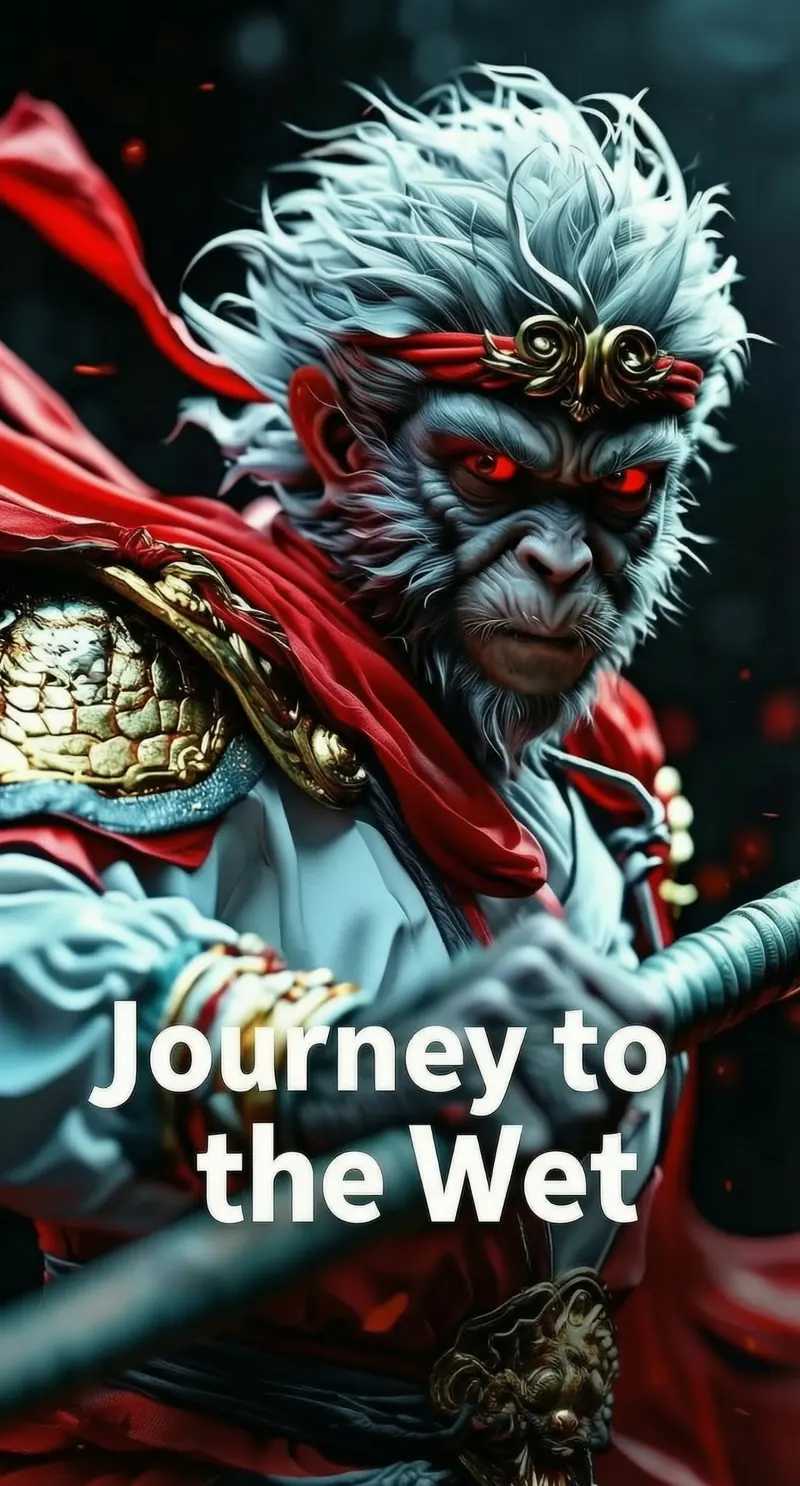
As Tripitaka drew near to examine him, the monkey appeared thus: a pointed mouth and gaunt cheeks, eyes blazing like fire and gleaming like gold. Moss grew on his head, and creeping vines sprouted from his ears. His temples had little hair but were covered in green grass; his chin was beardless but overgrown with green sedge. Dirt filled the creases between his brows, and mud clung to the hollow of his nose—a truly wretched sight. His fingers were thick, his palms calloused, all covered in grime and dust. Yet his eyes still moved, and his voice was still clear. Though his speech was nimble, his body remained utterly immobile. This was none other than the Great Sage Sun from five hundred years past, whose calamities had now run their course, and who was about to be freed from Heaven's bonds.
Liu the Huntsman, bold as ever, stepped forward and pulled the grass from the monkey's temples and the sedge from his chin, asking, "What words do you have to say?"
The monkey said, "I have nothing else to say. Let that master come closer; I have a question for him."
Tripitaka approached and asked, "What do you wish to ask me?"
The monkey said, "Are you not the one sent by the Great Tang emperor of the East to fetch scriptures from the Western Heaven?"
Tripitaka said, "I am indeed. Why do you ask?"
The monkey said, "I am the Great Sage Equal to Heaven , who five hundred years ago wreaked havoc in the Heavenly Palace. Because I committed the crime of deceiving Heaven, the Buddha trapped me here. Some days ago, the Bodhisattva Guanyin, acting on the Buddha's command to seek a scripture pilgrim in the East, came to me. I begged her to save me, and she advised me to stop my evil ways, take refuge in the Buddha's Dharma , and wholeheartedly protect the scripture pilgrim on his journey to the West to worship the Buddha and seek the true scriptures. When the task is accomplished, there will naturally be rewards. So I have been waiting day and night with bated breath, hoping for my master to come and free me. I am willing to protect you on your scripture quest and become your disciple."
Tripitaka was overjoyed and said, "You have this kind intention, and by the Bodhisattva's teaching you wish to enter the Buddhist path. But I have no axe or chisel—how can I free you?"
The monkey said, "No axe or chisel is needed. If you are willing to save me, I can get out on my own."
Tripitaka said, "I am willing to save you, but how will you get out by yourself?"
The monkey said, "On the summit of this mountain is a golden seal talisman pressed down by our Buddha Tathagata . If you go up the mountain and remove that talisman, I will be able to come out."
Hearing this, Tripitaka turned and pleaded with Liu Boqin, "Huntsman, would you accompany me up the mountain?"
Boqin said, "Who knows if what this monkey says is true or false!"
The monkey shouted loudly, "It is true! I swear I am not deceiving you!"
Boqin had no choice but to tell the servants to hold the horses, while he himself helped Tripitaka back up the mountain. The two of them climbed, grasping vines and clutching creepers, until they reached the summit. There, they indeed saw ten thousand beams of golden light and a thousand wisps of auspicious vapor. On the peak lay a square boulder, and on that boulder was affixed a seal bearing the six golden characters: Om Mani Padme Hum .
Tripitaka approached, knelt down, and bowed several times before the golden characters on the stone. Facing west, he prayed: "Your disciple, Chen Xuanzang, has been sent by imperial decree to seek scriptures in the Western Heaven. If I am truly destined to take on a disciple, may I be allowed to remove this golden seal and free the divine monkey, so that we may journey together to the Holy Mountain to realize the Buddha's truth. If I am not destined for a disciple, and this monkey is a vicious, deceitful monster, may I be unable to remove the talisman." After his prayer, he bowed again, stepped forward, and gently peeled off the six golden characters.
No sooner had he removed them than a fragrant wind swept through, and the seal was snatched into the air. A voice cried out: "We are the divine messengers who guarded the Great Sage. His calamities are now complete, and we must return to the Western Heaven to see the Tathagata and deliver this seal."
Tripitaka, Liu Boqin, and their party fell to their knees in fright, bowing to the sky. Then they descended the high mountain and returned to the stone crevice, where Tripitaka said to the monkey, "The seal has been removed. Can you come out now?"
The monkey shouted joyfully, "Master, step aside a little so I can come out. I don't want to frighten you."
Hearing this, Boqin led Tripitaka and the others quickly to the east. After walking five or six miles, they heard the monkey cry out again: "Farther! Farther!" Tripitaka walked an even greater distance and descended the mountain. Suddenly, a thunderous roar shook the earth, as if the mountains were cracking and the ground splitting open. Everyone trembled with fear. Then they saw the monkey already standing before Tripitaka's horse, naked, kneeling and saying, "Master, I am free!"
The monkey bowed four times to Tripitaka, then quickly rose and clasped his hands to Boqin, saying, "Thank you for escorting my master, elder brother, and thank you for pulling the grass from my face." After giving thanks, he went to pack the luggage and prepare the horse's saddle. As soon as the horse saw the monkey, its legs went weak, its hooves trembled, and it could barely stand—for the monkey had once been the Protector of the Horses in Heaven, where he had learned the art of taming celestial steeds, and thus all mortal horses feared him.
Seeing that the monkey truly had good intentions and appeared like a disciple of the Buddhist order, Tripitaka asked, "Disciple, what is your surname?"
The monkey said, "My surname is Sun."
Tripitaka said, "I will give you a Dharma name, so we can address you properly."
The monkey said, "Don't trouble yourself, Master. I already have a Dharma name: Sun Wukong."
Tripitaka said happily, "This name fits perfectly with our Buddhist lineage. Since your appearance is like that of a young ascetic, I will give you a nickname: 'Pilgrim.' What do you think?"
Wukong said, "Good! Good! Good!" From then on, the monkey was also called Sun the Pilgrim.
Seeing that Sun the Pilgrim was eagerly packing the luggage and preparing to depart, Boqin turned and clasped his hands to Tripitaka, saying, "Venerable Sir, it is fortunate that you have found such a fine disciple here. How wonderful! This monkey can indeed accompany you to the Western Heaven. I will take my leave now."
Tripitaka bowed and said, "I am deeply grateful for your trouble in escorting me so far. Please give my regards to your mother and wife. I have imposed on your hospitality, and when I return, I will come to your home to thank you in person."
Boqin returned the bow, and the two parted ways.
Sun the Pilgrim invited Tripitaka to mount his horse, while he himself carried the luggage on his back and strode forward, naked. Before long, they passed Two Realms Mountain, when suddenly a fierce tiger came bounding toward them, roaring and lashing its tail. Tripitaka was so terrified that his heart quaked, but the Pilgrim, standing by the roadside, said cheerfully, "Don't be afraid, Master. It has come to bring me some clothes."
The Pilgrim set down his luggage, reached into his ear, and pulled out a needle. He shook it in the wind, and the needle instantly transformed into an iron staff as thick as a rice bowl. Grasping the staff, he laughed and said, "This treasure has not been used in over five hundred years. Today, I will use it to earn myself some clothing."
He strode forward to meet the tiger and shouted, "Beast! Where do you think you're going!" The tiger crouched low, flattening itself against the ground, not daring to move. The Pilgrim brought his staff down on the tiger's head with a single blow, sending brains and blood splattering everywhere, its teeth flying out. Tripitaka was so frightened that he tumbled off his horse, biting his finger and crying, "Heavens! Heavens! Liu the Huntsman struggled for half a day to kill that striped tiger the other day, but today Sun Wukong has smashed this one to pulp with a single blow, without any effort! Truly, 'there is always a stronger hand among the strong'!"
The Pilgrim dragged the tiger over and said, "Master, sit for a moment while I take off its 'clothes' and put them on before we go."
Tripitaka said, "Where would it have clothes?"
The Pilgrim said, "Don't worry about that, Master. I have my ways."
What a fine Monkey King! He plucked a single hair from his body, blew on it with a magical breath, and cried, "Change!" The hair instantly became a sharp ox-ear knife. The Pilgrim slit open the tiger's belly, peeled back the skin, and removed a complete tiger hide. He then chopped off the tiger's claws and cut off its head, trimmed the hide into a neat square, held it up to measure it, and said, "A bit wide—one skin can serve as two." He cut off half and put it away, then wrapped the other half around his waist. Plucking a vine from the roadside, he tied it tightly to cover his lower body, and said, "Master, let's go! When we reach a place with people, I'll borrow a needle and thread to sew it up."
He twisted the iron staff back into a needle and tucked it into his ear, then shouldered the luggage and invited his master to mount the horse.
As they continued on their way, Tripitaka asked from the saddle, "Wukong, where did that iron staff you used to beat the tiger disappear to?"
The Pilgrim laughed and said, "Master, you wouldn't know. This staff originally came from the Dragon Palace of the Eastern Ocean. It is called the 'Divine Iron That Anchors the Heavenly River,' also known as the 'As-You-Will Golden-Banded Staff.' When I wreaked havoc in Heaven five hundred years ago, it was my main weapon. It can change size at will, growing large or small as I command. Just now, I turned it into an embroidery needle and hid it in my ear. When I need it, I simply take it out again."
Tripitaka was secretly pleased and asked further, "And why did that tiger just now lie still and let you strike it?"
Wukong said, "To tell you the truth, Master, not just a tiger—even a dragon would not dare to show me disrespect. I, Old Sun, have the power to subdue dragons and tigers, the ability to overturn rivers and stir up seas. I can read faces to discern hearts and hear voices to understand intentions. When I expand, I can encompass the entire universe; when I shrink, I can become as small as a hair. My transformations are endless, my appearances and disappearances unpredictable. What is skinning a tiger compared to that? When we encounter real difficulties, I will show you my true abilities!"
Hearing this, Tripitaka felt even more at ease and urged his horse onward. As master and disciple walked and talked, the sun set without their noticing. Behold: the slanting rays of the setting sun cast a brilliant glow, and clouds from the ends of the earth and the corners of the sea drifted back home. Birds from a thousand peaks and ten thousand ridges chirped incessantly, flying in flocks to the forests to find shelter for the night. Wild beasts, in pairs and in packs, returned to their dens. A crescent moon hung in the twilight sky, and countless stars twinkled with faint light.
The Pilgrim said, "Master, hurry up—it's getting late. Over there, where the trees are thick, there must be a village. Let's quickly seek lodging there."
Tripitaka urged his horse toward that place and dismounted at the gate of a farmstead. The Pilgrim set down his luggage, stepped forward, and shouted, "Open the door! Open the door!"
An old man from within the courtyard came out leaning on a staff. With a clatter, he opened the door and saw the Pilgrim's fearsome appearance—a tiger hide wrapped around his waist, looking like a thunder god—and his legs went weak with terror. He muttered incoherently, "A ghost! A ghost!"
Tripitaka quickly stepped forward to support the old man, saying, "Don't be afraid, venerable benefactor. He is my disciple, not a demon."
The old man looked up and saw Tripitaka's refined and elegant appearance, then steadied himself and asked, "Which monastery's monk are you, bringing such a fierce creature to my home?"
Tripitaka said, "I am from the Great Tang, journeying to the Western Heaven to worship the Buddha and seek the scriptures. I happened to pass by here, and since it is late, I wish to stay at your home for one night and leave before dawn. I humbly beg you to grant me this favor."
The old man said, "You may be from the Tang, but this fierce creature is certainly not from the Tang."
Wukong shouted loudly, "You old fellow, you have no eyes! The man from Tang is my master, and I am his disciple! I am no 'sugar man' or 'honey man'—I am the Great Sage Equal to Heaven. People from these parts have seen me before, and I have even met you!"
The old man said, "When have I ever seen you?"
Wukong said, "When you were a child, didn't you cut firewood in front of me? Didn't you pick wild vegetables from my face?"
The old man said, "You're talking nonsense! Where do you live? Where do I live? How could I have cut firewood or picked vegetables in front of you!"
Wukong said, "If I'm lying, I'm your son! You don't recognize me, but I am the Great Sage from the stone box at the foot of Two Realms Mountain. Look at me again carefully."
The old man then realized and said, "You do look a bit like him. But how did you get out?"
Wukong told him in detail how the Bodhisattva had advised him to turn to good and "let me wait for the Tang Monk to remove the seal and free me." The old man immediately knelt down and invited Tripitaka into the courtyard. He then called his wife and children to come and meet them, telling them the whole story. The entire family was overjoyed and busied themselves with serving tea.
After the tea, the old man asked Wukong, "Great Sage, you must be quite old by now, aren't you?"
Wukong said, "How old are you this year?"
The old man said, "I am a hundred and thirty years old, wasted years."
The Pilgrim said, "Then you are still my great-great-grandchild! I can't remember the year I was born; I only know that I have been crushed beneath this mountain for over five hundred years."
The old man said, "That is true! I have heard my grandfather say that this mountain fell from the sky and crushed a divine monkey beneath it. Only now have you been freed. When I saw you as a child, you had grass on your head and mud on your face, and I was not afraid of you. Now that your face is clean and your head free of grass, you are thinner, and with that big tiger hide around your waist, you look almost like a demon!"
Hearing this, the whole family burst into hearty laughter. This old man was very kind-hearted and immediately ordered a vegetarian meal to be prepared. After the meal, Wukong asked, "What is your family name?"
The old man said, "My family name is Chen."
As soon as Tripitaka heard this, he rose and clasped his hands, saying, "Venerable benefactor, we share the same clan!"
The Pilgrim said, "Master, your surname is Tang. How can you be of the same clan?"
Tripitaka said, "My secular surname is also Chen. I am from Juxian Village in Hongnong Prefecture, Haizhou, in the Tang Empire. My Dharma name is Chen Xuanzang. Later, the Great Tang Emperor Taizong honored me as his sworn brother, Tripitaka, and ordered me to take Tang as my surname, which is why I am called Tang Sanzang."
Hearing that they shared the same surname, the old man was even more delighted. Wukong said, "Old Chen, I have imposed on your hospitality today. I have not bathed in over five hundred years. Could you heat some water so that my master and I can wash? Consider it a farewell gift."
The old man immediately ordered hot water to be heated and a bathtub brought, and lit the lamps. After master and disciple finished bathing, they sat before the lamp, and Wukong said, "Old Chen, I have one more favor to ask. Lend me a needle and thread."
The old man said, "I have them! I have them!" He immediately asked his wife to fetch the needle and thread and hand them to Wukong.
The Pilgrim, quick-witted as he was, saw that his master had taken off a white cloth undergarment while bathing and had not put it back on. He picked it up and draped it over his shoulders, then took off the tiger hide, pieced it together, folded it into a skirt-like garment, and tied it around his waist with a vine. He stepped before his master and said, "How does Old Sun look today compared to yesterday?"
Tripitaka said, "Good! Good! Good! Now you truly look like a pilgrim." He added, "Disciple, if you don't mind that this garment is old, you may wear it."
Wukong clasped his hands and said, "Thank you, Master, for your gift!" He then went to find some fodder to feed the horse.
With all matters settled, master and disciple, along with the old man, each retired to their rooms to rest.
As the poem says:
Buddha is the mind, and the mind is Buddha;
Mind and Buddha have always been essential.
If you know there is no thing and no mind,
That is the true Dharma body of Buddha.
The Dharma body Buddha has no form;
A single sphere of light contains all phenomena.
The body without a body is the true body;
The form without form is true reality.
It is not form, not emptiness, nor not-emptiness;
It does not come, does not go, does not transfer merit.
It is neither different nor the same, neither being nor non-being;
Difficult to grasp, difficult to take, difficult to hear or see.
The inner and outer spiritual light are the same everywhere;
One Buddha realm lies within a single grain of sand.
A single grain of sand contains a thousand great worlds;
One body and mind, and ten thousand are the same.
To know this, you must master the secret of no-mind;
Remaining unstained and unhindered is pure karma .
A thousand kinds of good and evil, all without action—
That is the homage to Shakyamuni Buddha.
The next morning, Wukong awoke and invited his master to rise and continue the journey. Tripitaka dressed and told the Pilgrim to pack the bedding and luggage. Just as they were about to take their leave, the old man had already prepared wash water and a vegetarian breakfast. After finishing the meal, master and disciple set out. Tripitaka mounted his horse, and Wukong led the way. Along the road, they ate when hungry and drank when thirsty, stayed at inns at night and set out at dawn, until before they knew it, the season had turned to early winter.
Behold: frost had tinted the red leaves, leaving the thousand forests sparse and gaunt; a few pines and cypresses on the ridges remained verdant and sturdy. Unopened plum blossoms released a faint, pure fragrance. The days grew shorter, and it was the time of the small spring, when chrysanthemums withered and lotus leaves decayed, yet camellias bloomed profusely. Ancient trees on the cold bridge vied for branches and leaves, and in the winding mountain streams, spring water trickled gently. Pale clouds covered the sky as if threatening snow; a north wind suddenly rose, whipping sleeves and skirts, and the evening chill was hard to bear.
Master and disciple had traveled for a long while when suddenly they heard a whistle from the roadside, and six men burst forth. Each carried a long spear or short sword, a sharp blade or a strong bow. They shouted loudly, "You monk! Where do you think you're going! Leave your horse and luggage at once, and we will spare your life!"
Tripitaka was so frightened that his soul seemed to flee and his spirit to scatter. He fell from his horse, unable to speak. Wukong reached out and helped him up, saying, "Master, don't worry. It's nothing. These people have come to deliver clothes and traveling money to us."
Tripitaka said, "Wukong, did you mishear? They told us to leave our horse and luggage. How can you say they are bringing us clothes and money?"
Wukong said, "You just watch over the clothes, luggage, and horse. Let Old Sun have a word with them and see what's what."
Tripitaka said, "A good fighter cannot beat two fists, and two fists cannot beat four hands. There are six of them, and you are so thin and small—how dare you fight them?"
But Wukong's courage was naturally immense. Without further discussion, he stepped forward, crossed his arms over his chest, and clasped his hands to the six men, saying, "Gentlemen, what business do you have blocking our path?"
The man said, "We are kings of the road who rob travelers, benevolent lords of these mountains. Our reputation has long been spread far and wide. You must not have heard of us. Leave your belongings at once, and we will let you pass. If you utter a single 'no,' we will grind your bones to dust and mince your flesh!"
Wukong laughed and said, "I, too, am a king by inheritance and a longtime lord of the mountains, but I have never heard of your great names."
The man said, "You don't know us? Let me tell you: one is called Eye That Sees and Delights, one is called Ear That Hears and Angers, one is called Nose That Smells and Loves, one is called Tongue That Tastes and Thinks, one is called Mind That Perceives and Desires, and one is called Body That Feels and Worries."
Wukong laughed and said, "So you are six petty thieves! But you do not recognize that this monk is your true master. Instead, you block my path. Bring out all the treasures you have plundered, and I will divide them into seven shares, giving you a fair share, and spare your lives!"
Hearing this, the thieves were variously pleased, angered, covetous, thoughtful, worried, and consumed by desire. Together, they rushed forward, shouting in confusion: "This monk is too insolent! You have nothing yourself, yet you come to demand a share of our goods!"
They raised their spears and brandished their swords, charging in a crowd, and began hacking wildly at Wukong's head. With clangs and bangs, they struck him seventy or eighty times. Wukong stood in their midst as if he felt nothing at all.
The thieves said, "What a monk! Your head is truly hard!"
Wukong laughed and said, "Barely passable! Your hands must be tired from all that hitting. Now it's time for Old Sun to bring out his needle and play."
The thieves said, "This monk must be an acupuncturist in disguise! We have no illness—why do you speak of needles!"
Wukong reached into his ear and pulled out an embroidery needle. Shaking it in the wind, it became an iron staff as thick as a rice bowl. Holding it in his hand, he said, "Don't run! Let Old Sun try a blow on you!"
The six thieves fled in all directions in terror, but Wukong strode after them, catching each one and beating them all to death. He stripped them of their clothes, seized their traveling money, and returned with a smile, saying, "Master, let's go. I have dealt with those thieves."
Tripitaka said, "You have brought great trouble upon us! Though they were robbers who blocked the road, even if captured and taken to the authorities, they would not deserve the death penalty. Even if you have skill, you could have driven them away—why did you have to kill them all? This is taking human life without cause. How can you call yourself a monk? A man of religion 'fears even harming an ant when sweeping the floor, and covers his lamp to spare the flying moth.' How could you, without distinguishing right from wrong, beat them all to death in one go? You have not a trace of compassion or a heart for good deeds! Fortunately, we are in the wilds where no one saw it. But if we were in a city, and someone accidentally offended you, you would also attack them with your staff. Then I would be considered your accomplice—how would I escape blame?"
Wukong said, "Master, if I had not killed them, they would have killed you."
Tripitaka said, "I am a monk who would rather die than commit violence. Even if I died, it would be only my own death. But you have killed six people—how can this be justified? If this case were brought before the authorities, even if your father were a judge, he could not defend you."
Wukong said, "To tell you the truth, Master, when I ruled as king and demon on the Mountain of Flowers and Fruit five hundred years ago, I killed who knows how many people. If, as you say, every case were brought to court, I would have quite a few lawsuits on my hands."
Tripitaka said, "It is precisely because you had no one to discipline you, because you ran wild in the mortal world and deceived Heaven, that you suffered five hundred years of torment. Now that you have entered the Buddhist path, if you continue to act violently and take lives as before, you will never reach the Western Heaven, nor can you be a true monk! This is too wicked! Too wicked!"
This monkey had never been able to bear being spoken to harshly. Seeing Tripitaka nagging on and on without end, he could no longer suppress the fury in his heart. He said, "Since you say I cannot be a monk or reach the Western Heaven, stop pestering me with your prattle. I'm going back!"
Before Tripitaka could respond, the monkey flew into a temper. He leaped into the air, cried out, "Old Sun is leaving!" and was gone.
Tripitaka looked up hastily, but Wukong had already vanished. He only heard a whoosh as the monkey flew eastward.
Tripitaka was left all alone. He nodded and sighed, his heart filled with sorrow. "This reckless monkey! He refuses to listen to instruction! I only said a few words to him, and he disappears without a trace! Enough! Enough! It must be my fate not to have a disciple or to increase my company! Now I cannot find him, and I cannot call him back. I must go on alone! I must go on alone!"
Truly, "Abandoning himself to his fate, he journeyed west, relying on no one but his own will." Tripitaka had no choice but to pack the luggage, place it on the horse, and, not mounting, walk forward with one hand gripping his pilgrim's staff and the other holding the reins, lonely and desolate.
He had not gone far when, ahead on the mountain path, he saw an old woman approaching, carrying a cotton robe with a floral cap placed on top. As she drew near, Tripitaka hastily reined in his horse and stood aside to let her pass.
The old woman asked, "Where have you come from, venerable monk, walking all alone like this?"
Tripitaka said, "Your disciple is from the Great Tang in the East, sent by imperial decree to journey west to worship the living Buddha and seek the true scriptures."
The old woman said, "The Buddha of the West dwells in the Thunderclap Monastery in the Heavenly Kingdom. From here, it is one hundred and eight thousand miles. You are all alone, with no companion and no disciple—how can you possibly make the journey?"
Tripitaka said, "A few days ago, I took on a disciple, but his temper was violent and unruly. I scolded him a little, and he refused to accept instruction and stole away."
The old woman said, "I have a cotton robe and a floral cap inlaid with gold. They originally belonged to my son. He was a monk for only three days before he sadly died young. I have just been to his monastery to weep and bid farewell to his master, and I brought these two garments as a keepsake. Venerable Sir, since you have a disciple, I will give you these clothes."
Tripitaka said, "Thank you for your generous gift, venerable lady, but my disciple has already left. I dare not accept them."
The old woman said, "Where did he go?"
Tripitaka said, "I heard a whoosh, and he went east."
The old woman said, "My home is not far to the east. He must have gone to my house. I also have a spell, called the 'True Words for Calming the Mind,' also known as the 'Tight-Band Spell.' You should memorize it secretly, learning it by heart, and never reveal it to anyone. I will go and catch up with him, make him return to you, and then you can give him these clothes to wear. If he refuses to obey your commands, you can silently recite this spell, and he will not dare to act violently or run away."
Hearing this, Tripitaka bowed his head in gratitude. The old woman transformed into a beam of golden light and flew eastward. Tripitaka knew that it was the Bodhisattva Guanyin who had come to teach him the spell. He hastily gathered a pinch of earth as incense and bowed reverently toward the east. After his worship, he put away the clothes and cap, hiding them in his bundle. He then sat by the roadside, reciting the "True Words for Calming the Mind," going over it several times until he had it memorized perfectly.
Meanwhile, after taking leave of his master, Wukong had flown