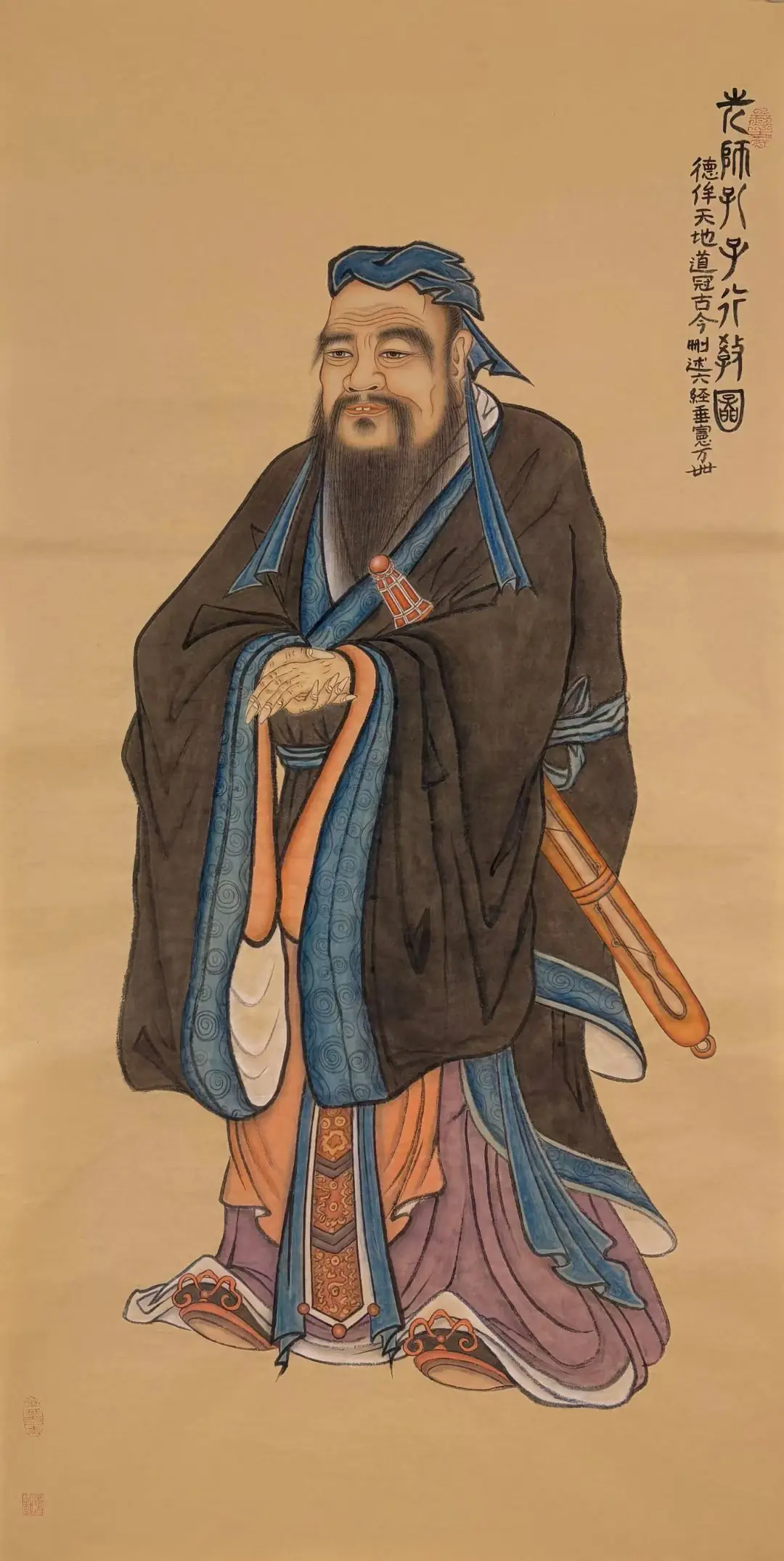
Bu Shang (507 BCE-?), also known by his courtesy name Zi Xia (a disciple of Confucius), was forty-four years younger than Confucius and a native of the State of Wei. He is mentioned nineteen times in The Analects. After Confucius returned from Wei to Lu in 484 BCE, Zi Xia became a student of Confucius and was among the ten most outstanding disciples. Bold in character and fond of associating with those superior to himself, he was renowned for his mastery of "literary learning" (wenxue) and served as the steward of Jufu (present-day Ju County, Shandong Province) in the State of Lu. His discussions with Confucius were notably profound, earning him great appreciation. Once, he asked Confucius: "What do the ancient poem lines mean—'The beautiful lady’s subtle smile reveals dimples so charming; her bright eyes with black-and-white pupils are so captivating; further adornment with white powder enhances her beauty'?" Confucius replied: "This means that to paint, one must first lay a good foundation, then add colors." Zi Xia said: "Doesn't this imply that a person must first possess the virtue of Zhongxin (Loyalty and Trustworthiness), then adorn it with Li (Propriety)?" Confucius remarked: "It is Bu Shang who inspires my heart. With someone like this, I can now discuss the Classic of Poetry (Shijing) with him." Zi Xia was listed among the "Four Disciplines and Ten Philosophers" (in the category of literary learning) among Confucius's disciples.
After Confucius's death, he went to Xihe in the State of Wei to lecture, advocating that rulers should study the Spring and Autumn Annals (Chunqiu) to learn lessons and prevent ministers from usurping power. He proposed the idea that "an official who excels in his duties should study, and a scholar who excels in his studies should serve as an official," and also maintained that officials must first gain the people's trust before demanding their service. Li Kui and Wu Qi (both prominent Legalist figures) were his disciples, and Marquis Wen of Wei also regarded him as a teacher, consulting him on state affairs, which greatly influenced later Confucian scholars.
Bu Shang (Zixia, a disciple of Confucius) was a lifelong scholar of broad learning and firm purpose, possessing vast knowledge. He transmitted the Five Classics and organized and disseminated ancient texts. Among Confucius's disciples, Bu Shang had the most works passed down to posterity. According to tradition, The Analects was compiled and edited by Bu Shang and Ran Yong (Zhonggong, another disciple). The Mao Commentary on the Classic of Poetry (Maoshi) was transmitted from Bu Shang, and the Preface to the Classic of Poetry (Shixu) was written by him. The chapter on mourning attire in the Book of Rites and Ceremonies (Yili) also came down from Bu Shang, and one volume of the Commentary on the I Ching (Yizhuan) was authored by him. The Han scholar Xu Fang also stated, "The Classic of Poetry, Book of Documents, Book of Rites, and Book of Music were established by Confucius; the elucidation of chapters and sentences began with Zixia." In spreading Confucian teachings, he independently formed the Zixia school, becoming an important and far-reaching figure among Confucius's disciples.