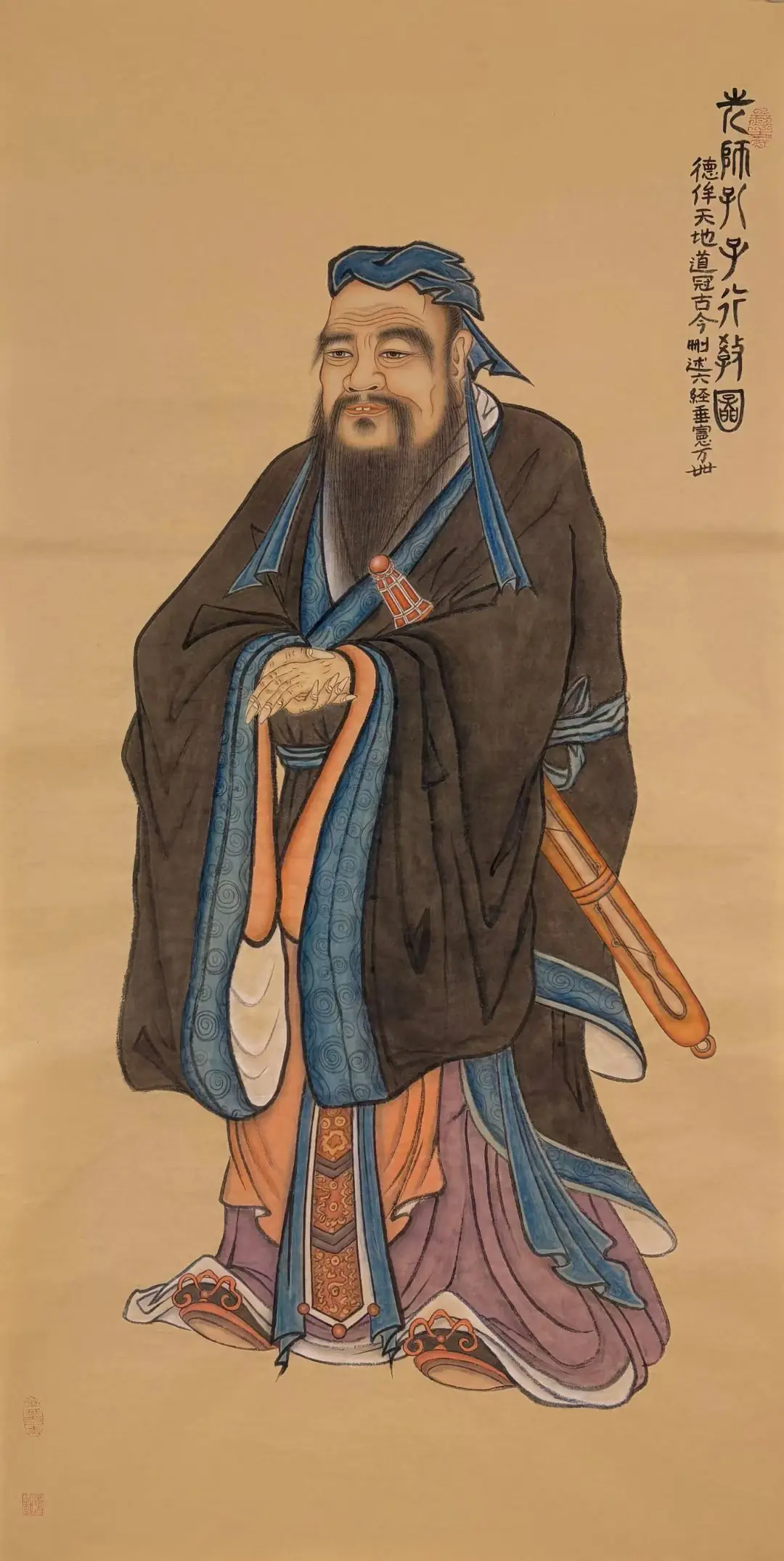
Gongye Chang (519-470 BCE), whose surname was Gongye and given name Chang, with the courtesy name Zichang, was a native of the State of Qi, though some sources say he was from the State of Lu. He was Confucius's son-in-law and is mentioned once in The Analects. Born into poverty, he was intelligent and studious, well-versed in classical texts and ritual, possessing both virtue and talent, for which Confucius held him in high regard.
Although Gongye Chang had been imprisoned, Confucius believed that "though Gongye Chang was in bonds, it was not his fault." His imprisonment was unjust, and Confucius not only did not look down on him but also married his daughter to him. Confucius had many disciples, yet he chose to marry his daughter to Gongye Chang, demonstrating that Confucius recognized his moral character and therefore appreciated him. From this, we can also see that Confucius judged people not by their circumstances but by their talent and virtue.
Legend has it that Gongye Chang (a disciple of Confucius who understood the language of birds) was returning from the State of Wei to the State of Lu when, upon reaching the border, he heard birds calling to each other to go to Qingxi Stream to eat the flesh of a dead person. Not far ahead, he encountered an old woman crying in the middle of the road. Gongye Chang asked her what was wrong, and she told him that her son had left home two days earlier and had not yet returned; she feared he was dead but did not know where. Gongye Chang said that he had just heard a flock of birds calling each other to go eat meat at Qingxi Stream, and suspected it might be her son. The old woman immediately went to Qingxi Stream and found that it was indeed her son, already dead. She then reported the matter to the village authorities. When asked how she knew where her son had died, she truthfully replied that she had met Gongye Chang, who had told her. The village official reasoned that if Gongye Chang had not killed the man, how could he have known where the body was? So Gongye Chang was arrested and imprisoned. The jailer interrogated him about the murder, but Gongye Chang denied it, claiming he could only understand the language of birds. The jailer then asked him to interpret bird calls to verify this. Once, when sparrows were chirping above the prison, Gongye Chang said the birds were saying that a cattle cart had overturned at Bailian River, spilling millet on the ground, and they were calling each other to go peck at it. The jailer was skeptical and sent someone to check, and it turned out to be true. Later, Gongye Chang also interpreted the calls of swallows and other birds, each time proving accurate, and he was eventually released from prison.
After Gongye Chang married, he had two sons: one named Zi Li, who died young, and the other named Zi Geng. He devoted his entire life to scholarship and never held an official position. The ruler of Lu repeatedly invited him to serve as a Grand Master, but he declined each time, choosing instead to carry on Confucius's legacy by teaching and educating others, thus becoming a renowned scholar of his time.