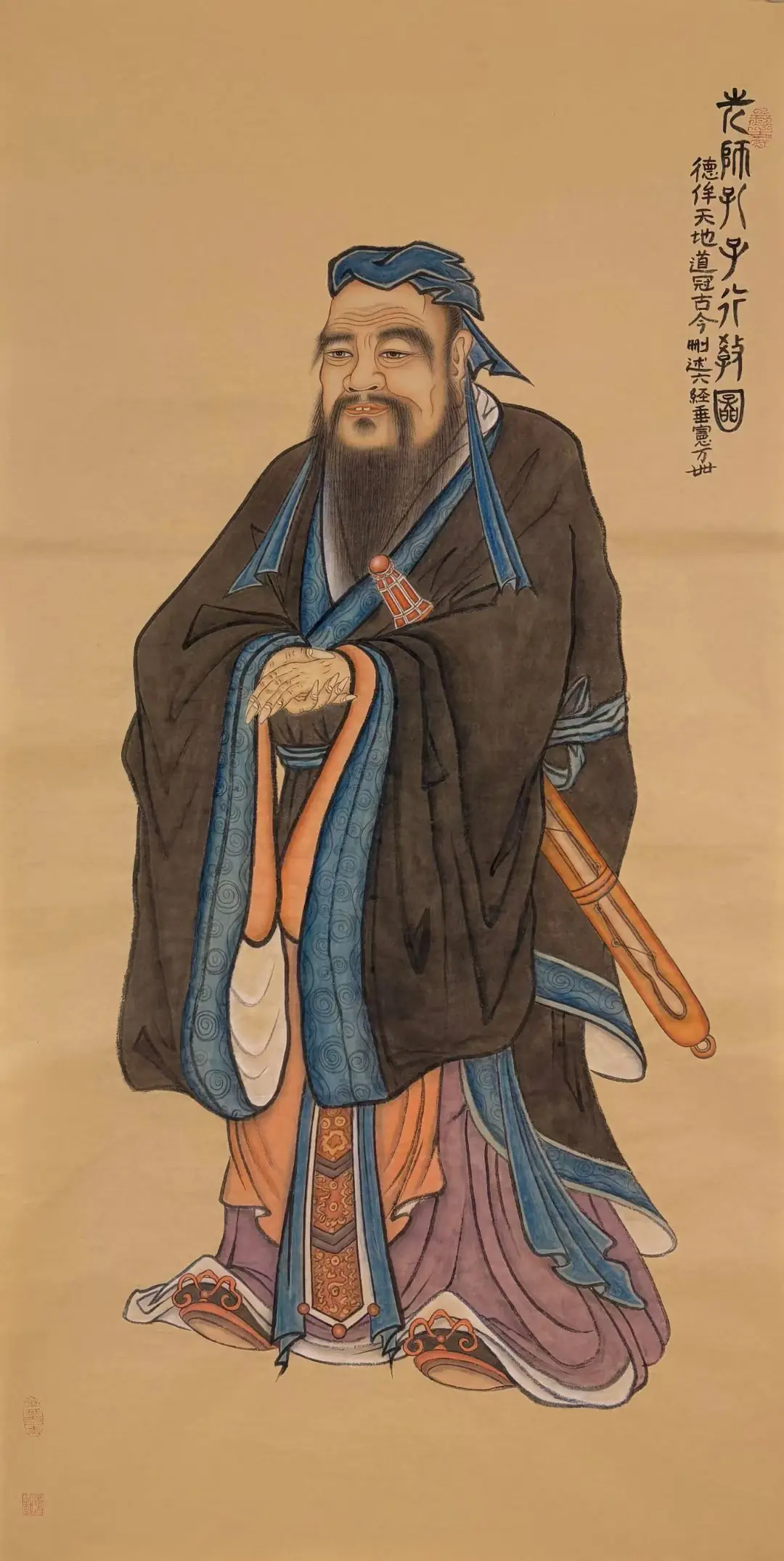
Chen Kang (511-430 BCE), whose given name was Kang and style name was Zi Kang or Zi Qin, was from the State of Chen and was forty years younger than Confucius. He once served as the magistrate of Shanfu, where he governed with De (Virtue) and was greatly beloved by the people. He is not listed in the "Records of the Grand Historian: Biographies of the Disciples of Zhongni," but is recorded as a disciple of Confucius in the "School Sayings of Confucius: Biographies of the Seventy-Two Disciples," which states he was "forty years younger than Confucius." In The Analects, Book 16, "Ji Shi," there is a record of Chen Kang asking Bo Yu (Confucius's son): "Chen Kang asked Bo Yu, 'Have you heard any special teaching from your father?' Bo Yu replied, 'No. Once, my father was standing alone, and as I hurried across the courtyard, he said, "Have you studied the Classic of Poetry (Shijing)?" I replied, "Not yet." He said, "If you do not study the Poetry, you will have no means to speak." So I withdrew and studied the Poetry. Another day, he was again standing alone, and as I hurried across the courtyard, he said, "Have you studied the Book of Rites (Liji)?" I replied, "Not yet." He said, "If you do not study the Rites, you will have no means to establish yourself." So I withdrew and studied the Rites. I have heard these two things.' Chen Kang withdrew and said joyfully, 'I asked one thing and got three: I heard about the Poetry, I heard about the Rites, and I heard that the Junzi (Exemplary Person) keeps his son at a distance.'" This is an account of Chen Kang consulting Confucius's son, Bo Yu, about Confucius's method of teaching his own child. He asked Kong Li (Bo Yu), "Did your father teach you anything special?" Kong Li honestly replied, "No. Once, my father asked if I had reviewed the Classic of Poetry, saying that without mastering it, I could not understand principles or speak properly. Another time, he asked if I had reviewed the Book of Rites, saying that without mastering it, I could not strengthen my virtue or establish myself in life. That's all I heard." Chen Kang was very pleased and said, "I asked one thing and learned three: besides understanding the principles of studying the Poetry and the Rites, I also learned that the Master treats his son the same as his other disciples, without any partiality or favoritism."
Additionally, The Analects records two conversations between Chen Kang and Zi Gong (a prominent disciple of Confucius). The first appears in Book 1, Chapter 10: "Zi Qin asked Zi Gong, 'When the Master arrives in a state, he invariably learns about its governance. Does he seek this information, or is it given to him?' Zi Gong replied, 'The Master obtains it through being gentle, good, respectful, frugal, and deferential. His way of seeking is perhaps different from that of others.'" The second appears in Book 19, Chapter 25: "Chen Ziqin said to Zi Gong, 'You are being respectful—how could Zhongni (Confucius) be superior to you?' Zi Gong replied, 'A Junzi (Exemplary Person) reveals wisdom with a single word, or ignorance with a single word—words must not be spoken carelessly. Our Master cannot be surpassed, just as the heavens cannot be climbed by stairs. If our Master were to govern a state or a clan, what is called establishing the people, they would be established; leading them, they would follow; pacifying them, they would come; mobilizing them, they would harmonize. In life he is honored, in death he is mourned—how could anyone equal him?'" Judging by the tone of Chen Kang's question in this latter passage, he seems not to have been a disciple of Confucius. However, aside from the "Kongzi Jiayu" (School Sayings of Confucius), Zheng Xuan's commentary on The Analects and the "Tan Gong" chapter of the Book of Rites (Liji) also consider Chen Kang a disciple.