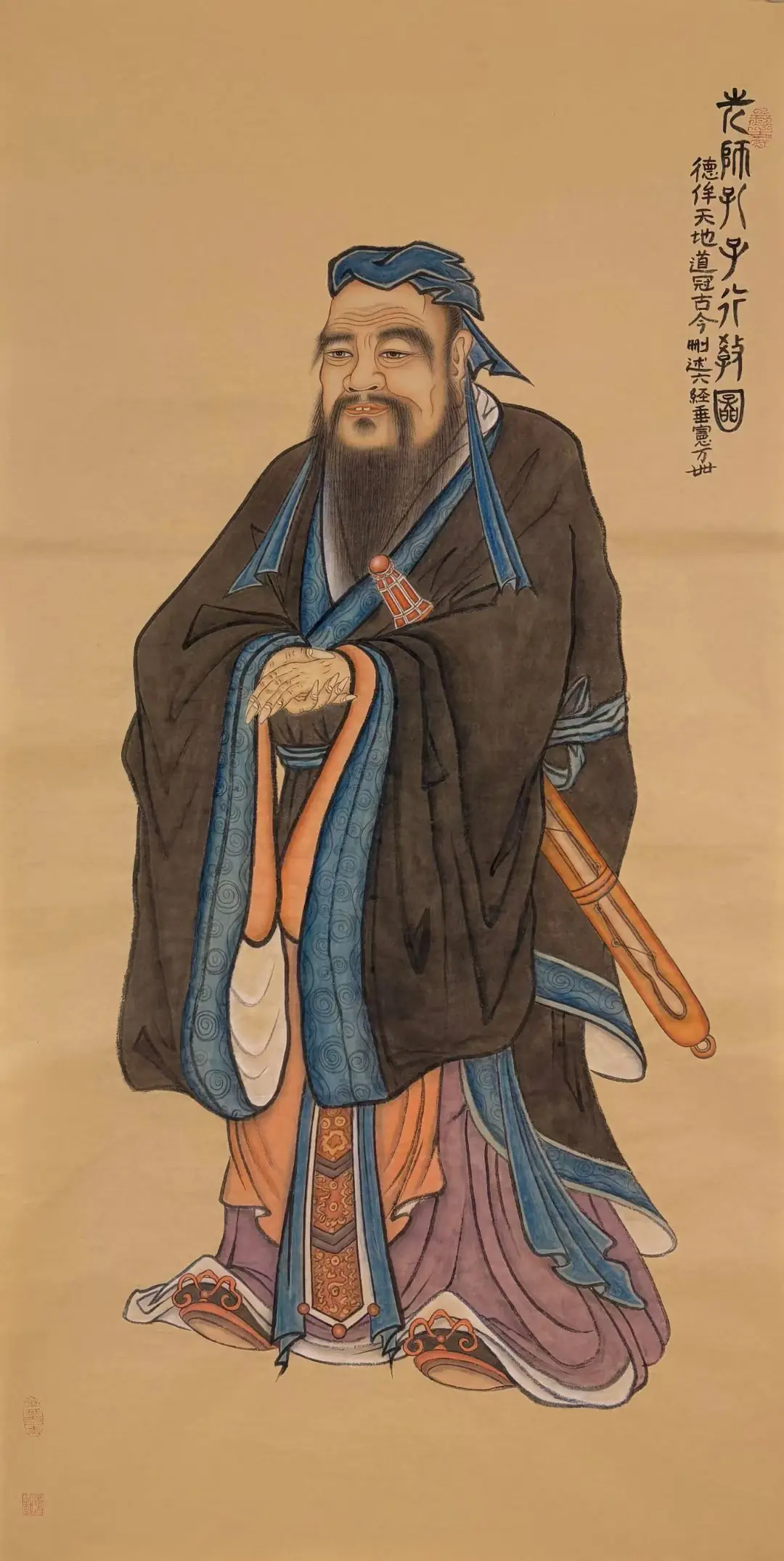
Yuan Xian (515 BCE-?, a disciple of Confucius), whose family name was Yuan, given name Xian, courtesy name Zisi—also known as Yuan Si—was thirty-six years younger than Confucius and a native of the State of Lu. Born into poverty, Yuan Xian maintained a pure and upright character, was stubbornly principled, refused to follow worldly trends, and remained content in poverty and devoted to the Dao (The Way) throughout his life. In Lu, he lived in a small square hut with a thatched roof, its door woven from wormwood and incomplete, its pivot made from mulberry twigs, its window fashioned from a broken jar, and partitioned with coarse cloth into two rooms. The roof leaked and the floor was damp, yet he sat upright there, strumming his zither and singing.
The *Analects* (Yong Ye, Chapter 6) states: "Yuan Si served as his steward, and Confucius gave him nine hundred measures of grain, but he declined. Confucius said, 'Do not decline. If it is too much for you, share it with your neighbors and fellow villagers.'" According to historical records, Confucius did not possess a fief, so Yuan Xian's role as "steward" was that of a household steward, meaning he served as Confucius's family manager when Confucius held the position of Minister of Justice in the State of Lu. The *Confucius Family Sayings* (Biographies of the Seventy-two Disciples) also states: "When Confucius was Minister of Justice in Lu, Yuan Xian once served as his steward."
Yuan Xian served as Confucius's household steward, and when Confucius offered him a salary of nine hundred hu of millet, he declined it, showing his integrity and lack of greed. The Analects, Chapter 14 (Xian Wen), states: "When the Way prevails in the state, take office and receive salary; when the Way does not prevail, taking office and receiving salary is shameful." The Analects, Chapter 8 (Tai Bo), says: "When the Way prevails in the world, appear; when it does not, go into hiding. When the Way prevails in the state, being poor and lowly is shameful; when the Way does not prevail, being rich and noble is shameful." Confucius advocated that even in poverty and hardship, one should not accept salary from a disorderly ruler. When a disorderly ruler is in power and the Way does not prevail in the world, coming out to seek office is shameful. Yuan Xian followed Confucius's teachings and diligently pursued the goal of Ren (Benevolence). When Confucius died, Yuan Xian was only thirty-seven years old, in the prime of his life, yet he did not seek official position or align himself with the powerful; instead, he went to the State of Wei and lived in seclusion. Zi Gong (a wealthy and eloquent disciple of Confucius) became an official in Wei and felt proud and satisfied. One day, Zi Gong drove a four-horse carriage, accompanied by a retinue of riders, pushing through overgrown weeds into a remote village to visit Yuan Xian. Yuan Xian received him wearing shabby clothes and a worn-out hat. Zi Gong asked him, "Are you ill?" Yuan Xian replied, "I have heard that lacking money is called poverty, but learning a set of principles and being unable to practice them is called illness. My current shabby state is merely poverty, not illness." Zi Gong left feeling ashamed.
He was one of the few disciples of Confucius who "did not tire of coarse food and lived hidden in a poor alley." Upholding Confucius's teaching that "when the Way prevails in the world, appear; when it does not, hide," he never lost his ambition in poverty, embodying the ideal of "being poor without resentment." In the *Hanfeizi • Xianxue* (Han Feizi's chapter on "Prominent Learning"), Yuan Xian's (a poor but virtuous disciple of Confucius) Confucian school is listed as one of the "Eight Schools of Confucianism."