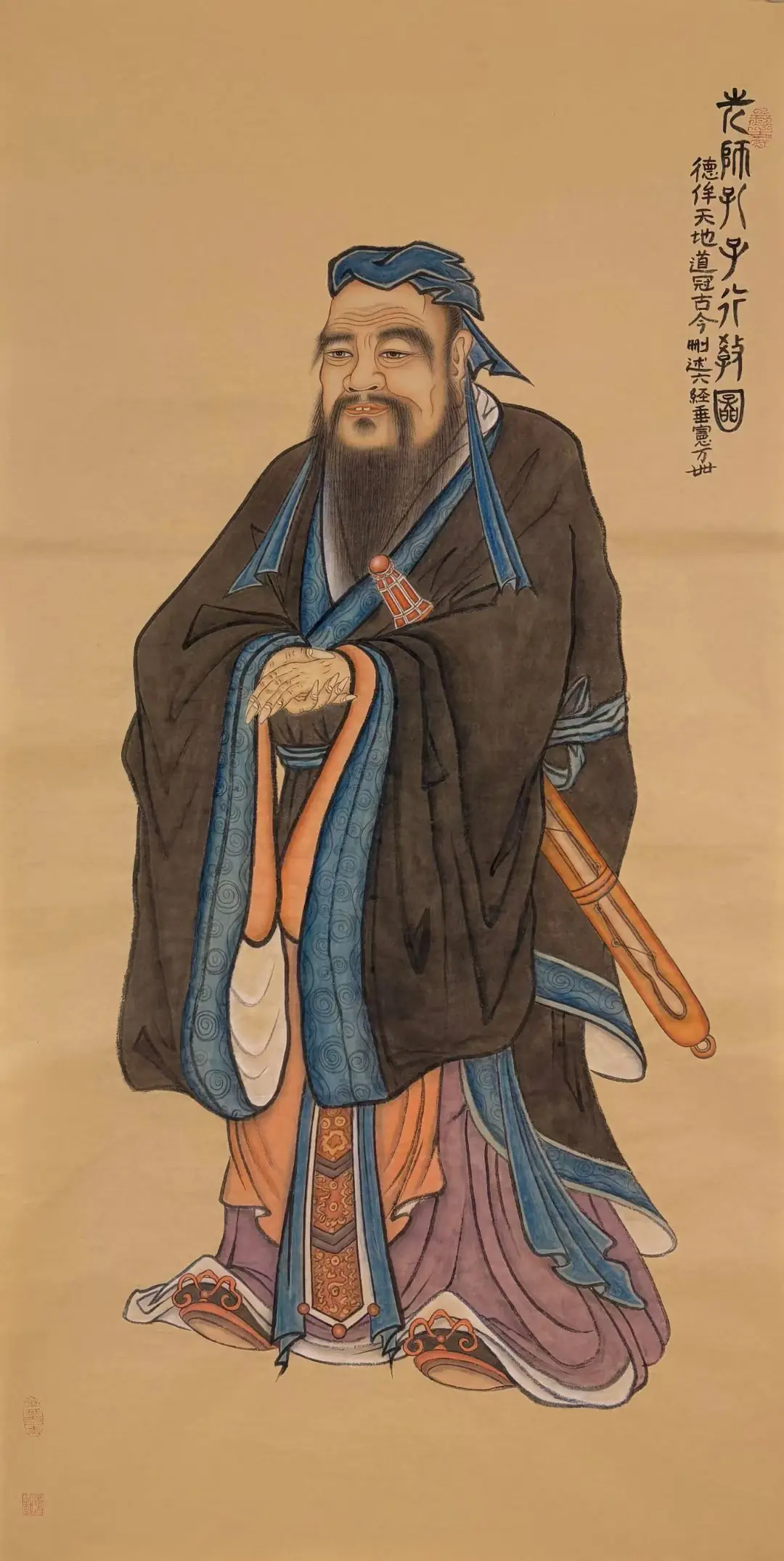
Yan Hui (521-481 BCE), with the surname Yan, given name Hui, and courtesy name Ziyuan, also known as Yanyuan, was thirty years younger than Confucius and a native of the State of Lu. By the time of Yan Hui and his father Yan Lu, the Yan family, aside from retaining their inherited aristocratic status and Yan Lu's title as a high minister of Lu, possessed only a simple dwelling in a humble alley, fifty mu (about 8.3 acres) of farmland outside the city walls, and ten mu (about 1.7 acres) of garden plots within them. Yan Hui lived in poverty, dwelling simply in that humble alley, and never held an official position throughout his life. Confucius praised him, saying: "How rare is Yan Hui! A single bamboo container for his food, a single gourd dipper for his drink, and living in a humble alley. Others would find it unbearable, but Yan Hui remains content and does not change his joy in pursuing the Way and learning!" This shows that Yan Hui faithfully adhered to Confucius's teaching of "being poor yet delighting in the Way." Yan Hui valued cultivating Ren (Benevolence) and was deeply appreciated and beloved by Confucius. Confucius rarely used the term "Ren" to praise anyone, including himself, but he said: "As for Hui, for three months his mind does not stray from Ren." In contrast, "others attain it only occasionally, perhaps once a day or once a month."
At thirteen, Yan Hui entered the school of Confucius and achieved success six years later. He was not only exceptionally intelligent but also modest and eager to learn, and he came to recognize the profound breadth of Confucius's teachings earlier than others. His respect for Confucius surpassed the typical reverence of a student for a teacher—he revered Confucius as one would a sage of antiquity, and their bond was as close as that between father and son. Yan Hui once exclaimed: "The more I look up at the Master's Way, the higher it seems; the more I delve into it, the harder it becomes. I see it before me, but when I seek it ahead, it suddenly appears behind. Though the Master's Way is so profound and elusive, he skillfully guides us step by step, enriching us with various texts and knowledge, elevating us, and restraining us with proper Li (Propriety), making it impossible for us to stop learning." Thus, when Shao Zhengmao competed with Confucius for disciples, and "the school of Confucius was three times full and three times empty," only Yan Hui never left Confucius's side. Later generations commented: "Yan Yuan alone recognized that Confucius was a sage" (Lunheng, Chapter on Portents and Auspicious Signs). Therefore, Confucius regarded Yan Hui as a kindred spirit and said to him: "If employed, I act; if set aside, I withdraw—only you and I share this!" Yan Hui was highly praised for his virtuous conduct and was thus listed among the "Four Disciplines and Ten Philosophers" (in the category of Virtuous Conduct) of Confucius's school.
Yan Hui (Confucius's most beloved disciple) possessed exceptional natural talent but was not good at self-expression, speaking little, giving an initial impression of being somewhat dull. Confucius said his first impression of Yan Hui was that whatever he said, Yan Hui would follow without objection, as if he were slow-witted. But upon further observation, Confucius found that Yan Hui could understand and expand upon his words in private, simply preferring not to show his intelligence outwardly. Yan Hui was inwardly brilliant and diligent in his studies. When asked which of his disciples was fond of learning, Confucius said Yan Hui was the one, but unfortunately he died young, and now there was no disciple as devoted to learning. Thus, Yan Hui's academic progress was rapid, as Confucius lamented, "I saw him constantly advancing; I never saw him stop." On another occasion, Confucius spoke with Zi Gong (a wealthy merchant and eloquent disciple) and asked how he compared to Yan Hui. Zi Gong, known for his eloquence and quick wit, and an outstanding talent in both learning and governance among Confucius's disciples, frankly admitted he was no match for Yan Hui, highly praising Yan Hui for being able to infer ten things from one, while he himself could only infer two—a vast gap. Yan Hui followed Confucius on his travels through various states for fourteen years. After returning to the State of Lu, he taught students, transmitted the Six Classics of Confucianism, assisted Confucius in compiling ancient texts, gradually expanded his influence, and formed a branch of Confucianism known as the Yan School. In the process of learning and promoting the Confucian doctrine founded by Confucius, he always exhausted his thoughts and poured all his energy into it, coupled with a life of extreme poverty (living on a single bamboo bowl of rice and a gourd of water), which severely damaged his health. At twenty-nine, Yan Hui's hair turned completely white, and he died at forty-one. When Yan Hui died, Confucius wept bitterly, crying out, "Oh! Heaven is destroying me! Heaven is destroying me!"—violating the funeral rites' rule of moderate grief. Because Confucius believed that among his disciples, Yan Hui was one of the most qualified to inherit his teachings and was also his hope. Now that Yan Hui had died first, there was no suitable successor for his ideal of benevolent governance and moral rule.
Yan Hui (Confucius's most beloved disciple) was highly learned, possessed noble character, and was renowned for his moral virtue, later ranked by Confucian scholars as the foremost among the "Seventy-Two Worthies."