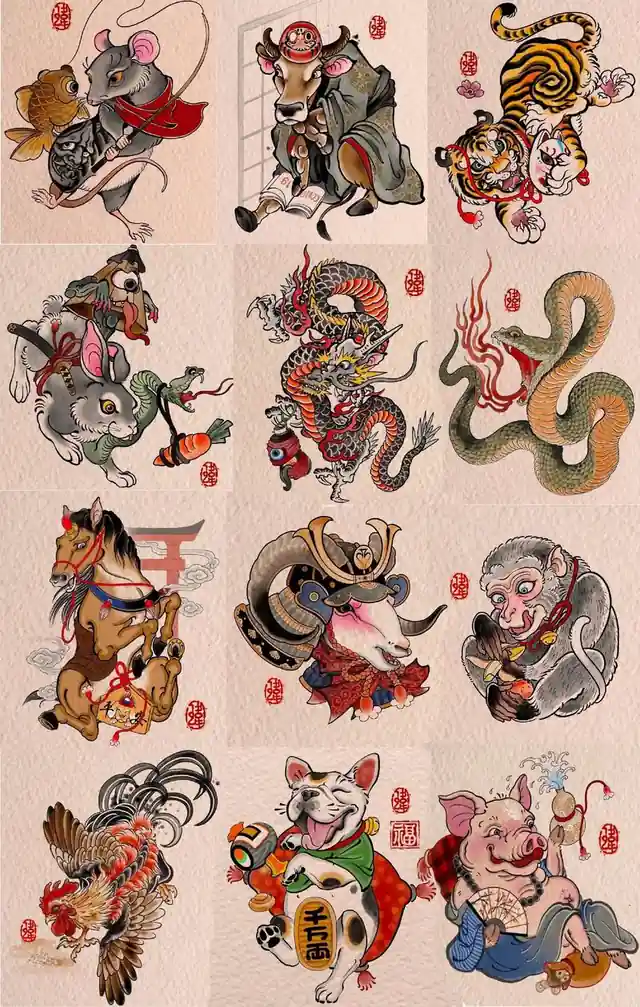
In the view of ancient Chinese people, each animal in the twelve zodiac signs was inextricably linked to concepts of "auspiciousness" and "inauspiciousness." They not only used a twelve-year cycle with zodiac signs to mark the years but also assigned zodiac animals to each day, which naturally imbued daily life with differing shades of "good fortune" and "bad fortune."
As early as the Shang Dynasty (c. 1600-1046 BCE), the practice of divination using tortoise shells and animal bones to select auspicious days was already widespread. At that time, people consulted the gods and sought oracles for everything from national affairs to trivial personal matters, including sacrifices, weather forecasts, harvest predictions, military campaigns, hunting expeditions, illnesses, and childbirth. These divinations determined courses of action or inferred fortune and misfortune. Consequently, the oracle bone inscriptions of the Shang Dynasty have preserved a wealth of precious historical records, while also demonstrating that the ancients had already become quite skilled in combining the Heavenly Stems and Earthly Branches with the zodiac animals to mark days.
The Yunmeng Qin bamboo slips "Rishu" (Daybook) state: "Do not trade slaves or horses on the Wu day," and also, "Do not trade slaves, horses, cattle, or goods on the Shen day." These two historical records reflect that people at that time believed it was unlucky to conclude transactions involving horses and slaves on the Wu or Shen days, possibly because the Wu day corresponds to the Horse zodiac sign. Later, with the prevalence of sacrificial rites and shamanistic practices, those specializing in such activities even divided the 365 days of the year into "auspicious" and "inauspicious" categories, and even "refined" this down to specific hours, establishing various "taboos and preferences" for "auspicious days and favorable hours" versus "inauspicious days and baleful times." These gradually permeated people's daily lives, and after a long period of development, they eventually became part of folk customs.
Take market trading as an example. In some Han and Yi mixed areas of Yunnan, the twelve zodiac animals are used to mark the days, and market names are based on the corresponding zodiac sign. The day on which a market is held is named after that day's zodiac animal. In theory, each of the twelve zodiac names should have an equal chance of being used as a market name, but in reality, this is not the case. Among the twelve zodiac signs, some are used more frequently, such as Horse, Goat, and Rooster, as these animals are considered auspicious omens. Others are rarely used, such as Rat, Rabbit, and Snake, which are symbols of inauspiciousness.
The Lisu people of Yunnan use twelve zodiac animals to mark their days, and the influence of this practice can also be seen in their marriage customs. According to a report titled "A Socioeconomic Survey of the Lisu People in Kashi and Sediwadi Villages, District Five, Bijiang County," it is stated that: "Engagement begins with the groom's family sending a matchmaker to the bride's family to negotiate the bride price. The bride's family also sends representatives to the groom's family to convey the amount of bride price they require... Once the bride price is agreed upon, the groom's family selects an auspicious date to inform the bride's family (the engagement date must be chosen on days corresponding to the Rat, Tiger, Snake, Monkey, Rooster, or Pig zodiac signs), and then the agreed-upon bride price is delivered to the bride's family." The date for the wedding ceremony must also be carefully chosen based on the zodiac signs. As recorded in "A Socioeconomic Survey of the Lisu People in Deyideng Village, Sede Township, District Five, Bijiang County": "The wedding date can only be selected on the days of the Rat, Monkey, or Snake zodiac signs, as these three days are believed to bring many children." This is likely because these three zodiac animals are known for their strong reproductive abilities, and thus, by choosing days associated with these signs, people express their hopes for abundant offspring.
In the funeral customs of the Lisu ethnic group, the selection of a burial date also considers the zodiac signs. "Generally, burial is only permitted on days corresponding to the zodiac animals Rat, Rabbit, Snake, Monkey, Rooster, and Pig."
In some local folk traditions, there is a custom known as "avoiding the Yin day." The Qing Dynasty scholar Shu Wei wrote in his poem "Miao Bamboo Branch Song: Red Miao": "Weaving fine silk not given to others, beating bronze drums to honor mountain gods, their feelings deep yet speechless, tonight the empty room is for avoiding Yin." A later annotation explains: "The Red Miao are only found in Tongren Prefecture, their clothes all made of fine silk, and women's work focuses on this. They beat bronze drums to dance, called 'adjusting the drum.' Every year on the Yin day of the fifth month, husbands and wives sleep separately and dare not speak, believing that doing so would bring harm from tigers." Yin represents the Tiger, and "avoiding Yin" seems to regard the tiger as a watcher: whoever dares to violate the custom by sharing a bed on the Yin day of the fifth month will be harmed by tigers. Visits between relatives and friends also avoid this day. The Qing Dynasty scholar Bei Qiaqing recorded in his "Miao Prostitute Poems": "On the Yin day of the fifth month, people shut their doors and stay hidden, couples sleep in separate rooms, and relatives do not visit each other. Those who violate this are said to inevitably encounter a tiger disaster."
In essence, the ancient people assigned different meanings to each zodiac animal, whether auspicious or inauspicious, positive or negative, due to the specific historical circumstances in which they lived, serving as a form of spiritual sustenance for the people. For a long time, this culture of zodiac omens has deeply influenced people's beliefs. While actively criticizing its superstitious elements, we should also recognize the historical and cultural significance it carries, which will benefit the further development of zodiac culture.
Further Reading
The Hani ethnic group has a custom of catching locusts on Rooster Day and Monkey Day.
The Grasshopper Catching Festival, held on Rooster or Monkey days, is a traditional folk festival of the Hani ethnic group. Every year, on the first Rooster or Monkey day after the 24th day of the sixth lunar month, when rice paddies need pest control, Hani men, women, and children go to the fields together to catch locusts. The captured locusts are clamped with bamboo strips and inserted at the field edges as a deterrent. Afterwards, the locusts are collected and eaten. When leaving the fields, people shout: "Locusts, we won't catch you for three days, and don't come to eat the rice for three months." The reason for choosing Rooster or Monkey days for this festival is likely rooted in the Chinese zodiac: Roosters eat insects, and Monkeys are agile and adept at catching them. This tradition merges festival customs with agricultural practices.