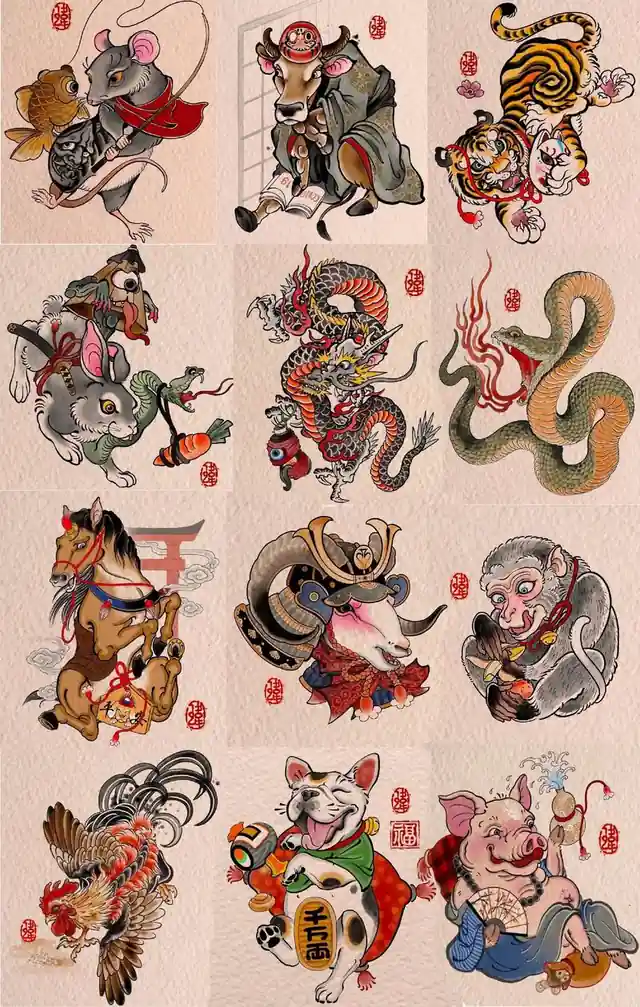
As a relic of primitive totem worship, the Chinese zodiac Nuo dance (a traditional exorcism dance) has been completely preserved and remains active across China to this day. As an important aspect of zodiac culture, the zodiac Nuo dance reflects the ancient people's long history of reverence and belief in the twelve zodiac animals.
Nuo Dance is a form of dance originating from primitive totems. The Fangxiangshi, who serves as the lead dancer in Nuo Dance, wears a mask with four gleaming golden eyes that is both majestic and terrifying. This type of mask was once unearthed from ancient tombs at Yinxu in Anyang, providing physical evidence of Nuo Dance from the Shang Dynasty. A painted pottery basin from the Neolithic period, discovered in Qinghai, depicts scenes of totemic dance.
The Yi people living in the Daliang Mountain region of Sichuan Province, at the junction of Yunnan, Guizhou, and Sichuan provinces, have preserved rich astronomical knowledge with profound historical roots. This knowledge is intertwined with Yi mythology, folklore, and even astrology, and increasingly permeates the daily lives of local people. The twelve zodiac animals of the local Yi people are essentially the same as those of the Han Chinese. However, based on the folklore that has been passed down among the Yi to this day, the customs associated with these zodiac signs are far more closely connected to totemic worship than those of the Han. Locally, the twelve animals are used to mark days: if today is the Rat Day, tomorrow is the Ox Day. On Tiger Day, they hold a tiger market (a market day), and on Pig Day, a pig market. In some places, temples dedicated to the twelve zodiac animals have been built, where annual sacrificial ceremonies are conducted. During these solemn and dignified rituals, a dance of the twelve zodiac spirits is performed. This dance of the twelve zodiac spirits is the influential zodiac Nuo Dance (an exorcism dance).
Regarding the twelve zodiac animals in the exorcism customs, the Tang Dynasty artifact "Jin Ye Hu Ci" (Lyrics for Entering the Night Barbarians) unearthed from Dunhuang clearly states: "There are also the twelve zodiac signs, which are likewise used to interpret good and bad fortune." The "twelve zodiac signs" refer to the twelve zodiac animals. Additionally, according to the record in "Yang Gong Bi Lu" (Records of Mr. Yang) by Yang Yanling of the Northern Song Dynasty: "Emperor Jingzong of Tang was skilled at playing cuju (ancient Chinese football) and, after nightfall, would personally catch foxes for amusement, calling it 'hitting the night foxes.'" From this, it can be understood that the "Jin Ye Hu" (Entering the Night Barbarians) custom among the Dunhuang folk of the Tang Dynasty was a type of exorcism ritual filled with a religiously fervent atmosphere. The ghosts from all directions were "captured without missing a single one," and the twelve zodiac animals, representing both directional and temporal significance, were also employed in these exorcisms to turn misfortune into good fortune.
The phrase "there are also twelve zodiac animals used to interpret fortune and misfortune" is consistent with the records in the Book of Han (Hanshu) regarding exorcism rituals, which mention "twelve beasts with fur and horns" and "twelve deities pursuing evil spirits." Both share a common origin in primitive totem worship.
Why was the exorcism Nuo dance specifically performed with twelve animals? This likely has some inherent connection to the Chinese zodiac. From another perspective, the twelve animals (or twelve deities) selected for the Great Nuo ceremony were probably intended to correspond to the twelve months of the year and the twelve cardinal directions, thereby seeking peace for each month and driving away evil spirits from all directions. This correspondence with the twelve directions naturally involved the Twelve Earthly Branches, which in turn linked to the twelve zodiac animals. Thus, it can be seen that the twelve spirit animals and the twelve zodiac animals share the same lineage, with their common origin being primitive animal worship.
The Baima people (also known as Baima Tibetans), who live in the border region between Sichuan and Gansu provinces in Pingwu County, Nanping County, and Wen County, still maintain the custom of performing the Twelve Animal Mask Dance. Most of the patterns on the masks of this dance are derived from the twelve zodiac animals. While the masks vary slightly among different tribes, they share many common features, with the animals depicted basically corresponding to the twelve zodiac signs. Occasionally, animals such as wild geese, peacocks, lions, and elephants are substituted for the Rat or Rabbit, which is influenced by Buddhist traditions. The purpose of performing the Twelve Animal Mask Dance is primarily to ward off disasters and pray for good fortune. The Baima people's exorcism dance, known as the Twelve Animal Mask Dance, is a remnant of totemic dance traditions. In essence, this dance involves wearing masks representing the twelve zodiac animals, which clearly illustrates the relationship between the zodiac and totems.
Further Reading
The zodiac Nuo dance, known as Zhonghuang Gaotai (Central Yellow High Platform).
Zhonghuang Gaotai is one of the forms of folk artistic performance popular in the Xiangfen County area of Shanxi Province. Because the "Gaotai" (elevated platform) in Zhonghuang Village within Xiangfen County has unique characteristics, this performance style is called "Zhonghuang Gaotai." In fact, this form of performance had already taken shape as early as the Ming Dynasty (1368-1644). Whenever there was a day for worshipping the gods, performers dressed as various deities would emerge from the temple accompanied by lively music played with blowing and percussion instruments. They would then parade around, attracting and drawing crowds of men, women, young, and old from the streets and alleys to follow and watch. Because the crowds were large, jostling and pushing made it difficult to see clearly, so someone came up with an idea: elevate the positions of the performers playing the various "gods" by placing them on wooden boards and then carrying those boards. This allowed the audience to clearly watch the performances of those "gods." Later, the content of this performance was gradually made more popular and lifelike, which is the origin of the Gaotai. There are often twelve Gaotai platforms, which not only represent the twelve zodiac animals but also combine each zodiac sign to present twelve separate theatrical scenes, such as "Five Rats Make Havoc in Tokyo," "The Cowherd and the Weaver Girl," "Wu Song Fights the Tiger," and so on. In essence, "Zhonghuang Gaotai" is a form of zodiac Nuo Dance (exorcism dance) rich in northern Chinese folk characteristics and shaped through historical development and evolution.