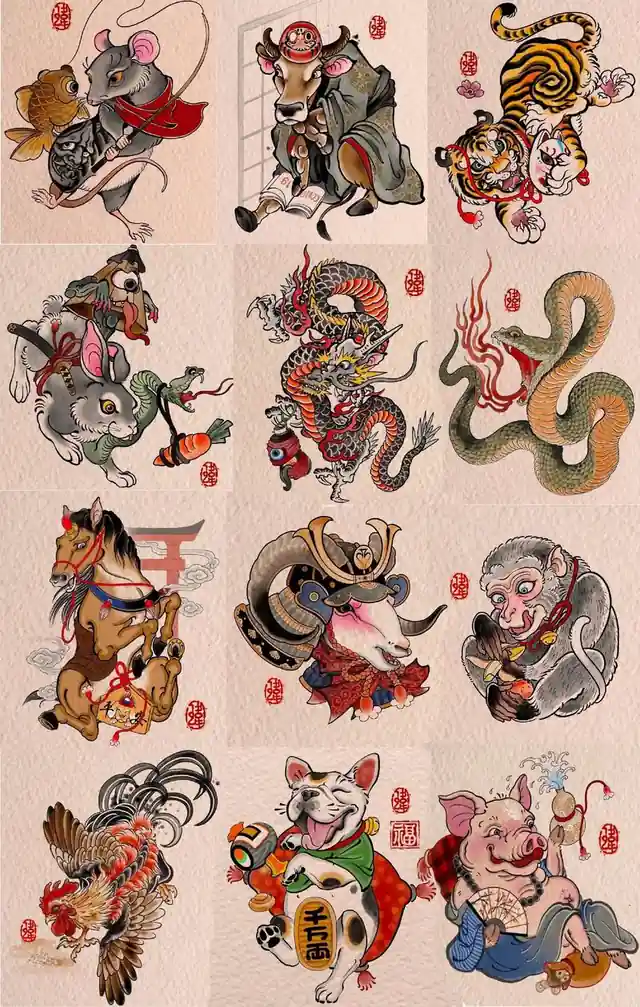
The theory of mutual generation and mutual restraint among the Chinese zodiac animals has a long history. During the long period of old society, people suffered deeply from it. We should stay away from this kind of superstition, arm our minds with science, and purify zodiac culture.
The theory of mutual generation and restraint among zodiac signs evolved from the basic principles of the Five Elements (Wu Xing), where mutual generation refers to the nurturing and promotion of one element by another, while mutual restraint refers to the inhibition and suppression between them. This concept of zodiac compatibility and conflict is what we commonly refer to as "Chong Hai" (clash and harm).
The earliest record of the theory of the Five Elements (Wu Xing) appears in the "Hong Fan" (Great Plan) chapter of the Book of Documents (Shangshu). According to this text, King Wu of Zhou once consulted Ji Zi on the principles of state governance, and Ji Zi expounded the "Hong Fan Jiu Chou" (Nine Categories of the Great Plan), which are nine major laws for ruling a country. The first category explains the Five Elements: Water, Fire, Wood, Metal, and Earth. It states: "First, the Five Elements: the first is Water, the second is Fire, the third is Wood, the fourth is Metal, and the fifth is Earth. Water moistens and descends; Fire blazes and ascends; Wood can be bent or straightened; Metal can be molded and transformed; Earth allows for sowing and harvesting. That which moistens and descends produces saltiness; that which blazes and ascends produces bitterness; that which can be bent or straightened produces sourness; that which can be molded and transformed produces acridity; and that which allows for sowing and harvesting produces sweetness." From its inception, the theory of the Five Elements had already permeated various aspects of traditional Chinese culture, and the culture of the Chinese zodiac is no exception.
The ancients divided the Ten Heavenly Stems and Twelve Earthly Branches into two categories, distinguishing yin and yang, and also assigned the Five Elements to both. According to ancient explanations, among the Ten Heavenly Stems, those occupying odd-numbered positions — Jia, Bing, Wu, Geng, and Ren — are considered yang stems, while those on even-numbered positions — Yi, Ding, Ji, Xin, and Gui — are yin stems. The Twelve Earthly Branches were similarly divided into yin and yang branches: the yang ones are Zi, Yin, Chen, Wu, Shen, and Xu, while the yin ones are Chou, Mao, Si, Wei, You, and Hai. Assigning the Five Elements to the Ten Heavenly Stems is also straightforward: Jia and Yi correspond to Wood, Bing and Ding to Fire, Wu and Ji to Earth, Geng and Xin to Metal, and Ren and Gui to Water. However, dividing the Twelve Earthly Branches according to the Five Elements is not a simple equal distribution, and the ancients devised a clever solution. According to the "Huainanzi (The Masters of Huainan)," Chapter on Astronomical Patterns: Yin and Mao correspond to Wood, Si and Wu to Fire, Shen and You to Metal, Hai and Zi to Water, and the four seasonal months correspond to Earth. The four seasonal months refer to the end of spring, the end of summer, the end of autumn, and the end of winter, which correspond to Chen, Wei, Xu, and Chou among the Twelve Branches. Thus, the Five Elements attribution of the Heavenly Stems and Earthly Branches, combined with the directional concept of the Five Elements, becomes: Jia, Yi, Yin, and Mao are Eastern Wood; Bing, Ding, Si, and Wu are Southern Fire; Wu and Ji are Central Earth; Chen, Xu, Chou, and Wei are the Four Repository Earths; Geng, Xin, Shen, and You are Western Metal; and Ren, Gui, Hai, and Zi are Northern Water.
Because of the theory of "mutual generation and mutual restraint" (Xiang Sheng Xiang Ke) among the Five Elements (Wu Xing) of Yin and Yang, when this is combined with the Ten Heavenly Stems (Tian Gan) and the Twelve Earthly Branches (Di Zhi), the associated zodiac animals also acquired the meaning of mutual generation and mutual restraint. In people's view, individuals can voluntarily regulate the Five Elements within themselves, thereby achieving satisfaction, turning adversity into smoothness.
The ancient Chinese believed that the Rat and the Horse were in direct opposition, the Ox and the Goat were in direct opposition, the Tiger and the Monkey were in direct opposition, the Rabbit and the Rooster were in direct opposition, the Dragon and the Dog were in direct opposition, and the Snake and the Pig were in direct opposition. This is known as the theory of "Six Conflicts" or "Direct Opposition." Superstitious people also firmly believed that the Rat and the Goat harmed each other, the Ox and the Horse harmed each other, the Tiger and the Snake harmed each other, the Rabbit and the Dragon harmed each other, the Monkey and the Pig harmed each other, and the Rooster and the Dog harmed each other. Regarding this, there is also a folk rhyme: "The white horse offends the black ox, the goat and rat will part once they meet, the snake and tiger are like a knife's mistake, the dragon and rabbit weep bitter tears, the golden rooster fears the jade dog, and the pig and monkey never reach their end." In places like Yuexi, China, there is also an "Anti-Marriage Song": "The white horse has always feared the golden ox, the goat and rat part ways upon meeting, the snake meeting the fierce tiger is like being cut with a knife, the golden rooster seeing the dog weeps bitter tears, the clever monkey and the pig do not share the same pen, and the dragon and jade rabbit never reach their end." Although the forms and wording differ, the content is surprisingly consistent.
The theory of zodiac conflicts and harms was most commonly applied to marriage and funeral customs. In ancient times, marriage was governed by the principles of "parents' command and matchmaker's words." The belief in zodiac conflicts and harms was a significant part of arranged marriages during the feudal era, and it could even be considered a crucial component — if a man and woman were deemed to be in conflict or opposition, their marriage would certainly not proceed. Many lovers failed to become spouses due to so-called "incompatible zodiac signs," leading to repeated marital tragedies.
In addition, there are also zodiac taboos during the grand encoffining ceremony for funerals. There are many taboos at the time of "grand encoffining," and one of them is that people with certain zodiac signs must avoid being present. These are calculated by the yin-yang master and written on the "Yang Shu" (Book of Calamities). In the past, if the deceased did not die a natural death, the yin-yang master could refuse to issue the "Yang Shu," and without it, the deceased could not be encoffined and buried.
From a scientific perspective, the so-called theory of mutual generation and restraint among zodiac signs has no truth or scientific basis whatsoever; it is nothing but groundless and baseless nonsense!
Further Reading
The taboo of "a goat entering the tiger's mouth"
Once, the renowned dan actor Sun Yiyun was summoned to perform "Yu Tang Chun" (The Story of the Jade Hall) for Empress Dowager Cixi in the imperial palace. The play contained a line that went, "A goat entering a tiger's mouth will never return." To everyone's shock, Cixi flew into a rage upon hearing this, ordered the performance to stop immediately, and commanded that Sun Yiyun be expelled from the palace, leaving the entire audience trembling with fear. Sun Yiyun accepted the punishment, yet had no idea what crime he had committed. Later, he learned that it was because his line "goat entering a tiger's mouth" had touched a taboo: Cixi was born in the year of Yiwei (the Goat year in the Chinese zodiac). As a staunch conservative, Empress Dowager Cixi was particularly sensitive to such "major matters" that concerned her own fate and would never tolerate such a "curse." This anecdote touches upon the concept of mutual compatibility and conflict among zodiac signs.