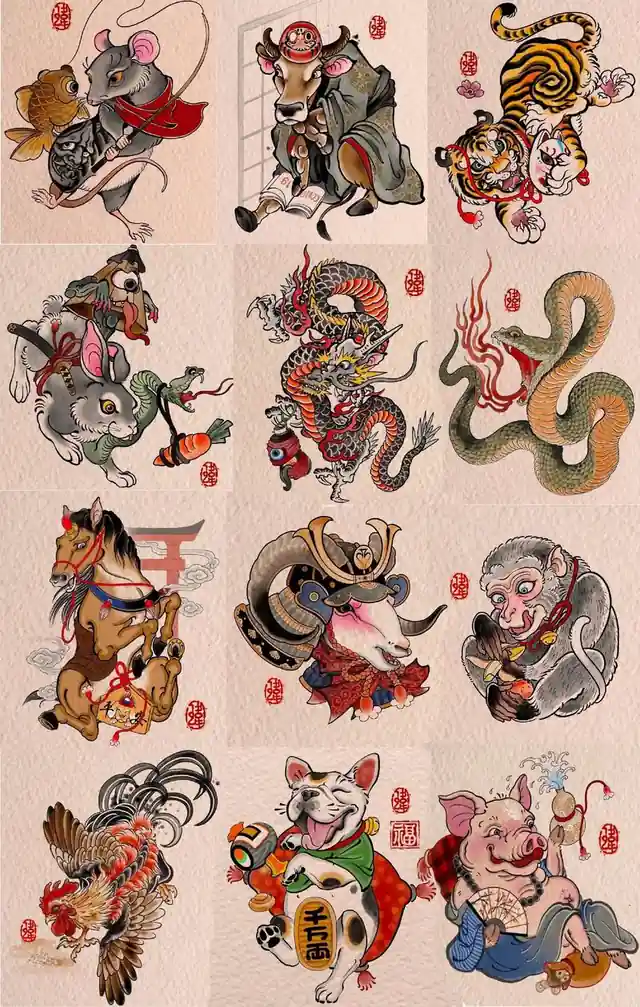
Buddhism and the Chinese zodiac were originally two independent cultural systems. However, as history developed, these two cultures influenced and merged with each other. Traces of zodiac culture can be found within Buddhist culture, and Buddhist cultural elements are also evident in the zodiac.
As is well known, Buddhism was first introduced to China from India. However, during the translation of Buddhist scriptures, translators deliberately incorporated traditional Chinese culture into the texts to facilitate their Sinicization, and the zodiac culture was included in this process.
Twelve Celestial Palace Guardians
In Buddhist legends, the Tathagata Buddha entrusted the Bodhisattva Mahasthamaprapta (Great Strength Bodhisattva) to select twelve animals as guardians of the heavenly palace. After Mahasthamaprapta conveyed the Buddha's decree, various animals rushed to respond. The first to arrive was the Cat, followed in order by the Rat, Ox, Tiger, Rabbit, Dragon, Snake, Horse, Goat, Monkey, Rooster, and Dog. Mahasthamaprapta selected the earliest arrivals as guardians and asked them to wait quietly for the Tathagata Buddha's arrival. The Cat grew impatient and slipped away to play. By the time the Tathagata Buddha arrived, the Cat had not yet returned. Just then, the Pig rushed in and was placed last, while the Cat was left out of the selection.
This story indirectly reflects the Buddhist concept of "the ocean accepts all rivers" and "tolerance leads to greatness," as well as the importance of zodiac culture within Buddhism.
The Twelve Guardian Deities
The Buddhist scripture "Mahavaipulya Mahasannipata Sutra" (Great Collection Sutra) contains this record: "Outside Jambudvipa, in the four surrounding oceans, there are twelve animals, all of whom are manifestations of Bodhisattvas guiding and transforming beings. When a human is first born, if the Bodhisattva resides in that animal's cave, the person will belong to that animal's guardianship and receive its benefits..." Analyzing this in conjunction with the early Indian myth "Apavasa," the twelve zodiac animals were originally the mounts of twelve divine generals, gradually evolving into the Dharma-protecting deities of Buddhism.
According to the Buddhist scripture "Medicine Buddha Sutra" (Yaoshi Benyuan Jing), the principal deity of the Eastern Pure Lapis Lazuli World is called the Medicine Buddha (Bhaisajyaguru). When he attained Buddhahood, he made twelve great vows to cure the root causes of sentient beings' suffering and heal their deep-seated chronic ailments. Thus, among Buddhist disciples, it is widely praised that Amitabha Buddha has forty-eight great vows while the Medicine Buddha has twelve great vows. These twelve great vows are centered on the fundamental Buddhist teachings of the Four Noble Truths: suffering, accumulation, cessation, and the path. Corresponding to these twelve great vows are the twelve guardian spirit generals under the Medicine Buddha's command, who are further divided to protect according to the twelve two-hour periods of the day and night, each corresponding to one of the twelve zodiac animals.
According to Buddhist scriptures, the Twelve Divine Generals, also known as the Twelve Shining Deities, are the twelve guardian deities of the Medicine Buddha. Their order exactly matches the arrangement of the twelve zodiac animals in the Chinese tradition.
Vikarala Maharaja (Pijialuo Dajiang): His original deity is Shakyamuni Tathagata, and he is the guardian deity of the Zi hour (11 PM-1 AM). His entire body is blue-green in color, manifesting a wrathful appearance, wearing a rat crown on his head. His right hand hangs down holding a three-pronged vajra, while his left hand assumes the posture of pulling the right sleeve.
General Zhaoduluo: His original form is Vajrapani Bodhisattva, and he is the guardian deity of the Hour of the Ox (1:00-3:00 AM). His entire body is red, appearing in a wrathful form, wearing an ox crown on his head, holding a horizontal sword in his right hand, and grasping the tip of the sword with his left palm open.
General Cintala: The original form (benzon) of this general is Samantabhadra Bodhisattva (Puxian Pusa), and he serves as the guardian deity of the Yin Hour (3:00-5:00 AM). He appears with a smiling yet fierce expression, wearing a tiger crown on his head, holding a precious jewel in his right hand and a sacred staff in his left hand.
Mahoraga General: His original form is the Medicine Buddha (Bhaisajyaguru), serving as the guardian deity of the Mao hour (5:00-7:00 AM). His entire body is cyan in color, with a slightly wrathful expression. His hair is red and stands upright. He wears a rabbit crown, with his right hand forming a fist at his waist and his left hand holding an axe.
General Boyiluo: His original form is Manjushri Bodhisattva, and he is the guardian deity of the Chen hour (7:00-9:00 AM). His body appears white with a flesh-colored tone, his countenance is wrathful, and he wears a dragon crown. His right arm is bent with a fist holding an arrow, while his left hand carries a bow.
General Indala: His original form is Kshitigarbha Bodhisattva (Earth Treasury Bodhisattva), and he is the guardian deity of the Si Hour (9:00-11:00 AM). His entire body is red, he wears a crown adorned with snakes, his right hand is bent at the elbow with the palm open and placed near his chest, and his left hand holds a trident.
The Great General Shandi Luo: His original form is the Akashagarbha Bodhisattva (Kokuzo Bosatsu), and he serves as the guardian deity of the noon hour (11:00 AM - 1:00 PM). His entire body is red, appearing in a wrathful form, wearing a horse-headed crown. In his right hand he holds a three-pronged trident, and in his left hand he grasps a conch shell.
General Aluola, whose original form is Marici (the Goddess of Light), serves as the guardian deity of the hour of the Goat (1:00-3:00 PM). He appears entirely white in a wrathful manifestation, with hair standing upright and wearing a goat crown on his head. His right hand holds an arrow feather, while his left hand grips the arrow shaft, bending the arrow into the shape of a bow.
General Andira: The original deity is Avalokiteshvara Bodhisattva, and he is the guardian deity of the hour of Shen (3:00 PM to 5:00 PM). His entire body is red, appearing in a great wrathful form, wearing a monkey crown on his head. His right hand is bent at the elbow before his right chest with the palm open facing forward, while his left hand is bent with the palm open, holding a precious gem on the palm.
General Miqiluo (Mekhila), whose original deity is Amitabha Tathagata, serves as the guardian deity of the Hour of the Rooster (5-7 PM). His entire body is red, and he appears in a wrathful form, wearing a rooster crest on his head. In his right hand, he holds a single-pronged vajra (ritual implement), while his left hand forms a fist pressed against his lower abdomen.
Vajra General: This deity is the incarnation of Mahasthamaprapta Bodhisattva and serves as the guardian deity of the hour of Xu (7-9 PM). His entire body is cyan, appearing in a wrathful form, with thick hair standing upright, wearing a dog crown on his head, holding a sword in his right hand, and making a fist with his left hand placed at his waist.
General Kumbhira: His original form is Maitreya Bodhisattva, and he is the guardian deity of the Hai hour (9-11 PM). His entire body is red, appearing in a wrathful form, wearing a pig crown on his head. He holds a large sword horizontally above his head in his right hand, while his left hand is open with the palm placed at his waist.
The twelve zodiac guardian deities form a rigorous system of protective directional positions
Further Reading
Shamen Du Gou (A Buddhist Monk Rescues His Dog)
The story of "Shramana Saves the Dog" is a highly representative tale from the Buddhist scriptures: "Once upon a time, in a certain country, grain prices soared and the people were starving. A shramana (Buddhist monk) was going out of the city gate to beg for alms when he encountered a hunter carrying a puppy home to kill it. The shramana begged for the dog's life, but the hunter refused to listen. The shramana then offered his own food to feed the dog, stroked it with his hand, and recited blessings so the dog could eat. A kind heart arose in the dog, and the hunter took it home. After the hunter slaughtered and ate the dog, the dog was reborn into the family of a wealthy elder, where it again encountered the shramana, left home to become a monk, and attained enlightenment." This shows that in Buddhism, the animal aspects of the twelve zodiac signs are mostly linked to the Buddhist concepts of compassion, benevolence, and magnanimity, promoting the equality between humans and animals.