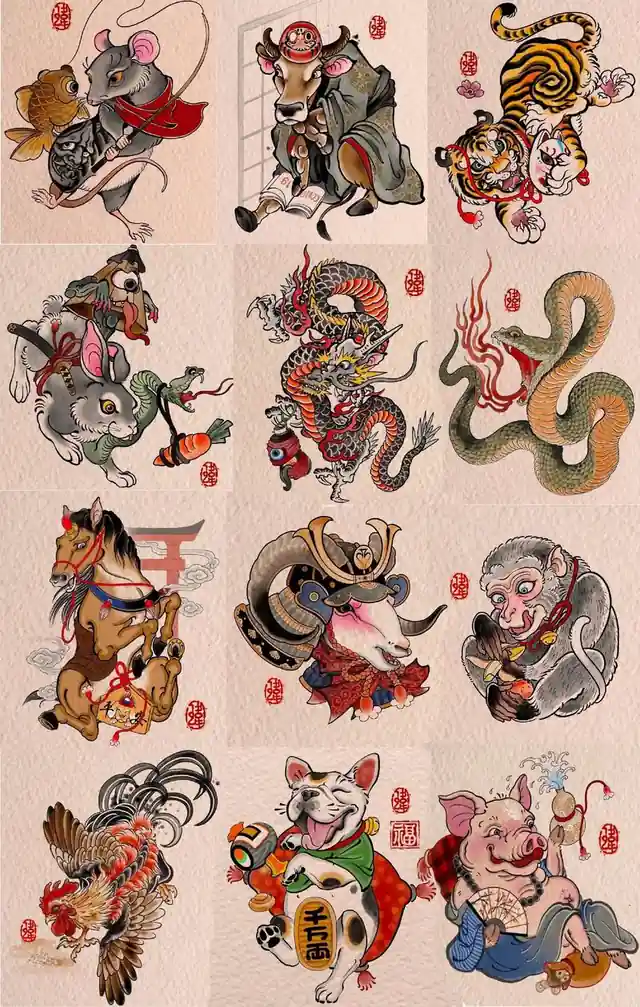
Most people today are unfamiliar with the term "Chen Wei" (prophetic and divination texts), yet it was prevalent throughout much of China's feudal society. Due to the inclusiveness and influence of zodiac culture, people often combined the zodiac with Chen Wei, a practice that endured for a long time.
According to historical records, the Chen Wei (prophetic and divination) tradition emerged during the Qin Dynasty (221-206 BCE), flourished in the Western and Eastern Han Dynasties, and has a history of over 2,200 years. The term "Chen Wei" is actually a combination of "Chen" and "Wei." "Chen" refers to mysterious hidden words or prophecies that serve as revelations from heaven, indicating future fortune or misfortune, order or chaos, and prosperity or decline. It took forms such as Chen prophecies (spoken or written predictions) and Tu Chen (diagrams with prophetic texts). "Wei" refers to Wei texts (apocryphal books), which used Confucian classics to interpret human affairs and predict political stability and change. These were various works created by Han Dynasty Confucian scholars who attributed them to ancient sages and attached them to the Confucian classics. During the Eastern Han Dynasty (25-220 CE), the "Seven Wei" texts circulated, including the Yi Wei (Apocryphon of the Book of Changes), Shu Wei (Apocryphon of the Book of Documents), Shi Wei (Apocryphon of the Book of Songs), Li Wei (Apocryphon of the Book of Rites), Yue Wei (Apocryphon of the Book of Music), Xiao Jing Wei (Apocryphon of the Classic of Filial Piety), and Chun Qiu Wei (Apocryphon of the Spring and Autumn Annals). All of these texts used superstitious techniques and prophecies to interpret Confucian classics. Some prophetic records already appeared in the Zuo Zhuan (Commentary of Zuo) from the pre-Qin period (before 221 BCE), while Wei texts are generally believed to have emerged in the Western Han Dynasty (206 BCE-9 CE). Later, Chen and Wei gradually merged: Wei texts were used to complement the classics and were thus called "Jing Wei" (classical apocrypha); Chen texts were attached to the classics and called "Jing Chen" (classical prophecies). Since Chen Wei often included diagrams, they were also called "Tu Chen" (diagram prophecies), "Tu Lu" (diagram records), or "Tu Wei" (diagram apocrypha). Because they were believed to have verification through omens, they were also called "Fu Chen" (omen prophecies), and because they were considered divine books, they were called "Ling Pian" (spiritual writings).
The Chen Wei (prophecy and divination) theory primarily draws on ancient myths such as the He Tu (Yellow River Chart) and Luo Shu (Luo River Writing), the Yin-Yang and Five Elements doctrine, and Dong Zhongshu's theory of the mutual resonance between Heaven and humanity from the Western Han Dynasty. It often spreads in the form of "prophecies," with its creators employing subtle hints and metaphors to create an air of mystery and ambiguity, making it easy to reinterpret events after the fact. Since each of the twelve zodiac animals can be interpreted as representing time, direction, symbolic meaning, or specific individuals, they offer great flexibility in explanation—like being able to "advance or retreat" at will—making them frequently exploited by Chen Wei practitioners. Feudal rulers recognized the danger in this, so nearly every dynasty issued bans against such practices. Consequently, many Chen Wei texts were lost, leaving only fragmented remnants, yet they continued to circulate intermittently in later generations. Among the most systematic records and comprehensive collections of Chen Wei techniques, the foremost are the "Tui Bei Tu" (Back-Pushing Chart), a Tang Dynasty prophecy predicting dynastic changes after the Tang, and the "Shao Bing Ge" (Baked Cake Song), attributed to Liu Bowen, a founding minister of the Ming Dynasty, which foretold the rise and fall of successive dynasties.
Tui Bei Tu (The Prophecy Chart).
According to the tenth volume of the Qing Dynasty scholar Xu Ke's "Qing Bai Lei Chao" (Classified Anecdotes of the Qing Dynasty), it is recorded: "The Tang Dynasty Imperial Observatory directors Yuan Tiangang and Li Chunfeng compiled the 'Tui Bei Tu' (Back-Pushing Chart), totaling sixty images, each corresponding to a hexagram. The image discussing the current dynasty is the thirty-third image, which is the Bing Shen (33rd year of the sexagenary cycle) with the trigram Xun below and Dui above, forming the Da Guo (Great Exceeding) hexagram. The prophecy reads: 'When the Yellow River runs clear, governance follows order. Host and guest are not distinguished, and the Earthly Branches lack the Zi (Rat).' The eulogy reads: 'The white waterfall from the sky flows long, the Hu people's (nomadic tribes') vigor does not wane. Many fences have been removed, and the young children are somewhat pitiable.' This refers to the omen of Emperor Shizu (Shunzhi Emperor) entering the pass (taking control of China), with the characters 'Shun' and 'Zhi' (meaning 'smooth governance') contained within it."
The "Tuibei Tu" (Back-Pushing Chart) features both prophetic images and inscriptions, with its final image depicting two people pushing each other's backs while walking, accompanied by the line "It is better to push back and return to rest," hence its name. The characters "Shun Zhi" (Smooth Governance) were selected from the prophecy "When Qi is smooth, governance follows," which was a clever stroke by those who fabricated interpretations. Some prophecies in the "Tuibei Tu" were later associated with zodiac animals. For example, the line "The rooster crows at dawn, who is the rooster?" was interpreted as referring to Empress Wu Zetian of the Tang Dynasty, who changed the reign title to Chuigong (Bowing to the Palace) in the year of Yiyou (a Rooster year). However, the fabricators deliberately avoided discussing Wu Zetian's first reign title, Guangxian (Glorious Light), and bypassed it without mention.
"The Sesame Cake Song (Shaobing Ge)"
Equally famous as "Tuibei Tu (The Book of Prophecy)" is "Shaobing Ge (The Sesame Cake Song)," attributed to Liu Bowen, the founding military strategist of the Ming Dynasty. According to legend, "One day, Emperor Taizu of Ming was eating a sesame cake in his side hall. Just as he took a bite, a eunuch suddenly reported that Liu Ji (Liu Bowen) sought an audience. The emperor covered the cake with a bowl before summoning Liu Ji in. He asked, 'What is in the bowl?' Liu Ji replied, 'Half resembles the sun, half resembles the moon, once bitten by a golden dragon, leaving a notch. This is food.' When the bowl was lifted, it was indeed so. The emperor then asked about the affairs of the empire and future generations, and Liu Ji expounded on them in detail." The title "Shaobing Ge" originates from this fabricated story, and most of its content has been interpreted to align with Qing Dynasty history. The prophecies involve several zodiac animals, such as "The Golden Goat and Water Monkey years bring famine and hardship, dogs bark and pigs squeal, tears flow in two streams," "Fire burning the Rat and Ox is still bearable, but the Tiger falls into a mud nest with nowhere to hide," and "The Yellow Dragon dies early in the Red City, pigs, sheep, roosters, and dogs leave nine households empty." Among them, the line "At the foot of Yellow Ox Mountain, there is a cave" is explained in "Qingbai Leichao (A Classified Anthology of Qing Dynasty Anecdotes)" as follows: "This refers to yellow as the color of gold, metal corresponds to Xin in the Heavenly Stems, the Ox in the Earthly Branches is Chou, one refers to Liu Kunyi, and the cave refers to Zhang Zhidong." Later generations have extensively correlated the history of the Qing Dynasty with "Shaobing Ge," even matching it with perfect precision, not missing a single word or meaning. This ironically makes it seem more like a retrospective account from someone who has lived through the events rather than a prophetic inference from a contemporary seer.
In summary, the Chen Wei prophecies (divination and mystical texts) mixed together various elements such as Yin-Yang, the Five Phases, and zodiac animal associations to create an eerie atmosphere, giving people a sense of predestined fate and uncanny foresight. In reality, these Chen Wei statements were merely forced interpretations and deliberate fabrications, and are not to be trusted.
Further Reading
Wang Mang's reforms employed the Chen Wei prophecy (divination texts and prophetic omens) related to the Chinese zodiac.
During the late Eastern Han Dynasty, Wang Mang, in order to usurp the throne, repeatedly used so-called prophetic texts such as "inscribed stones" and "golden casket documents" to spread rumors like "declare Anhan Gong Mang as emperor" and "the acting emperor should become the true emperor," fabricating justifications for his own ascension. When Liu Xiu was overthrowing Wang Mang and restoring the Han Dynasty, he also concocted prophecies such as "Liu Xiu raises troops to capture the unruly, Mao Jin Xiu De becomes the Son of Heaven" (where "Dao" is a homophone for "knife," and the combination of Mao, Jin, and Dao forms the traditional character for "Liu") to prove that he was the legitimate heir of the Western Han rulers. This shows that Chen Wei prophecies were merely tools deliberately fabricated by rulers or charlatans for the benefit of the ruling class or to swindle money, lacking any genuine scientific basis.