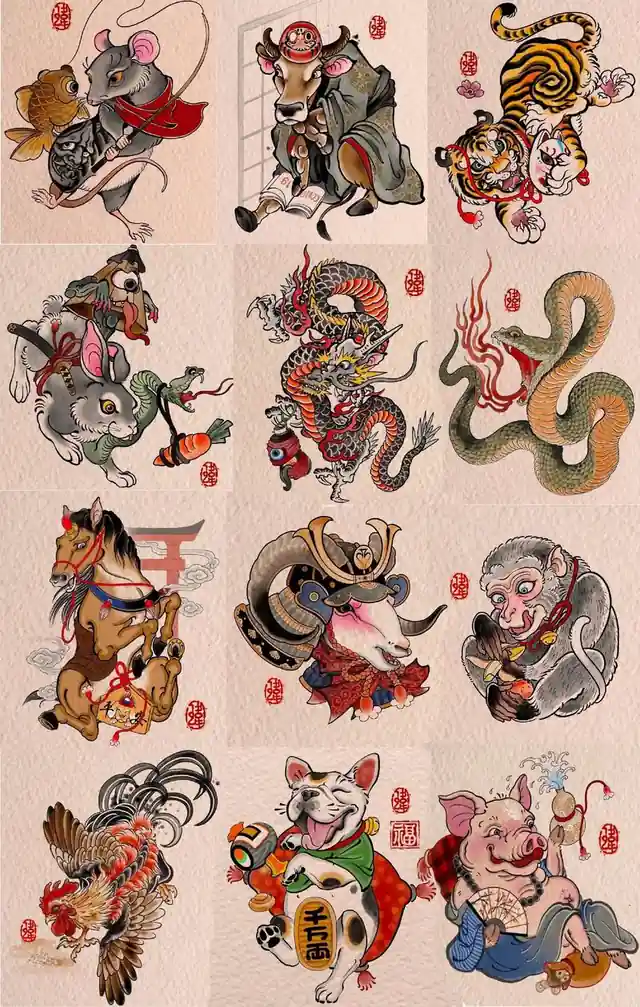
In ancient times, to meet certain needs, people integrated the zodiac culture into Daoist culture. The two mutually absorbed and influenced each other, which not only enriched the content of Daoism to a certain extent but also greatly enhanced the mystical overtones and cultural depth of the zodiac tradition.
Taoism is a religion native to China, and precisely because of this, the culture of the Chinese zodiac has been able to integrate seamlessly with it. Traces of zodiac culture can be found everywhere within Taoism.
The Twelve Zodiac Bronze Sheep (a bronze sculpture representing the zodiac sign of the Goat in the Chinese zodiac system).
Inside the Sanqing Hall (Hall of the Three Pure Ones) at the Qingyang Palace (Green Goat Palace) in Chengdu, there are two bronze goats. One of them, with a single horn, is the famous Twelve Zodiac Bronze Goat. Legend has it that this bronze goat originally belonged to Jia Sidao, a chancellor of the Southern Song Dynasty (1127-1279). After several transfers, it was eventually moved to the Qingyang Palace. The base of the bronze goat bears an inscription: "A bronze goat obtained from the capital market, moved to the ancient Daoist temple in Chengdu. At the pass, Yin Xi seemed to recognize it, and searching for it in Huayang brought endless joy." Because this bronze goat incorporates parts from each of the twelve zodiac animals — specifically, the ears of a Rat, the nose of an Ox, the claws of a Tiger, the back of a Rabbit, the horns of a Dragon, the tail of a Snake, the mouth of a Horse, the beard of a Goat, the neck of a Monkey, the eyes of a Rooster, the belly of a Dog, and the rump of a Pig — it is called the "Twelve Zodiac Bronze Goat." It is said that if a person feels pain in a certain part of their body, simply touching the corresponding part on the bronze goat will bring relief. Of course, this is merely a later superstition. However, since ancient times, there have been sayings that the camel embodies all twelve zodiac signs and the elephant's entire body contains the flesh of the twelve zodiac animals. The bronze goat at the Qingyang Palace, which also combines all twelve zodiac features, reflects the influence of zodiac culture on Daoist culture and demonstrates the inclusive nature of Daoist culture.
The Twenty-Eight Mansions Deities
The Yuan Dynasty (1271-1368) polychrome sculptures of the Twenty-Eight Lunar Mansions (Ershiba Xiu) preserved in the Jade Emperor Temple (Yuhuang Miao) in Jincheng, Shanxi Province, are considered treasures of ancient Taoist statuary. Among these sculptures of the Lunar Mansion Deities, there are: Xuri Shu (Void Sun Rat), with a rat nestled in its arm; Shihuo Zhu (Chamber Fire Pig), feeding a pig; Fangri Tu (House Sun Rabbit), releasing a rabbit; Zuihuo Hou (Beak Fire Monkey), taming a monkey; Maoji Ji (Pleiades Sun Rooster), with a fighting rooster; Weihuo Hu (Tail Fire Tiger), subduing a tiger; and Niujin Niu (Ox Metal Ox), leading an ox. Each Lunar Mansion Deity has a distinct expression: Wei Yue Yan (Danger Moon Swallow), holding a crescent moon and a flying swallow in one hand, appears refined and contemplative; while Yi Huo She (Wing Fire Snake) is fierce and bold, clutching a long snake with bare chest and glaring eyes.
Taoism clearly adopted the format of the twelve zodiac animals and then developed and refined it, eventually forming the twenty-eight lunar mansions deities. Ye Ziqi's early Ming Dynasty work "Caomu Zi" (Master of Plants and Trees) also contains this explanation: "Furthermore, based on the twelve zodiac animals, creatures of similar categories were divided into yin and yang, matched to form twenty-eight constellations. For example, the Tiger is paired with the Leopard. Each of the twelve two-hour periods has two creatures, while the four cardinal periods have three creatures."
The Sixty-Year Cycle Tai Sui (Grand Duke Jupiter).
The number "sixty" is derived from the combination of the twelve Earthly Branches, the ten Heavenly Stems, and the twelve zodiac animals, which in Taoism gives rise to the concept of the Sixty-Year Cycle Tai Sui (Grand Duke Jupiter). Each year in the sixty-year cycle is associated with a specific constellation deity, resulting in sixty stellar gods. Among the depictions of these sixty deities, fifteen of them—exactly one-quarter—feature zodiac animal motifs. The most common form of representation is headdress ornamentation. For example: Ding Mao wears a white rabbit headdress; Xin Wei wears a white goat headdress; Gui Wei wears a black goat headdress; Ding Hai wears a pig headdress; Ji Chou wears a black ox headdress; Yi Wei wears a white goat headdress; Ding You wears a red-crested rooster headdress; Ji Hai wears a black pig headdress with large ears; Yue Wu wears a white horse headdress; Ren Yin wears a tiger headdress, with a small tiger beneath its knee. Additionally, Wu Chen holds a dragon with both hands, Ren Chen holds a green water dragon with both hands, and Gui Si holds a snake in its hand, representing one type of depiction. Wu Wu has a horse head on its chest, representing another type.
In addition, elements derived from the twelve zodiac animals can be found in Taoist incense burners, the Eight Trigrams (Bagua), and temple halls, though the zodiac culture here has been heavily imbued with Taoist overtones. For this reason, we should distinguish between zodiac culture within Taoism and zodiac culture within folk customs, and should not conflate the two.
Further Reading
The Taoist concept of "the Ding of the Six Ding and the Jia of the Six Jia" theory.
We know that the Twelve Earthly Branches are paired with zodiac signs to form the Chinese zodiac, and the Twelve Earthly Branches are paired with the Ten Heavenly Stems to create a sexagenary cycle numbering system, from which the Sixty-Year Cycle Deities (Liushi Jiazi Shen) are derived. Beyond this, ancient scholars also conceived another combination, the Daoist Six Ding and Six Jia Deities (Liuding Liujia Shen). The Six Ding are Dingmao, Dingchou, Dinghai, Dingyou, Dingwei, and Dingsi, while the Six Jia are Jiazi, Jiaxu, Jiashen, Jiawu, Jiachen, and Jiayin. The Six Ding and Six Jia Deities are guardian spirits in Daoism. Among the Ten Heavenly Stems (Jia, Yi, Bing, Ding, etc.), Jia occupies an odd-numbered position and belongs to Yang, while Ding occupies an even-numbered position and belongs to Yin. In the sixty-year cycle, the Earthly Branches paired with Jia are all in odd-numbered and Yang positions, while those paired with Ding are all in even-numbered and Yin positions. Therefore, the Six Ding are described as female deities. The Southern Song Dynasty poet Lu You also wrote in his "Laoxue'an Notes" (Laoxue'an Biji): "In the Hall of Zhenwu at Zifu Temple in Fuzhou, statues of the Six Ding and Six Jia Deities are enshrined, with the Six Ding all depicted as female figures." These are clearly an extension and transcendence of zodiac culture.