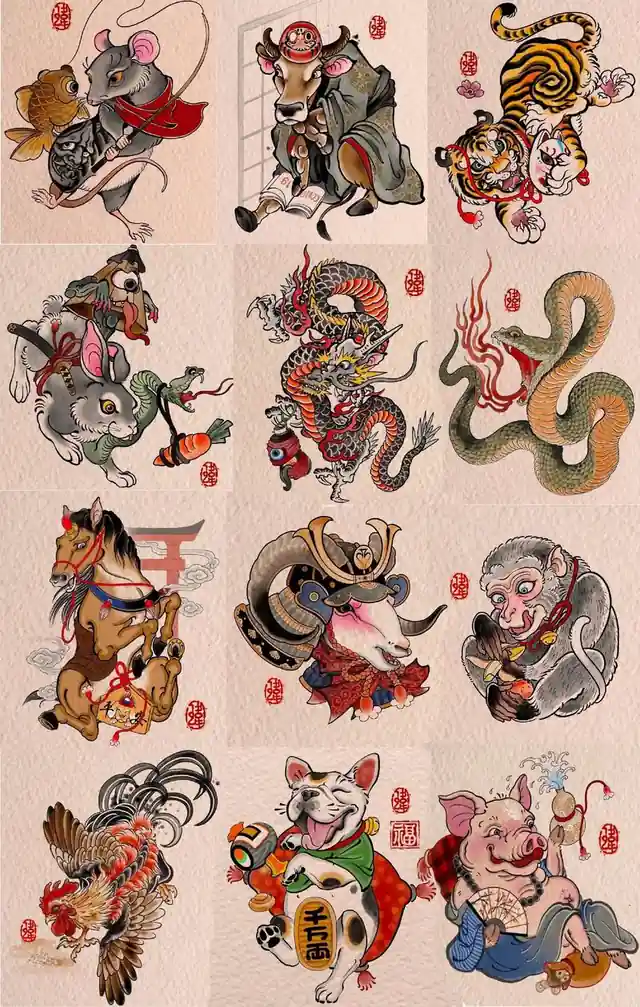
Throughout history, some people have linked the zodiac signs with human destiny to mystify them. The zodiac is merely a form of folk culture, and a person's fate cannot be determined by their zodiac sign.
In the Five Elements (Wu Xing) system, each of the twelve zodiac animals is associated with five different elemental types: for the Ox, there are Metal Ox, Wood Ox, Water Ox, Fire Ox, and Earth Ox. Over the sixty-year sexagenary cycle (Hua Jia), each zodiac animal is described with five distinct variations: for the Tiger, the year Wuyin corresponds to the "Mountain-ascending Tiger," Bingyin to the "Forest-dwelling Tiger," Gengyin to the "Mountain-emerging Tiger," Renyin to the "Forest-crossing Tiger," and Jiayin to the "Standing-still Tiger." Within the twelve months of a year, each zodiac animal is assigned twelve different interpretations; and across the twelve two-hour periods of a day, each zodiac animal is further adorned with twelve distinct nuances.
With so many variations, the destinies represented by each are vastly different. As a result, many people wonder: the Tiger king is majestic, the proud Dragon has its flaws, the mischievous Monkey is clever... Is it better to be born in the Year of the Tiger or the Year of the Dragon? A Golden Rat has boundless prospects, a Wood Rat is independent and self-respecting, a Fire Rat is shrewd and capable, and an Earth Rat is content with happiness—so is a Golden Rat better, or a Wood Rat? Thus, fortune-telling based on the Chinese zodiac naturally emerged.
During the Tang Dynasty, Li Xuzhong left behind a work titled "Ming Shu (Book of Destiny)," which used the Heavenly Stems and Earthly Branches of the year, month, and day to calculate a person's fate. In the late Five Dynasties and early Song Dynasty, Xu Ziping expanded this method by adding the stems and branches of the hour to the year, month, and day, creating what is known as the "Four Pillars" (Sizhu). Since these methods are all related to the Ganzhi system, the zodiac sign was inevitably drawn into the practice. In the Dunhuang Library Cave, a manuscript titled "Tui Shi Er Shi Ren Ming Xiang Shu Fa (Method for Calculating the Destiny of the Twelve Hours' Birth Animals)" was discovered, preserving valuable materials for studying ancient zodiac fortune-telling: "For those born in the Zi hour, the Rat is their zodiac, and their destiny belongs to the Black Emperor of the North. On Zi days: Three shi (a unit of volume) and fifty-one dai (a unit of time) of mulberry. It is appropriate to wear black clothing, and if ill, take black medicine. Great calamity strikes in Zi and Wu years, minor calamity in the fifth and eleventh months; one must not attend funerals or inquire about illness, and it is not suitable to share finances with those born in Wu years. For those born in the Chou hour, the Ox is their zodiac, and their destiny belongs to the Yellow Emperor of the Center. On Chou days: Three shi and seventy-one dai of millet. It is appropriate to wear yellow clothing, and if ill, take yellow medicine. Great calamity strikes in Chou and Wei years, minor calamity in the sixth and twelfth months; one must not attend funerals or inquire about illness, and it is not suitable to share finances or dealings with those born in Chou or Wei years throughout life..." The text not only pairs the Earthly Branches with zodiac animals but also introduces concepts from the Five Elements theory, such as the Five Emperors, Five Directions, and Five Colors, and even clothing and medicine must follow the "destiny attribution." In this "Tui Shi Er Shi Ren Ming Xiang Shu Fa," each of the twelve zodiac animals has its own entry, and fortune-tellers only needed to memorize these to handle seekers of fate.
In fact, the deceptive nature of fortune-telling using the Chinese zodiac lies in its reliance on countless tricks and pretentious methods to create an air of mystery. No matter how the calculations or interpretations are done, it all comes down to ambiguous explanations. For these specious interpretations, those well-versed in fortune-telling can twist the meaning to suit any situation. Xu Ke's Qingbai Leichao (Classified Anecdotes of the Qing Dynasty) includes such a case: "Zheng Mingxian of Chun'an practiced the Six Ren divination method, but he often made errors and was far inferior to his fellow villager Fang Shiqing. However, his 'Water Immortal' technique was quite remarkable. In this method, when someone came to inquire about doubts, they would list their questions item by item, write them on yellow paper as a petition, and seal it themselves. Zheng Mingxian would then press his seal over the seal, write a talisman, and burn it. He would prepare a basin of clean water, cover it with cloth, sit upright, and mumble incantations. After a while, characters would appear faintly on the water's surface, answering all questions without fail, often in rhymed verses. Zheng Mingxian would recite them and give the answer to the person, or sometimes a bystander would write them down. However, only Zheng Mingxian could see the characters on the water; others could not discern them. These predictions often proved accurate later. In the Guimao year of the Yongzheng reign (1723), Fang Yaofang was determined to take the three-level imperial examination. He consulted the Water Immortal, which gave him thirteen characters: 'The Rabbit will run, and the Dragon will also fly; between seven and nine, the number will not deviate.' Fang Yaofang was overjoyed, thinking that the year was the Mao year of the Rabbit. At that time, the Yongzheng Emperor had just changed the reign title, so it was called the 'Flying Dragon.' The Chen year (Dragon) was also an auspicious omen, and since Fang Yaofang was born in the Bingchen year (Dragon), he believed that 'the fleeing Rabbit cannot escape, and the flying Dragon is in the heavens; a thousand miles will not hinder his progress.' Yet, unexpectedly, he suddenly fell ill and could not recover, passing away on the sixteenth day of the eighth month. Someone later interpreted the verse as: 'Running and flying means he will not stay here long. The number between seven and nine is eight, indicating the month of his death. Adding seven and nine gives sixteen, which also reveals the day of his death, so it is said that the number will not deviate.'" The same oracle thus received completely different interpretations: "Running and flying means he will not stay here long." This is precisely the brilliance of fortune-tellers: a few ambiguous words can be interpreted in any direction, leaving it to the imagination of the listener.
Claims about fortune-telling based on one's zodiac sign and using the Chinese zodiac to predict fate are no more than man-made deceptions and lies, used to delude those who blindly believe in zodiac-determined destinies and to fool the ignorant masses. These are the true dregs of zodiac culture, which we should discard.
Further Reading
The zodiac fate theory in Jin Ping Mei (The Plum in the Scroll).
In the Ming Dynasty novel "Jin Ping Mei" (The Plum in the Golden Vase), Chapter 62, titled "Taoist Pan Summons the Yellow Turban Spirits, Ximen Qing Laments Over Li Ping'er," the story describes the death of Ximen Qing's concubine Li Ping'er and the fortune-teller's performance: "Master Xu opened his yin-yang esoteric book and examined it, saying: 'The deceased passed away on a bingzi day, at the chou hour of the earth. This corresponds to the Aquarius Palace above and the Qi region below. In her previous life, she was a man in the Wang family of Binzhou, who killed a pregnant ewe. In this life, she is reborn as a woman under the zodiac sign of the Goat. Although she attracts a noble husband, she often suffers from illnesses...'" According to this fortune-teller's claim, one's zodiac sign not only determines their fate in this life but also connects to past lives and future incarnations, which is utterly absurd. Zhang Zhupo commented after the line "killed a pregnant ewe, now reborn as a woman under the Goat sign": "This is ridiculous to the extreme. If this were true, then every person born under any of the twelve zodiac animals must have killed a corresponding animal in a past life. This truly exposes the foolishness of such beliefs."