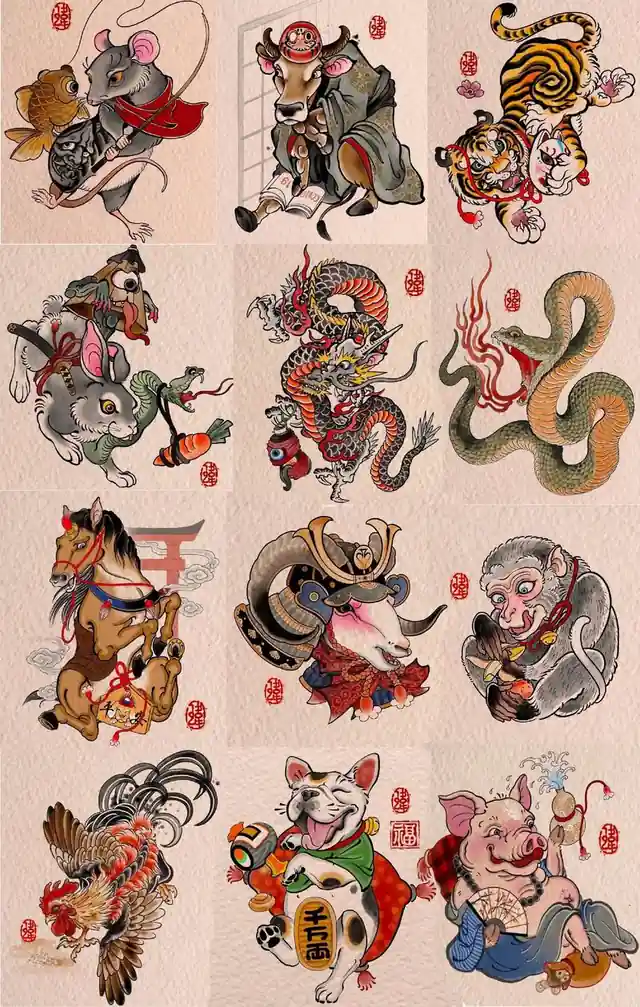
The ancient Chinese believed that there was a connection between the zodiac animals and the occurrence of droughts, floods, and agricultural harvests, with the zodiac even playing a decisive role in these matters. Therefore, it is necessary to explore this phenomenon within zodiac culture, as it has deep historical roots.
The ancients discovered that the twelve zodiac animals could reflect the quality of the year corresponding to each zodiac sign. As the proverb says, "In the years of the Ox and Horse, the fields are easy to plow," and "In the year of the Fat Pig, one eats well," meaning that the years of the Ox, Horse, and Pig are often good years with favorable weather for harvests. Conversely, "In the years of the Rooster and Dog, one must beg for food," and "In the year of the Fierce Tiger, disasters come one after another," indicating that the years of the Rooster, Dog, and Tiger are often poor harvest years with abnormal climate conditions. In ancient times, it was very common to interpret the quality of a year based on the zodiac.
"Years of the Ox and Horse are good for farming."
A farming proverb says: "In the Year of the Ox and the Year of the Horse, the fields are good for planting." Why are they considered "good for planting"? It is likely not only because the Ox, which pulls the plow, and the Horse, which pulls the cart, are zodiac animals, thus evoking associations with smooth agricultural work. This is a meteorological proverb, a summary of weather experience by the ancients. Generally speaking, drought and flood years occur alternately, and between droughts and floods, there are naturally also years with favorable weather and good harvests. The Year of the Ox and the Year of the Horse are separated by four years. If the Year of the Ox has no drought or flood, after several years of wind and rain, the Year of the Horse may again be a disaster-free bumper harvest year. Modern meteorological research has found that every five to eight years, one or two major natural disasters may occur, severely affecting people's lives, which coincidentally aligns with this understanding based on the twelve zodiac animals. Of course, this statement is too absolute. Examining thousands of years of Chinese history, examples of poor harvests in the Year of the Ox or the Year of the Horse are not uncommon. The workings of heaven have their constancy, and the natural cycles of clear skies, clouds, rain, and snow cannot be fully summarized by just a few farming proverbs.
The ancient Kyrgyz people, in their book "Kyrgyz Customs and Habits," also provided a relatively comprehensive introduction to rainfall and harvest conditions for different zodiac years: "Fish are aquatic creatures, so in Fish years there is abundant rainfall, grains and pastures grow well, and it is a bountiful harvest year; Tiger years tend to be cold, with even half of the water in large rivers freezing; Rat years are often drought years..." To this day, Kyrgyz people still arrange their lives and production based on the characteristics of different years to ensure preparedness and avoid misfortune.
"Ji Long Zhi Shui" (How Many Dragons Govern the Waters)
Most traditional Chinese almanacs (huangli) usually printed the twelve zodiac animal illustrations, along with phrases such as "how many oxen plow the fields," "how many dragons control the waters," "how many people share the fire (bing)," and "how many days obtain the metal (xin)." The first chou day (Ox day) occurring in the first lunar month determines the number of oxen plowing: if it falls on the third day, it is "three oxen plowing." Similarly, the first chen day (Dragon day) determines the number of dragons controlling the waters; "sharing bing" and "obtaining xin" follow the same pattern, except that these heavenly stems have no associated zodiac animal, so they are referred to directly as bing and xin.
So, how many dragons governing water would indicate a good year? According to old legends, the more dragons governing water, the less rainfall there would be, and the fewer dragons, the greater the rainfall. The Song Dynasty (960-1279) text "Jilei Bian (Chicken Rib Notes)" states: "The number of dragons governing water in the calendar is determined by the first Chen (Earthly Branch) day after New Year's Day. If Yin and Mao (Earthly Branches) fall on the sixth day, it is an omen of a bountiful harvest." According to this, Yin and Mao on the sixth day signal a good harvest, meaning that the Chen day would fall on the eighth or seventh day, which is equivalent to saying that "eight dragons governing water" or "seven dragons governing water" indicates a year with moderate rainfall.
There is another saying that if more than eleven dragons are in charge of water management in a given year, floods will occur. Yu Yue, a scholar from the Qing Dynasty (1644-1912), wrote in his poem "Four Chapters in Yuefu Style Recording the Great Floods of Jiangsu and Zhejiang: Lament for the Water Disaster": "Heaven's Lord, in his fury, would not allow this, yet he actually left eleven dragons to govern the waters. The Rain Master, ignoring the taboo days, caused boats to sail into the market. Have you not seen, stretching seven thousand li to the southeast, fields and homes all turned into filthy canals? Have you not seen the Yellow River's waters descending from the heavens, in a rage wanting to flood the Huai and Xu rivers? Alas, alas, the people have become fish!" Yu Yue vividly depicted a scene of rampant floods and a vast inland sea, attributing the disaster to the fact that "the first month's eleventh day coincided with the Chen (Dragon) day, making it a year of eleven dragons governing the waters, which portends floods."
In fact, how could the position of the first Dragon Day at the beginning of a new year determine whether the year would be dry or flooded?
Further Reading
The relationship between the Chinese zodiac and annual fortunes as studied through statistics.
In the book "Research on Long-Term Climate Prediction in Jilin Province's Agriculture" written by Pan Tiefu, a meteorological expert from the Jilin Academy of Agricultural Sciences, there is a section titled "Earthly Branches (Zodiac Signs) and Climate." Through a statistical analysis of temperature and precipitation in the Changchun area over 74 years, the author concluded: "Overall, among different Earthly Branch (zodiac) years, the years of Wei (Goat), Yin (Tiger), and Mao (Rabbit) are the best; years of Chen (Dragon) and Shen (Monkey) have less rainfall, which benefits the central and eastern regions but is unfavorable for the west; years of Chou (Ox) and Wu (Horse) have more rainfall, benefiting the west but causing a higher risk of waterlogging in the central and eastern regions; years of Xu (Dog) and Si (Snake) have moderate climatic conditions; years of You (Rooster), Hai (Pig), and Zi (Rat) have poor climatic conditions."
This is an application of statistical methods to analyze the probability of agricultural meteorological disasters, raising the issue of the relationship between zodiac years and climate. Of course, the conclusions drawn are both similar to and different from the agricultural proverb "Ox and Horse years are good for farming," which is not surprising. Given the vast size of China, a single year often brings bumper harvests in some regions and poor yields in others, with drought in some areas and floods in others. This cannot be captured by just one or two weather proverbs. Instead, we should approach both the rationality and irrationality of such sayings with a scientific attitude, so as to better serve agricultural development.