
Li Guang's ancestor was Li Xin, a great general of the Qin Dynasty, and the Li family served in the military for generations, achieving illustrious military merits for the state.
In 166 BCE, during the fourteenth year of Emperor Wen of Han's reign, Li Guang enlisted in the army and joined a large expedition to attack the Xiongnu. He was exceptionally skilled with a bow and arrow, hitting his target nearly every time, and in numerous battles he killed many enemies and captured many prisoners. When Emperor Wen learned of his heroic deeds, he joyfully appointed Li Guang as a Gentleman of the Palace, serving directly by the emperor's side. Whenever there were activities like horseback riding or hunting, Emperor Wen would have Li Guang display his talents before the crowd. Li Guang showed no fear, and his superb archery earned praise from all the officials. Emperor Wen once said to Li Guang with regret, "What a pity you were not born in the era of Emperor Gaozu; otherwise, with your skills, you would surely have become a Marquis of ten thousand households!" Knowing the emperor held him in such high regard, Li Guang vowed in his heart to repay his country with loyal service.
During the reign of Emperor Jing of Han, Li Guang was given important positions, first being appointed as the Commandant of Longxi and later promoted to General of the Cavalry. When the seven feudal states rebelled, Li Guang followed Zhou Yafu and achieved many military merits, but unfortunately Emperor Jing blamed him for privately accepting the seal of a general from the King of Liang, so after defeating the rebellious princes, Li Guang received no rewards.
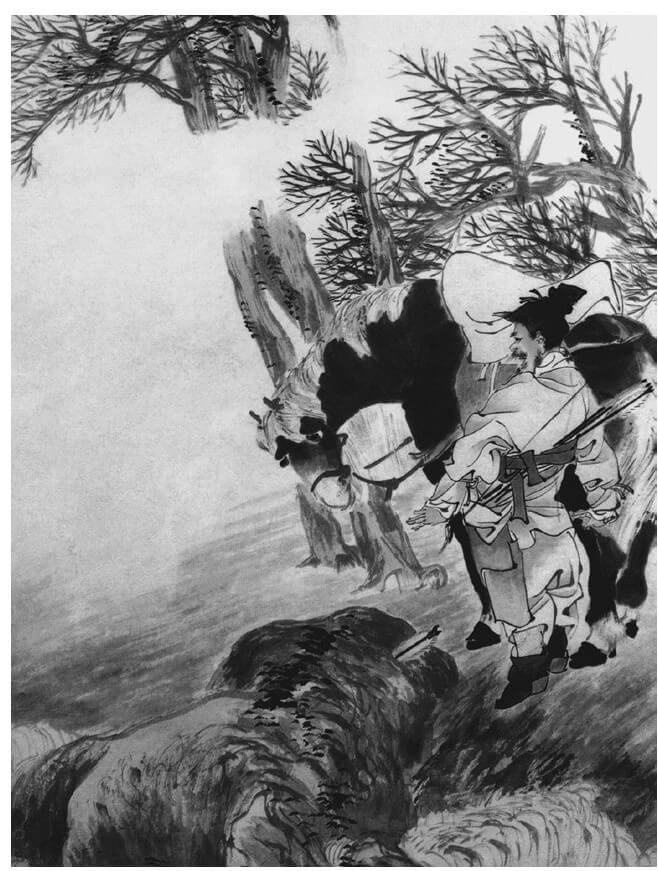
Not long after, Li Guang was appointed as the governor of Shanggu, stationed at the border, always keeping a close watch on the movements of the Xiongnu. When the Xiongnu heard that the general guarding the pass was Li Guang, they were all thrown into panic. It turned out that even the Xiongnu knew Li Guang was an expert archer and a fierce warrior. With him guarding the border, who would dare to overestimate their own strength? It was said that once, while hunting, Li Guang mistook a large rock for a tiger and shot an arrow at it with a "swish," piercing so deeply into the stone that it left a deep hole. Because of this, the Xiongnu called him the "Flying General."
Shang Commandery was a small border outpost frequently harassed by the Xiongnu, so Emperor Jing sent his favored eunuch to garrison there alongside Li Guang, where they drilled troops in archery daily to defend against Xiongnu incursions. One day, the eunuch led several dozen soldiers on a hunting expedition and encountered three Xiongnu warriors on the road. Seeing their enemies before them, both the Han troops and the Xiongnu drew their bows and began shooting. The Xiongnu were far superior archers to the eunuch, and within a short time, dozens of Han soldiers lay dead under a hail of Xiongnu arrows, while the eunuch himself was severely wounded and barely managed to escape back to camp. After hearing the eunuch's report, Li Guang immediately realized those three were elite marksmen among the Xiongnu forces. Without hesitation, he led a hundred cavalrymen charging out of the camp, vowing to capture the sharpshooters.
After galloping for some distance, Li Guang spotted three figures moving in the distance ahead. He ordered his soldiers to flank them from both sides. After a fierce skirmish, two Xiongnu soldiers were shot dead, and one was captured alive by Li Guang. Just as Li Guang and his men were preparing to return, a large force of Xiongnu soldiers suddenly appeared ahead. The Han soldiers were terrified and didn't know what to do. The Xiongnu, upon seeing the Han troops, also appeared greatly surprised and immediately assumed an attack formation, staring intently at Li Guang. The Han soldiers wanted to flee back to camp, but Li Guang said, "We are too far from our camp now. If we try to run back, the Xiongnu will surely catch us. If we stay here, they will instead think we are deliberately luring them, suspecting an ambush behind us, and won't dare to pursue us recklessly." After hearing Li Guang's explanation, the soldiers felt somewhat reassured. Following Li Guang's orders, they continued moving forward until they were very close to the Xiongnu, then stopped, removed their saddles, and sat down cross-legged to rest. Seeing the Han troops so composed, the Xiongnu truly believed these men were there to deceive them and did not dare to provoke an attack. After a while, a Xiongnu soldier riding a white horse appeared, seemingly an officer. Li Guang quickly led a few soldiers on horseback to charge forward, shot the officer with an arrow, then returned to the group and dismounted to rest. The Xiongnu clearly hadn't expected the Han troops to launch a sudden assault. As night gradually fell, the Han soldiers all lay down on the ground and began to sleep, which made the Xiongnu even more convinced of an ambush, and they soon withdrew. Thanks to Li Guang's quick thinking, everyone was able to return safely to camp. However, as a general, Li Guang had led his troops to pursue the Xiongnu without informing anyone of his whereabouts—if something had gone wrong, the consequences would have been unimaginable.
After Emperor Wu of Han ascended the throne, he recognized Li Guang as a rare military talent and appointed him as the Commandant of the Weiyang Palace. At that time, Li Guang's good friend Cheng Bushi also served as a Commandant in the palace. Cheng Bushi imposed many strict regulations on his troops, maintaining rigorous military discipline, while Li Guang was easygoing and did not overly restrict his soldiers with strict rules. Everyone preferred to fight alongside Li Guang, finding Cheng Bushi too harsh.
In 133 BC, Emperor Wu of the Han Dynasty set an ambush at Mayi to prevent the Xiongnu from raiding south, aiming to capture their leader, Chanyu Junchen alive. Li Guang was appointed as General of Agile Cavalry and stationed outside Mayi city. However, to the Han army's surprise, Chanyu Junchen learned of Emperor Wu's plan and did not appear at Mayi, forcing the Han forces to return without any success.
In 129 BC, the Xiongnu invaded southward again, with their advance forces reaching Shanggu (present-day Huailai, Hebei). Four generals—Gongsun He, Gongsun Ao, Wei Qing, and Li Guang—each led ten thousand cavalry to confront them. Wei Qing killed 700 Xiongnu soldiers at Longcheng (a site where the Xiongnu worshipped their ancestors), while Li Guang was surrounded by a large Xiongnu force. As his soldiers fell from their horses one by one, Li Guang fought fiercely despite mounting injuries, but the Xiongnu troops grew ever more numerous, and he was eventually captured alive. The Chanyu Junchen had specifically ordered that if Li Guang were captured, he must be brought back alive. So the Xiongnu hung a net made of ropes between two horses, laying Li Guang on it. Feigning near death, Li Guang made the Xiongnu lower their guard. When a Xiongnu soldier came close, Li Guang suddenly leaped onto the soldier's horse, pushed him off, slapped the horse's rump hard, and galloped toward the Han camp. The Xiongnu pursued closely, but Li Guang turned and fired arrows backward, each striking a Xiongnu soldier, causing many casualties and gradually widening the gap until he finally reached the Han camp. Although Li Guang's archery was admirable, his army was nearly annihilated in the battle, and he himself had been captured. Emperor Wu of Han sentenced him to death by beheading, but later, considering Li Guang's past outstanding achievements, commuted the sentence to demotion to commoner status.
In 119 BCE, the Grand General Wei Qing and the Agile Cavalry General Huo Qubing led a northern campaign against the Xiongnu. Li Guang, though very old at the time, persistently requested to join the expedition. Emperor Wu of Han could not bear to refuse him, so he appointed Li Guang as the Forward General to follow Wei Qing. During one battle, Wei Qing ordered Li Guang to lead his troops at the rear, ready to rush forward and reinforce if the front line became critical. Unexpectedly, Li Guang lost his way in the desert, and by the time he reunited with Wei Qing, the battle was already over. Wei Qing was furious and blamed Li Guang for delaying the military schedule. With tears streaming down his aged face, Li Guang said, "I am over sixty years old and have fought no fewer than seventy battles against the Xiongnu. I had hoped to contribute to the country in my old age, but instead, I made a mistake—truly, fate plays tricks on us!" With that, he drew his sword and slashed at his own neck. Before the crowd could rush forward and seize the blade, Li Guang was already dead. When the generals and soldiers who had followed Li Guang for many years heard the news, they wept bitterly in grief.