
After Emperor Xuan of Han ascended the throne, the Xiongnu's raids southward decreased somewhat as internal chaos broke out among them. Several Xiongnu royal princes, unwilling to be controlled by others, declared themselves chanyu, resulting in five chanyu emerging at once. These five fought fiercely for the throne, and one of them, Chanyu Huhanye, sought to use the Han Dynasty as a backing to defeat the other chanyu, so he personally came to Chang'an to pay homage to Emperor Xuan. Emperor Xuan, delighted to learn of his intentions, not only sent two generals leading ten thousand troops to accompany him back but also bestowed a large amount of grain.
In 49 BC, Emperor Xuan of the Han Dynasty died of illness, and Emperor Yuan ascended the throne. Chanyu Huhanye defeated the other four chanyus, becoming the ruler of the Xiongnu, and maintained friendly relations with the Han Dynasty. In 33 BC, Chanyu Huhanye came to Chang'an again, clearly expressing his desire to form a marriage alliance with the Han Dynasty.
The policy of marriage alliances was first proposed during the reign of Emperor Gaozu of Han by a minister named Lou Jing. At that time, the Xiongnu showed no respect for the Han dynasty, and to stabilize relations between the two states, the Han had to show weakness. However, Emperor Gaozu had only one biological daughter, and Empress Lü was unwilling to let her marry into the desolate north, so the emperor selected a girl from the palace, bestowed upon her the title of princess, and sent her far away to marry the Xiongnu. This time, the situation was different: the Xiongnu's power had greatly declined, while the Han dynasty had grown significantly stronger. Faced with a marriage proposal from Chanyu Huhanye, Emperor Yuandi of Han decided to choose a palace maid to send to him.
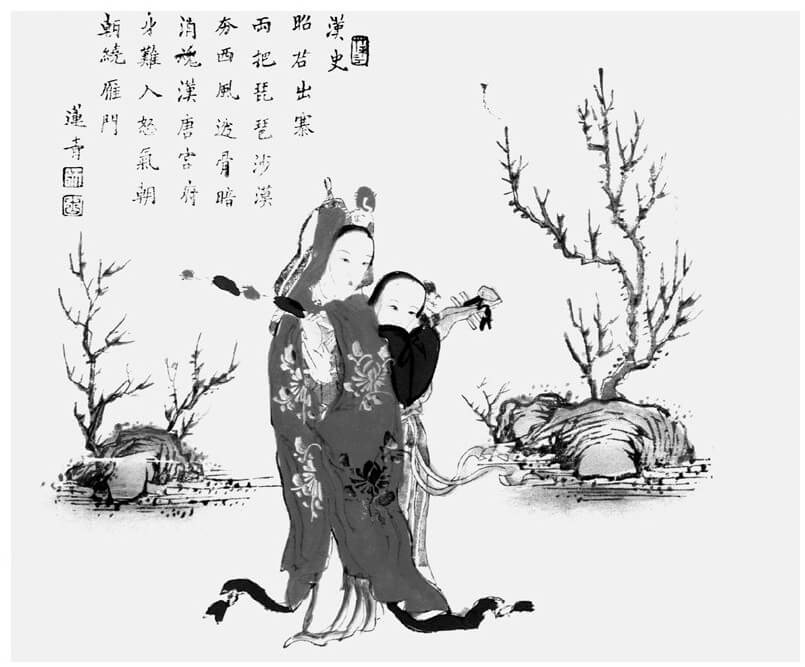
Emperor Yuan of Han sent someone to announce in the palace that the Xiongnu were seeking a bride, hoping someone would volunteer. The palace maids were naturally eager to leave, as entering the deep palace could mean being trapped there for life—even marrying an ordinary commoner was better than staying forever within the palace walls. However, when the maids learned that this time they would have to go to the desolate north and marry a Xiongnu, every one of them fell silent, unwilling to leave their homeland. Emperor Yuan grew anxious; if no one could be found to marry the Xiongnu, not only would the Han dynasty lose face, but Huhanye Chanyu would also be embarrassed, and the relationship between the two states might deteriorate once again.
At this moment, a palace maid volunteered to go to the Xiongnu, and Emperor Yuan of Han was overjoyed, quickly ordering her to be brought before him. This palace maid was named Wang Qiang, also known as Wang Zhaojun. When she was born, her father was already advanced in age, and the family cherished her deeply, raising her as if holding her in the palm of their hands. As Wang Zhaojun grew up, her beautiful appearance earned widespread admiration, and she was also skilled in music, chess, calligraphy, and painting. Word spread from person to person, reaching even the capital, where everyone knew of a girl named Wang Zhaojun, as beautiful as a celestial being, intelligent, and virtuous. In 36 BC, Emperor Yuan of Han ordered a nationwide selection of palace maidens, and it was at this time that Wang Zhaojun entered the palace. However, she did not immediately gain the emperor's favor upon entering. It is said that Emperor Yuan judged the maidens by viewing their portraits, and many of them secretly bribed the painter with money to make themselves look more beautiful in the paintings, but Wang Zhaojun did not do this. The painter, having accepted bribes from others, beautified each of them, but when painting Wang Zhaojun, he deliberately made her look ugly, so the emperor never discovered her beauty. Wang Zhaojun did not regret this. If the Xiongnu had not come to seek a marriage alliance, she might have lived quietly in the palace for her entire life. When Emperor Yuan was anxious about finding someone to send to the Xiongnu, Wang Zhaojun had already made up her mind. She knew that a marriage alliance with the Xiongnu held great significance for the Han Dynasty, and if no one else was willing to go, she would go herself.
Emperor Yuan of Han prepared a generous dowry for Wang Zhaojun, selected an auspicious day, and then informed Chanyu Huhanye that they would marry in a few days. Upon seeing Wang Zhaojun, Chanyu Huhanye was immediately captivated by her beauty, and after viewing the abundant dowry, he felt deep gratitude toward Emperor Yuan of Han from the bottom of his heart, vowing to maintain eternal goodwill with the Han Dynasty from then on.
Within a few days, Chanyu Huhanye set off back to Xiongnu with his new wife Wang Zhaojun, their procession grand and imposing. As the distant Chang'an grew smaller, a trace of sorrow welled up in Wang Zhaojun's heart. After a long journey of over a year, Wang Zhaojun finally arrived in the northern desert, where the Xiongnu people had already been eagerly awaiting her arrival. To thank Wang Zhaojun for her contributions to the Han Dynasty and the Xiongnu, Chanyu Huhanye specially bestowed upon her the title "Ninghu Yanzhi," meaning she brought peace to the Xiongnu.
After Wang Zhaojun married into the Xiongnu, relations between the Han Dynasty and the Xiongnu improved further, with the two nations living in harmony, continuous trade in border towns, and a scene of peace. Zhaojun and Chanyu Huhanye had a son, and after Huhanye's death, following Xiongnu customs, Zhaojun became the wife of the new Chanyu, later giving birth to two daughters. Zhaojun participated in Xiongnu politics, mediating relations between the Han Dynasty and the Xiongnu, and resolving crises.
After Wang Zhaojun departed for the frontier, Emperor Yuan of Han brought her brothers to Chang'an, granted them high official positions, and sent them as envoys to the Xiongnu to reunite with their sister; Zhaojun's two daughters also once traveled to Chang'an to serve the empress of Emperor Yuan. The story of Wang Zhaojun's marriage alliance has been passed down through the ages, and people admire her for leaving her homeland to contribute to the stability of her country, which brought a period of temporary peace between the Han and the Xiongnu, fostering unity between the two peoples.