Zhou Yafu was a renowned general and military strategist of the Western Han Dynasty, known for his unique methods in leading troops and waging war. His father was Zhou Bo, the Marquis of Jiang. After his father's death, the title was originally inherited by his elder brother, but when the brother was later executed for murder, Emperor Wen, who held great respect for Zhou Bo and did not wish to see his descendants left destitute, ordered that a virtuous and capable son of Zhou Bo be chosen to inherit the title. Thus, Zhou Yafu became the unanimous choice.
In 158 BCE, the northern territories of the Han Dynasty were fiercely attacked by the Xiongnu, so Emperor Wen appointed Liu Li, the Marquis of Zizi, and the He'nei Governor Zhou Yafu as generals, each leading troops stationed at different locations to form a solid defensive line against the Xiongnu invasion. Liu Li was stationed at Bashang, the Marquis of Zizi at Jimen, and Zhou Yafu at Xiliu (present-day northwest of Xianyang, Shaanxi). Additionally, a separate large force was dispatched to the front lines to engage the Xiongnu in battle.
News of repeated victories came from the front lines, greatly pleasing Emperor Wen of Han. He ordered the army to withdraw and return to court once the Xiongnu were driven beyond the borders. After arranging all matters, Emperor Wen decided to inspect the camps of the three defending armies.
Emperor Wen first arrived at Liu Li's military camp stationed in Ba Shang. Before even reaching the camp gate, he heard soldiers shouting loudly. Drawing closer, he saw each soldier dressed in simple cloth garments, running around the camp in a chaotic manner. When Emperor Wen's carriage reached the camp entrance, the guards, upon seeing the emperor's arrival, hastily opened the gates, bowed deeply, and welcomed the imperial convoy inside. Soldiers had already informed the general of the emperor's arrival, and the general, leading all his officers and men, stood in neat formation not far from the camp gate, waiting. Emperor Wen, seated in his carriage, ordered the convoy to circle the camp once before departing from the Ba Shang camp, escorted by the assembled generals.
Then Emperor Wen arrived at the camp stationed at Jimen, where the situation was much like that at Bashang—the soldiers appeared completely lacking in discipline and organization, idly scattered about the camp as if no war was happening at all.
When Emperor Wen arrived at Zhou Yafu's military camp, he first heard the soldiers' shouts during drills, orderly and resounding. It turned out that ever since Zhou Yafu had been stationed at Willow Creek, he urged his troops to train daily from morning to night without pause. He divided the soldiers into groups for combat exercises, rewarding the winners while the losers faced stricter training. Zhou Yafu also issued military orders: everyone in the camp must be fully armed, wearing armor and keeping their swords at hand at all times; anyone wishing to enter the camp must obtain the general's approval to prevent spies from infiltrating; all chariots and horses within the camp must move slowly, never galloping, to avoid injuries and chaos. Under Zhou Yafu's management, the camp was well-organized, with everyone assigned clear and specific duties.
The person in charge of driving the chariot announced to the guards at the gate of Zhou Yafu's military camp that the emperor was coming to inspect, but the soldiers sternly told the driver that without General Zhou's orders, no one could enter the camp. The driver was very annoyed and reported the matter to Emperor Wen, who felt that Zhou Yafu's approach was correct. So he personally wrote a letter and had the guard take it inside. After a while, the soldier returned and said the general had agreed, then opened the camp gate and instructed the driver not to drive the chariot too fast, because the general had ordered that all chariots and horses in the camp could only move slowly. Emperor Wen ordered the driver to comply, and the driver tightly held the reins, letting the chariot move slowly through the camp.
Emperor Wen's carriage arrived before the general's tent, where Zhou Yafu, fully armored, stood in front of the carriage and said, "There is a military order that armored soldiers need not perform the kneeling bow; please allow me to greet you with military etiquette." Deeply moved by this, Emperor Wen stepped out of the carriage, leaned on the wooden railing, and delivered an impassioned speech to Zhou Yafu, also expressing gratitude to the entire army. After speaking, the emperor re-entered the carriage, and the procession slowly made its way toward the camp gate.
On the way back to the palace, Emperor Wen couldn't contain his joy and said to his accompanying ministers, "You must have thought that Zhou Yafu's behavior would anger me, but in fact, this is the true spirit a general should have. If every general were like Zhou Yafu, the Han army would surely be even more unbreakable. The camps at Bishang and Jimen are truly disheartening to see—if the Xiongnu really attacked, how could we rely on them to fight for the state? Even the generals themselves might be captured. I have no worries at all about Zhou Yafu's camp." Upon hearing that Emperor Wen not only did not blame Zhou Yafu but also spoke many words of praise for him, the ministers felt relieved and their admiration for Zhou Yafu deepened.
A month later, the Xiongnu were completely driven back into the desert by the Han army, and the three garrison forces also withdrew to Chang'an. As soon as Zhou Yafu returned, Emperor Wen appointed him as the Commandant of the Capital, primarily responsible for the security of the capital. Emperor Wen held him in high regard and, on his deathbed, said to his son Liu Qi, who would later become Emperor Jing of Han: "Zhou Yafu is a rare military talent; you should make great use of him. If an emergency arises, be sure to entrust military command to Zhou Yafu."
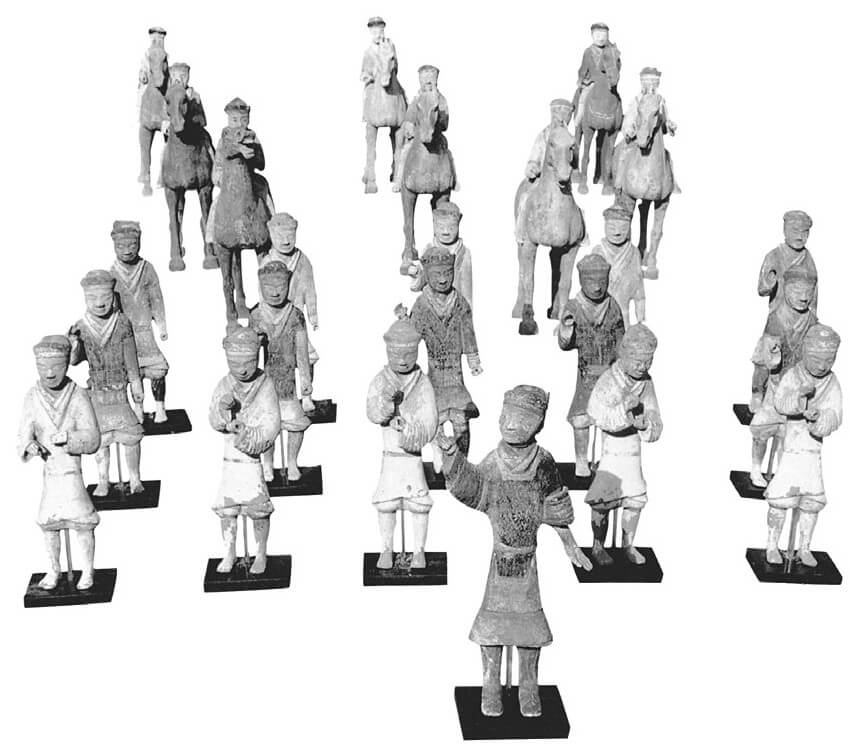
After Emperor Jing ascended the throne, he did not forget his father's instructions and appointed Zhou Yafu as General of Chariots and Cavalry; the subsequent Rebellion of the Seven Kingdoms further proved Zhou Yafu's excellent military leadership.