Duke Ai of Lu (reigned 494-468 BCE, died 468 BCE), with the clan name Ji and personal name Jiang, was the twenty-sixth ruler of the State of Lu. He was the son of Duke Ding of Lu and reigned for twenty-seven years.
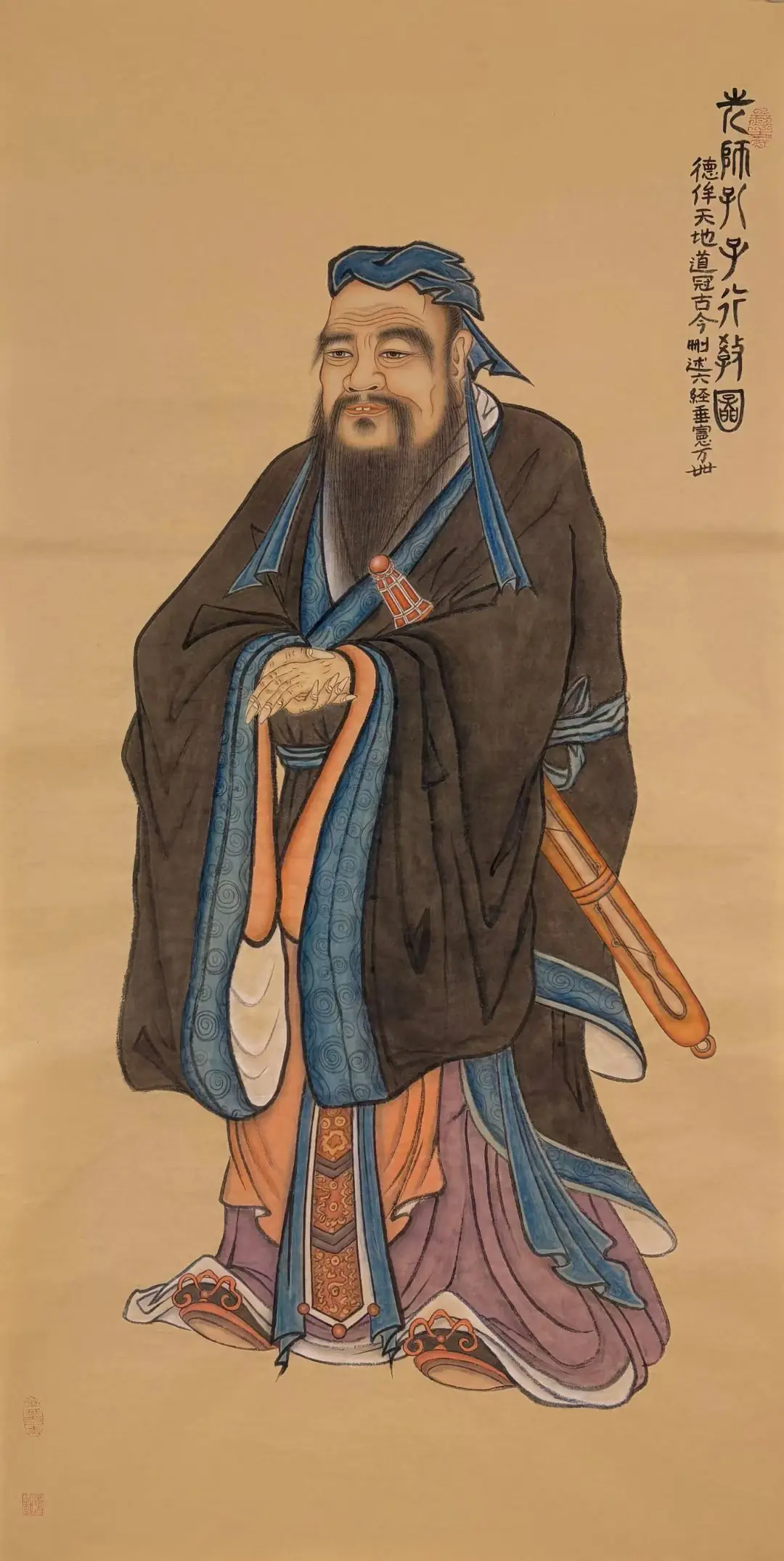
In his later years, Confucius returned to the State of Lu, where Duke Ai of Lu honored him as a "National Elder" and frequently sought his advice. Once, as Confucius sat beside Duke Ai, the Duke asked, "May I ask what is most important in the methods of governing the people?" Confucius's expression became serious as he replied, "For the ruler to raise such a question is truly the people's blessing! I dare not decline to answer; among methods of governing the people, governance itself is the most important." Duke Ai asked, "May I ask what is meant by governance (Zheng)?" Confucius replied, "Zheng means uprightness (Zheng). If the ruler acts uprightly in governance, then the people will obey. The ruler's actions are what the people imitate. If the ruler does not do something, how can the people imitate it?" This means that the ruler is like the upper beam; to govern others, he must first be upright himself—acting correctly, walking straight, and always minding his image, otherwise it is difficult for those governed to obey. Next, his deeds must be upright, both aboveboard and in accord with reason and fairness. His words and actions will naturally influence his ministers and even the common people. However, Duke Ai ultimately could not employ Confucius in a significant role. In 479 BCE, when Confucius passed away, Duke Ai personally attended his funeral and composed an elegy, saying, "Heaven has not shown mercy, not leaving behind this one elder, to shield me, a solitary one, in my position; forlorn and in sorrow, alas! O Father Ni, I have no model to follow." Zi Gong (a prominent disciple of Confucius) commented, "When he was alive, you could not employ him; now that he is dead, you eulogize him—this is not in accordance with Li (Propriety). Referring to yourself as 'the solitary one' is not fitting for your name."
During the reign of Duke Ai of Lu, he failed to properly appoint worthy individuals. There was a man named Tian Rao, who was highly talented and had served under Duke Ai for many years, yet Duke Ai did not give him an important position. One day, Tian Rao said to Duke Ai: "I am going to leave you and fly far away, like a swan." Duke Ai asked: "What do you mean by this?" Tian Rao replied: "Has Your Majesty never seen a rooster? It wears a red comb on its head, appearing very refined; it has sharp claws on its feet, looking especially martial. Facing an enemy, it dares to fight—this is a display of courage; seeing food, it calls its companions to share—this is a display of virtue; keeping watch and crowing at dawn, never missing the time—this is a display of trustworthiness (Xin). Although the rooster possesses these five merits, Your Majesty still orders your attendants to cook and eat it. Why is this? It is because it is close at hand. As for the swan, it flies a thousand li (about 500 km) at a time. Sometimes it stops in Your Majesty's pond to eat your fish and turtles; sometimes it stops in Your Majesty's fields to peck your beans and grains. Although it lacks the rooster's merits, Your Majesty still values it greatly. This is because it comes from afar. Please allow me to fly far away like a swan!" Duke Ai said: "Stay! I will record your words." Tian Rao said: "If you have capable people but do not employ them, what use is writing down their words?" With that, he left the State of Lu and went to the State of Yan. Yan appointed Tian Rao as its prime minister. After three years, Yan's national strength greatly increased, and the state was peaceful and prosperous. When Duke Ai of Lu heard this news, he could only sigh in vain. This story shows that Duke Ai of Lu could not promptly recognize the talent around him, and even after recognizing it, he lacked a proactive attitude. He had neither the insight to identify talent nor the trust to rely on it. When Tian Rao resigned, the duke appeared calm, but only felt regret three years later upon hearing of Tian Rao's effective governance and outstanding achievements in Yan—this sufficiently demonstrates the point.
In the twenty-seventh year of Duke Ai (468 BCE), Duke Ai of Lu wanted to request Yue State to attack the Three Huan families (the three powerful noble families of Lu). In the eighth month, Duke Ai went to the Youshan clan. The Three Huan families united to attack Duke Ai, who fled to Wei State, then to Zou State, and finally to Yue State. The people of Lu welcomed Duke Ai back, and he died at the Youshan clan.