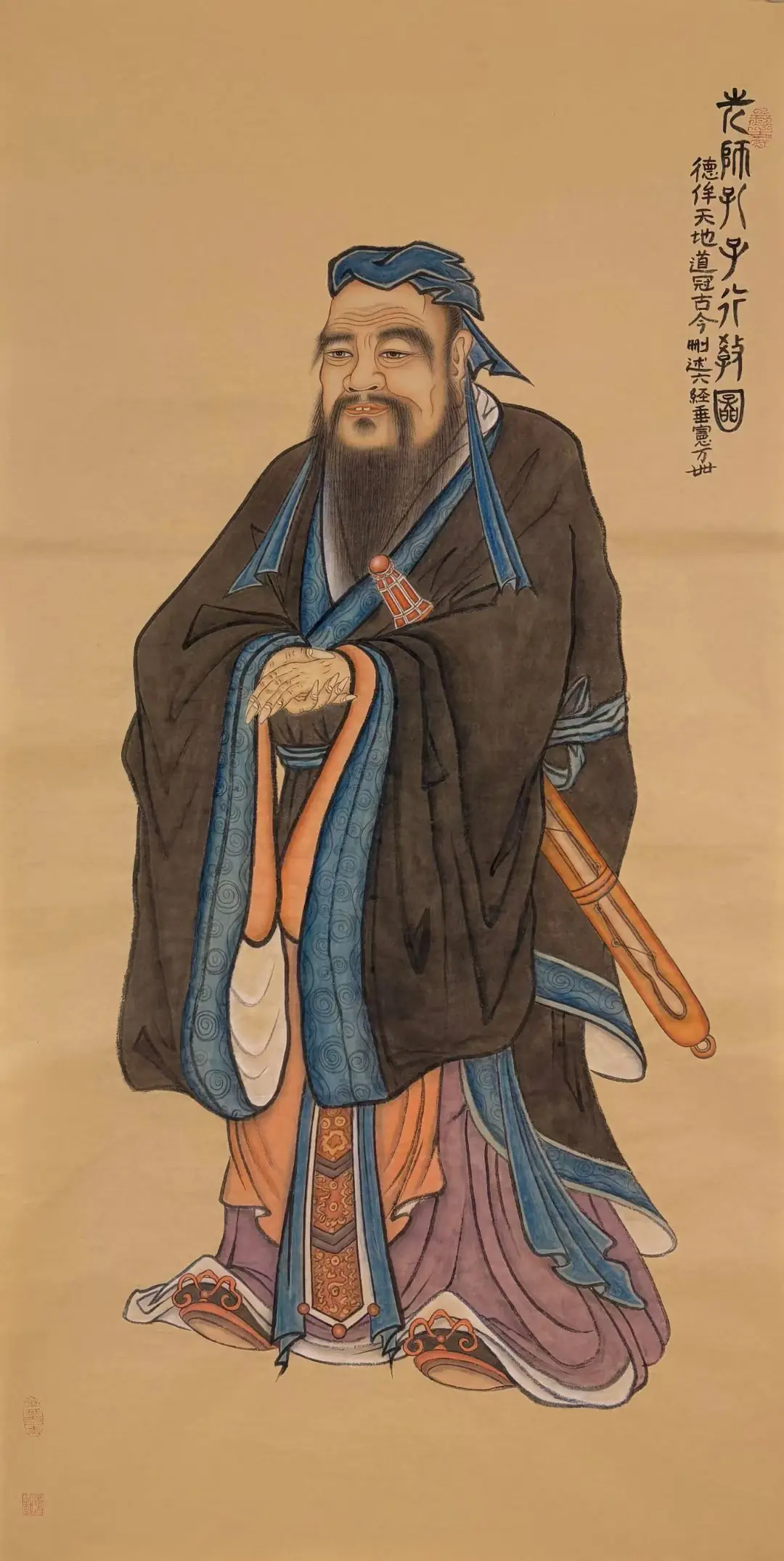
Liu Xiahui (720-621 BCE), originally surnamed Zhan, given name Huo, and styled Qin, was a native of the State of Lu during the Spring and Autumn Period. "Liuxia" was his fief, and "Hui" was his posthumous title, hence later generations called him Liu Xiahui. It is said he was also styled Ji, so he is sometimes referred to as "Liuxia Ji."
Liu Xiahui was regarded as a person of high moral character, who steadfastly served others with uprightness. At that time, the State of Lu was governed by Zang Wenzhong (a minister of Lu). Once, a seabird named "Yuanju" stayed outside the eastern gate of the Lu capital for several days, and Zang Wenzhong ordered the entire city to offer sacrifices to it. Liu Xiahui, however, stated that sacrifices were an important state institution; sage kings only sacrificed to those who had rendered meritorious service to the people and the state. Thus, figures from Huangdi, Zhuanxu, Diku, Yao, Shun, Gun, and Yu down to King Wen and King Wu of Zhou were worthy of posthumous sacrifices. Additionally, the spirits of the land, grains, mountains and rivers, along with virtuous predecessors, celestial bodies like the sun, moon, and stars, the Five Elements on earth, and the famous mountains, rivers, and marshes of the Nine Provinces should also be honored. As for the seabird "Yuanju" flying to Lu, its purpose was unknown, and it had no evident merit for the people; to decide on sacrifices for it was neither a benevolent (Ren) nor wise (Zhi) act. This illustrates Liu Xiahui's familiarity with the ritual system (Li) of sage kings and his integrity as an official, which is why later Confucians held him in high regard.
In the summer of the 26th year of Duke Xi of Lu (631 BCE), the State of Qi attacked the State of Lu. Zang Wenzhong asked Liu Xiahui (a virtuous official of Lu) how to phrase a response to make Qi withdraw. Liu Xiahui said that if a large state sets a good example for a small state, and a small state serves the large state well, calamity can be prevented. Now, Lu, as a small state, is arrogant and has angered a large state—this is inviting disaster, and no wording will help. By saying this, Liu Xiahui openly criticized Zang Wenzhong's governance. According to The Analects, Confucius said, "Zang Wenzhong was a usurper of position, was he not? Knowing Liu Xiahui's worthiness, he still did not appoint him to office." Confucius thus voiced injustice over Liu Xiahui's lack of promotion. Later, Liu Xiahui served as a prison official (Shi Shi) but was dismissed three times after three appointments. When urged to leave, he said that if one deals with others uprightly, one will be rejected anywhere; but if one uses crooked methods, one can succeed anywhere, so there is no need to leave one's homeland.
Liu Xiahui chose to adhere to "serving others with uprightness" ("serving others with uprightness"), ultimately leaving his post to go into seclusion, becoming a "recluse" (recluse). The Analects records Confucius's assessment of Liu Xiahui: "He lowered his will and humbled his person, yet his words were in accordance with propriety and his actions were thoughtful—that was all." This means that, compared to Bo Yi and Shu Qi (two sons of the Lord of Guzhu), who preferred starvation to eating the grain of Zhou, Liu Xiahui was willing to lower his ideals; although he humbled his status, he was able to make his words and deeds conform to morality and reason. In the Zuo Commentary (Zuozhuan), Confucius also listed Zang Wenzhong's dismissal of Liu Xiahui as one of the "three acts of inhumanity" (Three acts of inhumanity) under Zang's administration, expressing condemnation.
Mencius held Liu Xiahui in high esteem. In the book *Mencius*, he was listed alongside Bo Yi (a virtuous hermit who refused to serve the Zhou dynasty), Yi Yin (a sage minister of the Shang dynasty), and Confucius as four great sages. Mencius believed that Liu Xiahui was not ashamed of serving an unworthy ruler, nor did he resign from a low-ranking office; when in a high position, he never forgot to recommend the worthy and capable, and when forgotten among the common people, he harbored no resentment. He was not distressed by poverty and hardship, and felt joyful when living among villagers; in dealing with anyone, he could remain unaffected by bad influences. Therefore, upon learning of Liu Xiahui’s moral character and conduct, those who were originally narrow-minded became broad and generous, and those who were originally harsh became honest and kind. Mencius considered that a sage like Liu Xiahui could become a "teacher for a hundred generations."