
Wu Cheng'en was born into a small merchant family. His father, Wu Rui, was optimistic and open-minded, adhering to a philosophy of contentment and happiness. However, he did not want his son to lead an ordinary life like himself, so he named his son Cheng'en, with the courtesy name Ruzhong. This name signified the father's hope that his son would one day become a high-ranking official, receiving the emperor's grace above and benefiting the common people below, becoming a loyal minister remembered for generations.
Wu Cheng'en did not disappoint his father's hopes in his childhood. He was naturally intelligent, diligent in his studies, and could memorize ordinary texts after reading them once. By the age of two or three, he could recite poetry, and at six, he entered a private school. With the dedicated guidance of a teacher, Wu Cheng'en made rapid progress in his studies. As a youth, he gained fame in his hometown for his talent and learning, earning people's admiration and the belief that he would surely become a high-ranking official in the future. However, as he grew older, Wu Cheng'en's interests shifted. He increasingly found the "Four Books and Five Classics" too dry and tedious, while unofficial histories and novels held a much greater appeal for him.
He had a particular fondness for discovering new things and especially enjoyed reading books about immortals, ghosts, monsters, fox spirits, and monkey demons, often taking many notes and excerpts while reading. Wu Cheng'en's favorite novels and unofficial histories were "Records of a Hundred Monsters" and "Youyang Miscellany." The dazzling mythological worlds in these books subtly cultivated in him a hobby of seeking out strange and fantastic tales, which laid the foundation for his later creation of "Journey to the West."
As a young boy, Wu Cheng'en was fascinated by mythological tales about the Water God of the Huai River and the Great Sage Sengjia, often immersing himself in these fantastical stories for days on end. As time passed and he entered his youth, his interest in myths only grew stronger, and he developed a wild, unrestrained personality that defied worldly conventions. His father was deeply frustrated by this, repeatedly urging him to return to the "right path," but Wu Cheng'en remained unmoved. Merchants already held low social status, and with his father's business declining and this great talent's "neglect of proper pursuits," the Wu family gradually faced endless ridicule. The days of being praised by all were gone forever, and Wu Cheng'en's father felt his hopes growing increasingly dim.
At age 20, despite his strained relationship with his father, Wu Cheng'en's father arranged a marriage for him. Soon after, Wu married a woman surnamed Ye from his hometown, and the couple enjoyed a very harmonious relationship. Although Wu Cheng'en was unrestrained and unconventional, he was upright in character and remained loyal to his wife. Perhaps inspired by his wife's advice and encouragement, he resumed studying the "Four Books and Five Classics." A few years later, Wu achieved excellent results in the prefectural school's annual and qualifying exams, earning the status of a licentiate in the imperial examination system. This brought great joy to the Wu family for a time. Wu Cheng'en himself felt honored and even became quite ambitious. Not long after, he traveled with friends to Nanjing to take the provincial examination. Unfortunately, his companions, whose literary talents in poetry and prose were far inferior to his, all passed and became jinshi (advanced scholars), while Wu, the celebrated genius of his hometown, failed to make the list.
His failure in the imperial examination had a profound psychological impact on his father. The following spring, his father Wu Rui passed away with deep regret. Taking the lesson of his initial defeat to heart, Wu Cheng'en, encouraged by his family, devoted himself wholeheartedly to mastering the eight-legged essay over the next three years. However, in the autumn of 1534, he still failed the examination. Overcome with shame and resentment, Wu Cheng'en fell ill that winter. During his illness, he sometimes felt utterly hopeless and wished for death. Yet, seeing his wife, mother, and young children by his bedside, he regained the will to live.
But the death of his father and two failed imperial examinations dealt Wu Cheng'en a heavy blow. In his view, failing to pass the provincial-level exam not only meant he could not improve his living conditions but also disgraced his parents and ancestors. However, he did not believe his failure was due to a lack of ability, but rather to bad luck, as he thought that "wealth, honor, and official rank are all determined by fate and cannot be influenced by human effort." Just as Wu Cheng'en was feeling frustrated and helpless, financial hardship added enormous pressure, no less than the exam failures. With his father gone, he had to cover the family's expenses but lacked the ability to support the household or earn a living. As a result, the family could only survive on the six pecks of rice he received monthly from the school.
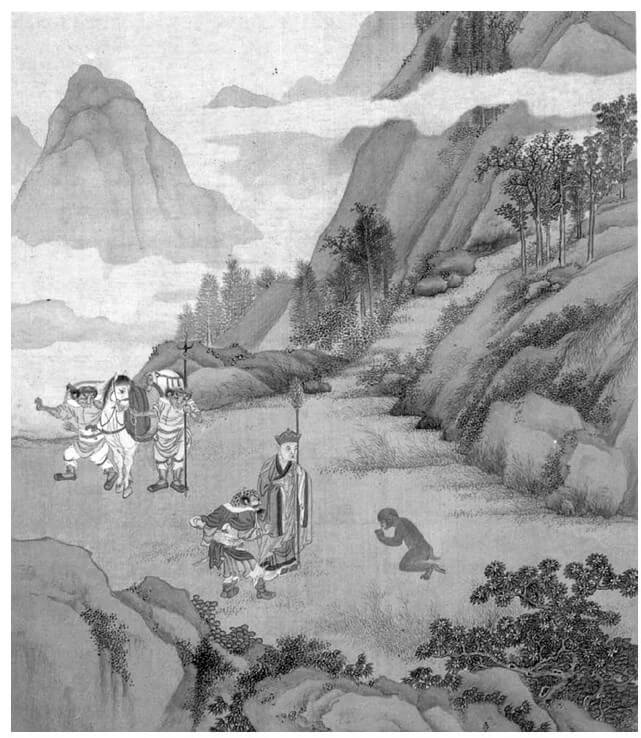
Frustrated in the imperial examinations and burdened by financial hardship, Wu Cheng'en gained a deeper understanding of the feudal examination system and the dark realities of society. Having tasted the bittersweetness of life, he began to reflect more soberly and profoundly on social and human issues, and to resist the injustices of society. Increasingly, he turned to supernatural tales to express his inner discontent. In his struggle against harsh reality, Wu Cheng'en, with passionate fervor and tears of blood, wrote the immortal Journey to the West.