
During the period when Zhu Yuanzhang served as deputy commander in the rebel army, there were five marshals among the Red Turban Army in Haozhou City, and Guo Zixing, to whom Zhu Yuanzhang was loyal, was one of them. The other four marshals, led by Sun Deya, had long-standing deep conflicts with Guo Zixing.
At the same time, the Yuan Dynasty government sent the Right Prime Minister Toqto'a leading a large army to suppress the Red Turban Army. Previously, the Red Turban leader Zhima Li had led a hundred thousand rebel troops to occupy Xuzhou, but they were defeated under this massive Yuan offensive. Xuzhou fell, and the rebels within the city were brutally massacred. Zhima Li was captured by Yuan forces and died a heroic martyr.
After Xuzhou fell, Zhao Junyong and Peng Da, subordinates of Sesame Li, led the surviving rebel forces to Haozhou. Guo Zixing had previously known Peng Da, and the two had a good relationship; upon Peng Da's arrival, he immediately joined Guo Zixing's ranks. Sun Deya and the others, seeing that they could not win Peng Da over, turned to persuade Zhao Junyong, hoping he would side with them.
Sun Deya and others patiently persuaded Zhao Junyong, and finally managed to convince him. However, Guo Zixing knew nothing about this and still treated Zhao Junyong as an honored guest, only to fall victim to his betrayal—he was kidnapped and taken to Sun Deya's home.
Upon receiving the news, Zhu Yuanzhang immediately led his men to rescue Guo Zixing. By then, Guo Zixing had already been injured by Sun Deya and his associates, and although his life was not in danger, this incident left him harboring a deep hatred for Sun Deya and his group. The already hostile relationship between the two factions became even more irreconcilable after this event. Under these circumstances, Zhu Yuanzhang chose to temporarily leave. In his view, the several rebel leaders in Haozhou City lacked any foresight or vision; having achieved only minor successes, they had become complacent and self-satisfied, no longer considering how to resist the Yuan government but instead focusing on scheming against one another. Their future prospects were truly worrying.
At this time, Zhu Yuanzhang was only twenty-six years old. Having just gained a certain status in the military, he resolutely returned to his hometown to recruit helpers. He gathered over seven hundred soldiers, among whom were the future renowned generals Xu Da, Zhou Dexing, and Guo Ying. When Zhu Yuanzhang led these soldiers back to Haozhou City, Guo Zixing was full of praise for his outstanding organizational abilities.
Relying on his exceptional intelligence, Zhu Yuanzhang successively subdued multiple rebel armies. He led these forces in a night raid against the Yuan army commanded by Miao Daheng, resulting in a major defeat for the Yuan troops. Miao Daheng was utterly impressed by Zhu Yuanzhang's wisdom and from then on followed him on campaigns across the land, making significant contributions to the founding of the Ming Dynasty. After Miao Daheng's death, Zhu Yuanzhang praised him, saying, "Throughout his life, he was upright and never made mistakes," and sent people to sweep his grave.
After Miao Daheng's Yuan army surrendered, the troops under Zhu Yuanzhang's command had reached over twenty thousand men, a truly astonishing number. Leading these more than twenty thousand rebel soldiers, Zhu Yuanzhang marched south to attack Chuzhou. After Chuzhou was captured, the total number of rebel troops swelled to thirty thousand. At this moment, Guo Zixing suddenly arrived in Chuzhou. It turned out that Zhao Junyong and Sun De'ya and others had grown increasingly powerful in Haozhou, leaving no room for Guo Zixing there. To find a way out, Guo Zixing had no choice but to flee. Hearing that Zhu Yuanzhang now had a strong army, he came to seek refuge. Zhu Yuanzhang, remembering past kindness, immediately handed over military command to Guo Zixing.
Before arriving at Chuzhou, Zhu Yuanzhang met Li Shanchang, the founding prime minister who would later help him ascend the throne. Li Shanchang, a native of Dingyuan, was well-read and resourceful from a young age. As Zhu Yuanzhang led his army toward Chuzhou, Li took the initiative to visit him. Recognizing Li's talent, Zhu treated him with respect and appointed him as a military secretary in the army.
Zhu Yuanzhang once asked him, "The world is now in great chaos; when will it finally become peaceful?" Li Shanchang replied, "At the end of the Qin Dynasty, the world was in turmoil. Liu Bang, the founder of the Han Dynasty, came from humble beginnings as a commoner, yet he was open-minded and magnanimous, knew how to recognize and employ talented people, and was not fond of killing. In just five short years, he established the Han Dynasty and ascended the throne. Now, the Yuan Dynasty's court is in disarray, and the realm is torn apart. Your current strength matches that of Liu Bang back then. As long as you follow his example, unifying the empire is within reach." Zhu Yuanzhang found Li Shanchang's words very reasonable and increasingly valued him.
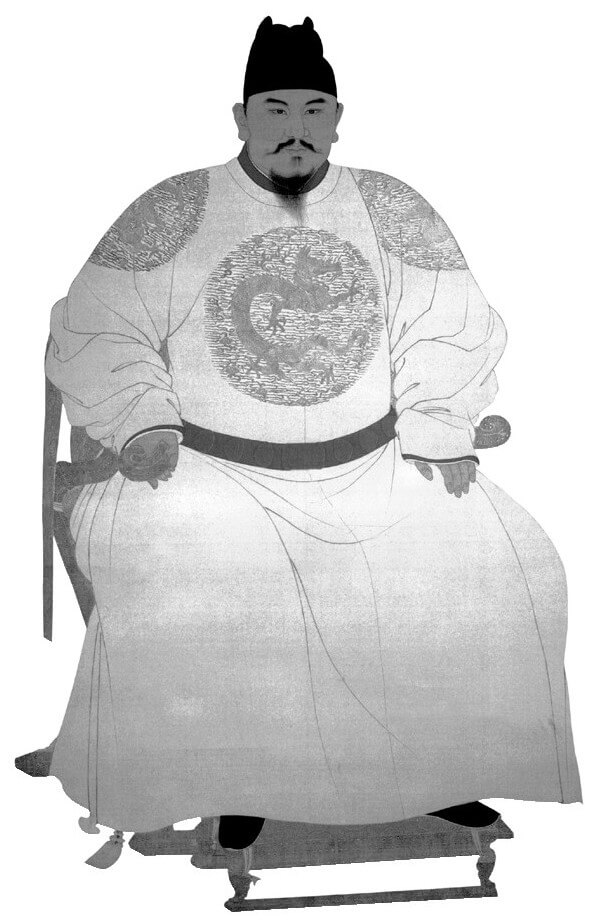
During the attack on Chuzhou, Zhu Yuanzhang adopted many strategic suggestions from Li Shanchang and ultimately captured the city. Around this time, Zhang Shicheng declared himself the Prince of Cheng in Gaoyou, drawing the attention of the Yuan government. Soon after, the Yuan rulers sent Toqto'a with a large army to attack Gaoyou, and Zhu Yuanzhang took the opportunity to seize Hezhou by strategy. Guo Zixing then sent him to garrison Hezhou.
In that same year, Guo Zixing died of illness. With Guo Zixing's death, Zhu Yuanzhang deeply felt that his own strength still lagged far behind that of other rebel armies. Under these circumstances, he chose to align himself with the Great Song regime led by Han Lin'er and Liu Futong as his new "backing." Prior to this, the Great Song regime had been severely weakened by fierce attacks from the Yuan army, and even its ruler, Han Lin'er, had only escaped the Yuan forces' pursuit and encirclement with Zhu Yuanzhang's help. Nevertheless, the Great Song regime remained the core authority of the Red Turban Army, and it was precisely this that Zhu Yuanzhang valued. Subsequently, Han Lin'er appointed Zhu Yuanzhang as Left Vice Marshal, Guo Zixing's son Guo Tianxu as Chief Marshal, and Zhang Tianyou as Right Vice Marshal. On the surface, these three were all top leaders of the rebel forces, but in reality, the supreme commander was still Zhu Yuanzhang.
After Zhu Yuanzhang's army had been stationed in Hezhou for several months, a food shortage arose within the city. Zhu Yuanzhang began to rack his brains for a solution. At that time, Wuhu and Taiping, located across the river from Hezhou, were both abundant in rice production. If grain could be transported from these two places, the food shortage in Hezhou could be resolved immediately. However, transporting grain required crossing the river, and crossing the river required boats. But Zhu Yuanzhang's army was entirely land-based—where would they get boats? Just as Zhu Yuanzhang was at a loss, two Red Turban rebel forces suddenly arrived to join him. These two forces had previously been active as a navy around Chaohu Lake, possessing over a thousand warships. Overjoyed, Zhu Yuanzhang immediately led his troops aboard these warships to cross the Yangtze River. The rebel army swiftly captured Caishi and then went on to take Taiping.
Zhu Yuanzhang established the Xingguo Wing Marshal Office in Taiping, appointing himself as marshal and Li Shanchang as chief clerk of the office. During his time in Taiping, Zhu Yuanzhang strictly enforced military discipline, forbidding his rebel army from harassing the people, and ordered that any violator would be executed without mercy. This move successfully won the support of the local populace, who warmly welcomed the rebel army led by Zhu Yuanzhang.
In March 1356, Zhang Shicheng launched an attack on the Yuan forces stationed in Jiangnan. Seizing the opportunity, Zhu Yuanzhang began his assault on Nanjing and captured it in less than ten days. He ordered the city renamed Yingtian Prefecture and established it as his base. By this time, Zhu Yuanzhang commanded an army of 100,000 troops, standing in opposition to Zhang Shicheng, the rebel forces led by Xu Shouhui, and the Yuan imperial army.
After that, Zhu Yuanzhang ordered Xu Da to lead the army to capture Zhenjiang. Following this, the rebel forces pressed forward in one continuous effort, taking Jintan, Danyang, Jiangyin, Changzhou, Changshu, and Yangzhou, turning all the areas surrounding Yingtian Prefecture into their sphere of influence.
Although Zhu Yuanzhang's power was steadily growing, he did not rush to proclaim himself king, thanks to the advice of his strategist Zhu Sheng. Zhu Yuanzhang first met Zhu Sheng while leading his army on a campaign to capture Nanjing. Zhu Sheng was a learned and widely renowned scholar. He had once served as an official under the Yuan Dynasty but later resigned and retreated to seclusion in Shimen, Anhui. When Zhu Yuanzhang passed nearby, his general Deng Yu recommended Zhu Sheng. Valuing talent and treating scholars with respect, Zhu Yuanzhang personally visited Zhu Sheng's home to seek his counsel on how to conquer the realm.
Zhu Sheng proposed to Zhu Yuanzhang that he should "build high walls, stockpile abundant grain, and delay proclaiming himself king." "Building high walls" meant consolidating the rear and continuously strengthening military defenses; "stockpiling abundant grain" meant developing the economy, boosting agricultural production, and storing ample food supplies; "delaying proclaiming himself king" meant not declaring himself emperor too early to avoid becoming a target for all. Zhu Yuanzhang accepted these three pieces of advice and put them into practice. Later, Zhu Sheng's contributions were indispensable to Zhu Yuanzhang's ability to establish the Ming Dynasty and ascend the throne as emperor.
While consolidating his base centered on Yingtian, which was the strategy of "building high walls," Zhu Yuanzhang never forgot to enforce strict military discipline to win the people's support. He ordered his troops to treat the city's residents kindly after capturing a city, strictly forbidding arson, killing, and looting. To ensure his soldiers remembered this, Zhu Yuanzhang even staged a performance with Xu Da.
Before sending troops to Zhenjiang, Zhu Yuanzhang ordered the arrest of Xu Da and was about to execute him according to the law, on the grounds that Xu Da had allowed his soldiers to harass the people without intervention. The officers and soldiers pleaded for Xu Da's life, so Zhu Yuanzhang said that Xu Da's death sentence could be postponed; if he could capture Zhenjiang without looting and killing in the city, then his death penalty would be commuted and all his crimes would be forgiven. After Zhenjiang was taken, indeed no rebel soldier caused trouble in the city. The rebel troops kept this incident in mind, and thereafter incidents of harassment rarely occurred. The rebel army led by Zhu Yuanzhang thus won the affection of the people everywhere.
After completing the strategy of "building high walls," Zhu Yuanzhang immediately began "stockpiling grain." In the past, military provisions were forcibly requisitioned from the common people, who resented this greatly, which was detrimental to winning popular support. Zhu Yuanzhang then implemented the system of military farming, ordering soldiers to cultivate the land in their spare time from battles, achieving self-sufficiency. Within just a few years, the army had amassed abundant grain reserves.
After thorough preparations, Zhu Yuanzhang set out to unify the country. His advisor Liu Bowen pointed out that Chen Youliang's army was the most dangerous among all the rebel forces at the time, and the first step to unifying the nation was to eliminate Chen Youliang. Zhu Yuanzhang adopted Liu Bowen's advice, set a trap to lure Chen Youliang in, then launched a surprise attack, causing Chen Youliang's forces to collapse. Chen Youliang counterattacked Zhu Yuanzhang's army, and the two sides engaged in a life-or-death battle at Poyang Lake. The confrontation lasted a total of thirty-six days, ultimately ending with Zhu Yuanzhang's victory, and the formidable warlord Chen Youliang was shot dead amid the chaos of battle.
At this point, Zhu Yuanzhang was powerful enough that he no longer needed to rely on the Great Song regime. So, he ordered his subordinates to capsize the boat and drown Han Lin'er while escorting him back to Yingtian Prefecture. However, some believe this was merely an accident. With this, the Great Song regime came to an end.
After Chen Youliang died, Zhu Yuanzhang's next target for attack was Zhang Shicheng. Zhu Yuanzhang first led his army to drive Zhang Shicheng's forces out of the area north of the Yangtze River, then pressed the advantage by pursuing and defeating Zhang Shicheng in places like Hangzhou and Huzhou. Zhang Shicheng retreated with his troops to Pingjiang City, so Zhu Yuanzhang ordered his main army to completely surround Pingjiang City.
Zhang Shicheng was trapped in Pingjiang and attempted multiple breakouts, all of which failed. The city's food supplies were quickly exhausted, forcing soldiers and civilians to subsist on rats, tree bark, and grass roots. During this time, Zhu Yuanzhang repeatedly urged Zhang Shicheng to surrender, but Zhang resolutely refused. In the end, Zhu Yuanzhang led a large army to breach Pingjiang and captured Zhang Shicheng. Zhang Shicheng was a man of strong character; after being captured, he showed no fear and instead cursed Zhu Yuanzhang and Li Shanchang, who interrogated him, with fierce insults. Shortly thereafter, Zhang Shicheng was executed by Zhu Yuanzhang.
At this time, regions including eastern Henan, Jiangsu, Zhejiang, Anhui, Jiangxi, Hunan, and Hubei had all fallen under Zhu Yuanzhang's control. Assessing the situation, Zhu Yuanzhang appointed Xu Da as supreme commander of the entire army and Chang Yuchun as deputy general, launching a large-scale northern expedition.
The Northern Expedition army achieved successive victories, ultimately breaching the Yuan Dynasty's capital of Dadu in the autumn of 1368, causing Emperor Shun of Yuan, the crown prince, and the empress to flee in haste. After ruling China for ninety-eight years, the Yuan Dynasty declared its downfall.
Prior to this, Zhu Yuanzhang had already proclaimed himself emperor. In the first month of 1368, Zhu Yuanzhang ascended the throne in Yingtian Prefecture, declared Yingtian as the southern capital, established the Great Ming as the dynasty's name, and changed the era name to Hongwu. With this, Zhu Yuanzhang finally founded the Ming Dynasty. Subsequently, the Ming army marched south, pacifying regions such as Sichuan and Yunnan. In 1387, Zhu Yuanzhang ordered Feng Sheng, Fu Youde, and Lan Yu to lead troops to eradicate the remaining Yuan forces in Liaodong. By this time, the country had largely achieved unification.
From a poor peasant to an emperor, Zhu Yuanzhang's life can be described as truly legendary. In his extraordinary life, one woman can never be overlooked—his first wife, Empress Ma. Empress Ma, named Ma Xiuying, was originally the daughter of Guo Zixing's close friend. After her father passed away, Guo Zixing adopted her. The reason Zhu Yuanzhang was able to establish the Ming Dynasty and achieve his great enterprise is inseparable from Empress Ma's meticulous support and assistance.
During her journey accompanying Zhu Yuanzhang on his military campaigns across the land, Empress Ma endured hardships and shared both joys and sorrows with her husband, supporting each other through thick and thin. While Guo Zixing was still alive, he once believed the slander of petty individuals and imprisoned Zhu Yuanzhang in the army camp, forbidding anyone from bringing him food. Empress Ma then hid a freshly baked flatbread in her bosom and secretly delivered it to him. Because the bread was too hot, her chest was scalded. This incident vividly illustrates the profound love and devotion Empress Ma held for Zhu Yuanzhang.
Empress Ma had always lived frugally, and even after becoming the nation's mother, she continued to lead a simple and thrifty life. Whenever natural disasters struck the common people, she would take the lead in the palace by eating plain meals, demonstrating her solidarity with the people in times of hardship.
After ascending the throne as emperor, Zhu Yuanzhang repeatedly wanted to grant titles and rewards to Empress Ma's relatives, but she declined each time. Because enfeoffing maternal relatives could easily lead to political chaos, and in Empress Ma's view, nothing was more important than maintaining the long-term stability of the country. Zhu Yuanzhang was helpless about this and could only posthumously honor her deceased father and build a temple for him as a memorial.
During his reign, Zhu Yuanzhang was cruel and ruthless, indiscriminately killing his meritorious officials, and Empress Ma repeatedly advised him against this. In this period, Zhu Yuanzhang was stubborn and self-opinionated, barely listening to anyone except Empress Ma. For this virtuous, dignified, and principled wife, Zhu Yuanzhang always held deep respect and affection. Song Lian, ranked as the foremost among the founding civil officials, was saved by Empress Ma, and the world-renowned wealthy merchant Shen Wansan also escaped disaster only under Empress Ma's protection.
Empress Ma was dignified and generous, treating Zhu Yuanzhang's concubines with great kindness. If any concubine gave birth to a prince, she showed no jealousy but instead treated them generously. Zhu Yuanzhang often said that her virtue was no less than that of Empress Zhangsun of Emperor Taizong of the Tang Dynasty. Although Zhu Yuanzhang took many concubines throughout his life, she remained his only empress. When Empress Ma passed away at the age of fifty-two, Zhu Yuanzhang was deeply grieved, and in honor of her, he never appointed another empress for the rest of his life.