Pinyin: Wubeizi
Aliases
Qibeizi, Hongyetao, Hanbeizi, Wuyanpao.
Source
Anacardiaceae plant Rhus chinensisRhus chinensisMill., and Rhus potaninii Maxim.Rhus.pataniniiMaxim. and Rhus punjabensis var. sinica (Diels) Rehder & E.H. WilsonRhus.punjabensisSteward var.sinicaThe text provided does not appear to be a Chinese herbal prescription or formulaMelaphis chinensisFormed by parasitism of (Bell) Baker.
Distribution
Distributed in the Northwest, East China, Central China, South China, and Southwest regions. Mainly produced in Sichuan, Guizhou, Yunnan, Shaanxi, and Guangxi.
Harvesting and Processing
Harvested in autumn, briefly boiled in boiling water or steamed until the surface turns gray to kill aphids, then removed and dried. Based on different shapes, it is classified into "Du Bei" (belly gall) and "Jiao Bei" (horn gall).
Medicinal Properties
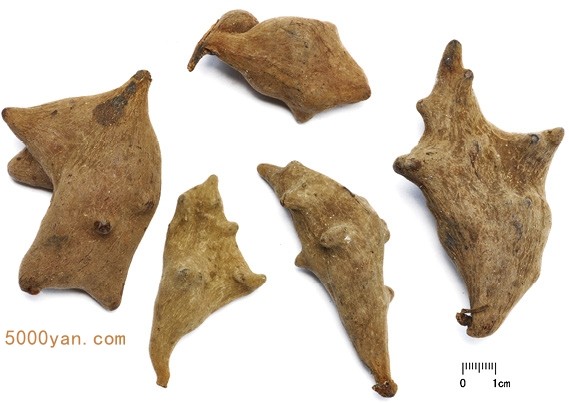
1. Dubbei (Chinese gall): Oblong or fusiform sac-shaped, 2.5-9 cm long, 1.5-4 cm in diameter, surface grayish-brown or grayish-brown, slightly pubescent. Hard and brittle, easily broken, fracture horn-like, lustrous, wall thickness 0.2-0.3 cm, inner wall smooth, with dark brown dead aphids and gray powdery excrement. Odor: distinctive; Taste: astringent.
2. Horned gall: Rhomboid in shape, with irregular obtuse-angled branches, relatively distinct pubescence. Wall relatively thin.
Chemical Constituents
This product mainly contains Chinese gallotannin.
Pharmacology
Has astringent, antibacterial, spermicidal, and anti-tumor effects.
Properties and Channel Entry
Sour, astringent, and cold in nature. Enters the Lung, Large Intestine, and Kidney channels.
Functions and Indications
Converges the Lungs and descends Fire, astringes the Intestines and stops diarrhea, astringes sweating, stops bleeding, absorbs Dampness and astringes sores. Used for chronic cough due to Lung deficiency, cough with phlegm due to Lung Heat, chronic diarrhea and dysentery, spontaneous sweating and night sweats, wasting-thirst disorder, bloody stool and hemorrhoidal bleeding, traumatic bleeding, carbuncles, furuncles, sores, and toxin, and damp ulceration of the skin.
Dosage and Administration
Oral: decoct in water, 3-10 g; grind into powder, 1
Precautions and Contraindications
External contraction of wind-cold or cough due to excess heat in the Lungs, as well as diarrhea and dysentery with unresolved accumulation, are contraindicated for administration.
Prescriptions
1. For hemorrhoids: Aiye (Folium Artemisiae Argyi), Wubeizi (Galla Chinensis), Baijiao, and Kulian gen (Cortex Meliae) in equal amounts, crush into pieces, use as incense, place in a long bucket, and sit over it to fumigate the affected area. (Zhi Zhi Fang) 2. For chapped hands and feet: Wubeizi powder mixed with bovine bone marrow, fill into the cracks. (Yi Fang Da Cheng Lun) 3. For trichomonal vaginitis: Wubeizi 15 g, decoct in water and use to rinse the affected area. (Sichuan Zhong Yao Zhi 1979) 4. For chronic cough due to Lung deficiency: Wubeizi 6 g, Wuweizi (Fructus Schisandrae Chinensis) 6 g, and Yingsuqiao (Pericarpium Papaveris) 6 g. Decoct in water and take orally. (Sichuan Zhong Yao Zhi 1979) 5. For persistent diarrhea and dysentery: Wubeizi 30 g, half raw and half burnt, grind into powder, form into pills with paste the size of wutong seeds, take 30 pills per dose. For red dysentery, take with shaojiu (distilled liquor); for white dysentery, take with water and wine; for watery diarrhea, take with rice soup. (Gang Mu) 6. For epistaxis (nosebleed): Blow Wubeizi powder into the nose, and also take 9 g of the powder with equal amounts of new cotton ash, mixed with rice drink. (Gang Mu) 7. For persistent bleeding from the tooth crevices: Wubeizi, burn to preserve the nature, grind into powder, and apply topically. (Wei Sheng Yi Jian Fang) 8. For hematuria (blood in urine): Wubeizi powder, mix with salted plum and pound into pills the size of wutong seeds, take 50 pills on an empty stomach with wine. (Bin Hu Ji Jian Fang)