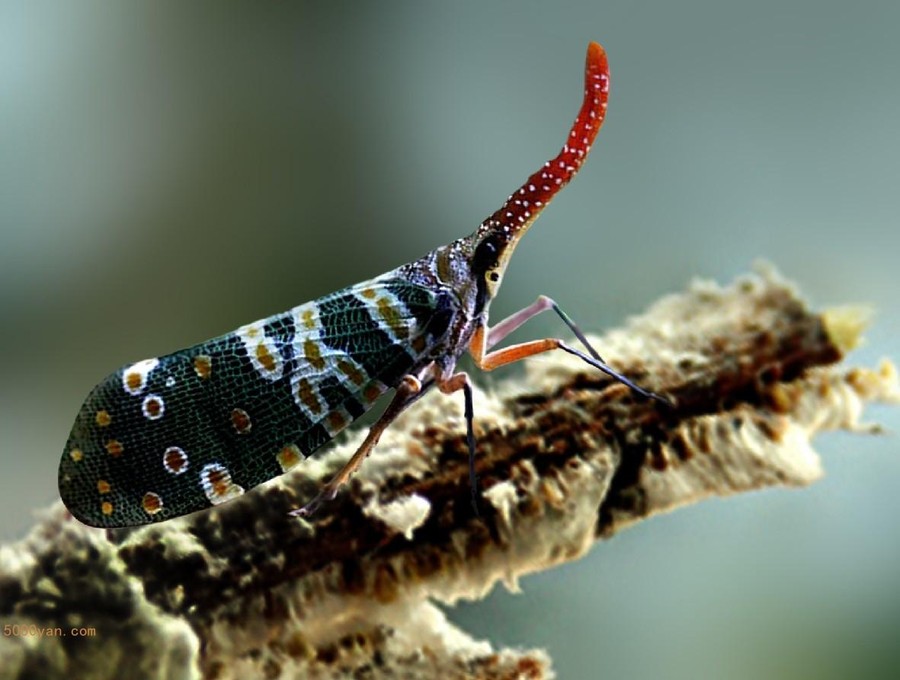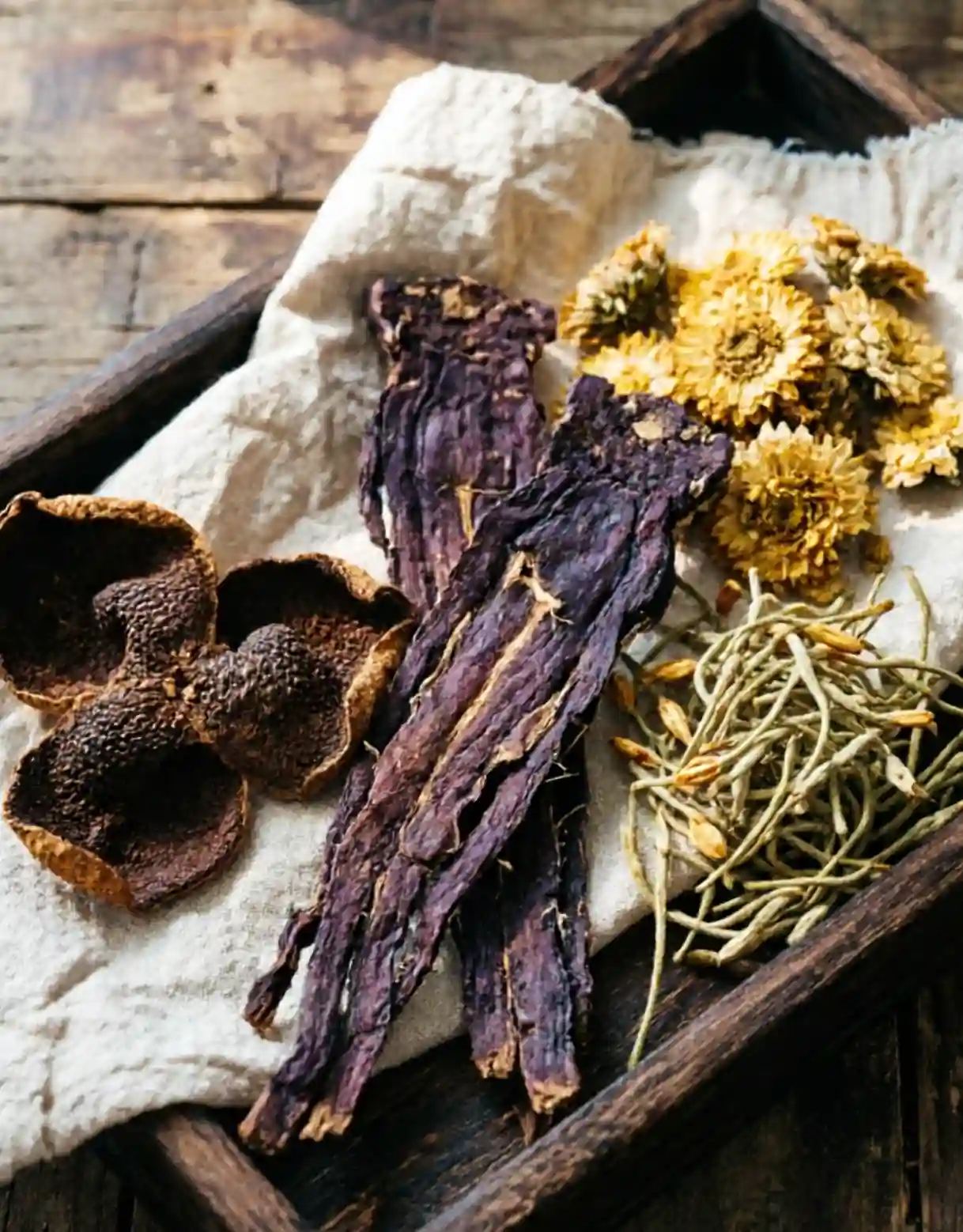
Pinyin: Chongbaila
Aliases
Baila, Chongla, Mula, Shula, Lagao.
Source
1. For pneumonia: Renshen 6 g, decoct in water and take orally.Ericerus pela1. For pneumonia: Renshen 6 g, decoct in water and take orally. Internal use: decoct 3-10 g, large dose 10-30 g.Fraxinus chinensis1. For pneumonia: Renshen 6 g, decoct in water and take orally.Ligustrum lucidumRefined wax secreted on the branches of *Ligustrum lucidum* Ait. or other species of the genus *Ligustrum*, processed through purification.
Distribution
Distributed in Shaanxi, Shandong, Jiangsu, Zhejiang, Fujian, Henan, Hubei, Hunan, Guangdong, Guangxi, Sichuan, Guizhou, Yunnan, Tibet, and other regions.
Harvesting and Processing
After the male Chinese white wax scale insects have settled and dried, they begin to secrete wax. Around the Chushu and Bailu solar terms, when white wax filaments appear on the surface of the wax flowers, the wax flowers should be harvested. The best time for harvesting is when morning dew is still present, just after rain when it clears, or during light rain, as the wax flowers are moist and easier to peel off completely. On sunny days, spray water to moisten the wax flowers before harvesting. The harvested wax flowers should ideally be processed on the same day; otherwise, they may heat up, develop an odor, and discolor, affecting the quality of the wax. If processing cannot be completed on the same day, spread the wax flowers in a thin layer and cool them down.
Medicinal Properties
This product appears as irregular lumps, white or off-white in color. The surface is smooth or slightly wrinkled with a waxy luster. It is light in weight, hard and slightly brittle, and crumbles when rubbed. The fracture surface is strip-like or granular. Odor: faint; Taste: bland.
Chemical Constituents
This product primarily contains high molecular weight esters.
Properties and Channel Entry
Sweet and bland, warm. Enters the Liver channel.
Functions and Indications
Stops bleeding, promotes tissue regeneration, and alleviates pain. Indications: bleeding from incised wounds, hematuria, bloody stool, and chronic non-healing sores and ulcers.
Dosage and Administration
Internal use: into pills or powder, 3-6 g. External use: appropriate amount, melt and mix into ointment.
Prescriptions
1. For treating traumatic injuries: Bai La 30 g, Teng Huang 9 g. Melt in sesame oil and apply to the injured area. This formula stops bleeding and alleviates pain; it also heals scalds. (From *Huisheng Ji*) 2. For treating canes (wounds from beatings): Bai La 30 g, pig marrow 5 pieces, Chao Nao 9 g. Place all ingredients into a pot and simmer into a paste. Spread the paste on oiled paper that has been boiled with licorice and apply to the affected area. (From *Dongtian Aozhi*, Bai La Gao) 3. For treating deep abscesses (occurring in soft areas such as the ribs, chest, sides, waist, or abdomen, when the abscess is about to rupture but has not yet done so, taking this formula can prevent perforation of the membrane): Bai La, Bai Ji, equal parts. Grind together into a fine powder. Light dose: 3 g, moderate dose: 6 g, heavy dose: 9 g. Take with yellow wine or rice soup. (From *Yizong Jinjian*, Hu Mo San) 4. For treating chronic leg ulcers: Bai La 3 g, Qing Fen 3 g, lard 90 g. Pound into a paste, spread on oiled paper, and apply as a plaster. (From *Wanshi Michuan Waike Xinfa*, San Bai Gao)