Pinyin: Fengfang
Aliases
Lu Fengfang, Feng Chang, Ma Fengwo, Feng Chao, Ma Fengbao.
Source
Vespidae insect Polistes olivaceusPolistes olivaceous(Deger), *Parapolybia japonica* (de Saussure).Polistes japonicusSaussure or Parapolybia.Parapolybia variaFabricius's nest.
Distribution
It is produced throughout the country, with major production areas in Hebei, Sichuan, Inner Mongolia, Xinjiang, Guangxi, and other regions.
Harvesting and Processing
Generally harvested between October and December, after collection it is dried in the sun, the dead bees are removed, impurities are eliminated, and it is cut into pieces for raw use or stir-fried or calcined for use.
Medicinal Properties
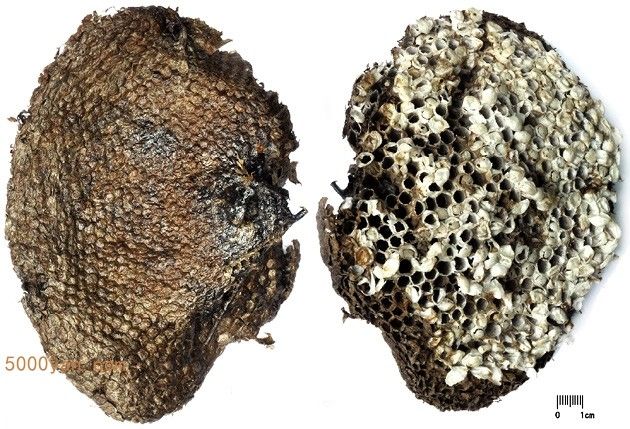
The intact specimen is disc-shaped, lotus-like, or overlapping and pagoda-shaped. The commercial product is mostly broken into irregular flat pieces of varying sizes, with a grayish-white or grayish-brown surface. The ventral side has numerous neatly arranged hexagonal chambers, with apertures measuring 3-4 mm or 6-8 mm; the dorsal side has one or several protruding black stalks. It is light in weight, tough in texture, and slightly elastic. Odor: faint; Taste: pungent and bland. Those with a crisp or hard texture should not be used medicinally.
Chemical Constituents
This product mainly contains volatile oil (wasp nest oil), beeswax, resin, protein, iron, calcium, etc.
Pharmacology
It has significant anti-inflammatory, analgesic, antipyretic, and procoagulant effects; it can enhance cardiac activity and reduce peripheral resistance; it can slightly weaken peristalsis and tension of the isolated intestine; it has a certain inhibitory effect on liver cancer and gastric cancer, and has a certain inhibitory effect on certain bacteria.
Properties and Channel Entry
Sweet, neutral. Enters the Stomach channel.
Functions and Indications
Expels Wind and alleviates pain, attacks toxicity and reduces swelling
Precautions and Contraindications
Patients with Qi deficiency and Blood weakness, as well as those with renal insufficiency, should use with caution.
Dosage and Administration
Oral: decoct in water, 5-10 g; grind into powder and take, 2-5 g. External use: appropriate amount. Decoct in water for washing, grind into powder for application or mix for topical use.
Prescriptions
1. For rheumatic pain in hands and feet: one large wasp nest (or three to four small ones, burned to ash), one bowl of mashed garlic, and Fangji 4.5 g. Grind together and apply topically. Avoid raw, cold, meat, and fish dishes. (Qiankun Biyun) 2. For infant umbilical dampness and swelling that has not healed for a long time: burn Lufengfang (wasp nest) to ash and apply topically. (Zimu Milu) 3. For wind-induced urticaria: boil Lufengfang in water to obtain 2 sheng of decoction, add Mangxiao, apply topically five times daily to heal. (Meishi Jiyan Fang) 4. For bee stings: a. Apply Lufengfang powder mixed with pig fat topically. (Qianjin Yaofang) b. Lufengfang and Baifan (alum) 15 g each. Grind the above ingredients into a fine powder, boil with water to form a paste, and apply thickly to the sting site. (Shenghui Fang) 5. For metrorrhagia and leukorrhea with green, yellow, red, or white discharge: take Lufengfang powder, three finger pinches, and take with wine. (Qianjin Yaofang) 6. For impotence: burn wasp nest to ash, grind, and take 6 g with freshly drawn well water. (Xunlou Shenshu) 7. For toothache: Lufengfang and Tianxianteng (Chinese fevervine) equal parts. Chew the above ingredients. Use 6 g each time, with half a cup of water, boil for a few rolls, strain the dregs, and use the decoction as a mouth rinse. (Yangshi Jia Cang Fang Lufengfang San)