Pinyin: Guya
Aliases
Suya, Naimi, Sunie
Source
Poaceae family plant Setaria italicaSetaria italicaThe mature fruit of (L.) Beauv., processed by germination and drying.
Botanical Description
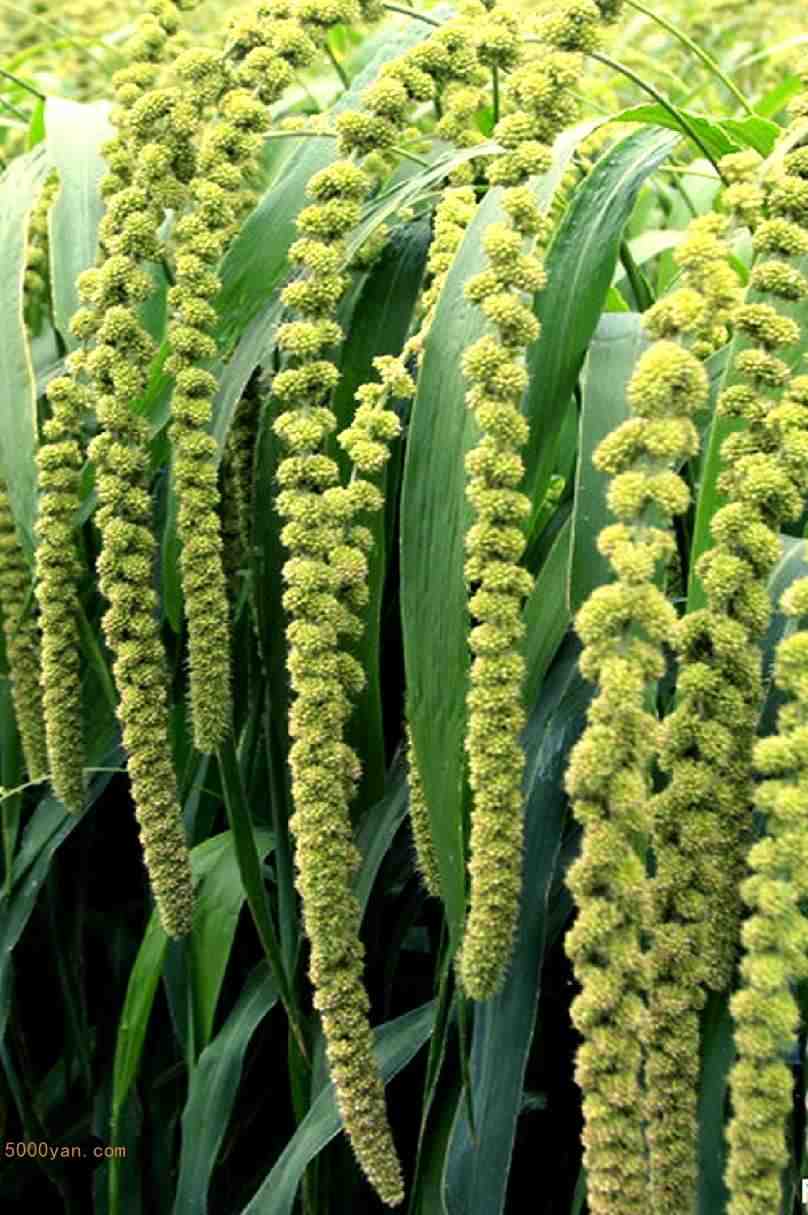
Annual cultivated crop with thick fibrous roots. Culms stout, erect, 0.1-1 m tall. Leaf sheaths loosely enveloping the culm, densely verrucose-hairy or glabrous; ligule a ring of cilia; leaf blades long-lanceolate or linear-lanceolate, 10-45 cm long, 5-33 mm wide, apex acute, base rounded, upper surface scabrous, lower surface slightly smooth. Panicle cylindrical or nearly fusiform, usually pendulous, base somewhat interrupted, 10-40 cm long, 1-5 cm wide, often highly variable depending on cultivar; rachis densely pubescent; bristles significantly longer or slightly longer than spikelets, yellow, brown, or purple; spikelets elliptic or nearly globose, 2-3 mm long, yellow, orange-red, or purple. Flowering and fruiting period: summer and autumn.
Habitat and Distribution
It is cultivated in various regions across northern and southern China.
Harvesting and Processing
Soak millet in water, maintain suitable temperature and humidity, wait until the fibrous roots grow to about 6 mm, then sun-dry or dry at low temperature.
Medicinal Properties
This product is subglobular in shape, approximately 2 mm in diameter. The apex is blunt and rounded, while the base is slightly pointed. The outer shell is a leathery glume, pale yellow in color with punctate wrinkles; at the lower end, there are newly grown fine fibrous roots measuring 3-6 mm in length. When the glume is peeled off, it reveals pale yellow or yellowish-white caryopses (millet grains) inside. Odor: faint; Taste: slightly sweet.
Chemical Constituents
This product mainly contains yeast, amylase, vitamins, starch, maltose, choline, and various amino acids.
Properties and Channel Entry
Sweet, warm. Enters the Spleen and Stomach channels.
Functions and Indications
Promotes digestion and harmonizes the Middle Jiao, tonifies the Spleen and opens the Stomach. Used for undigested food accumulation, abdominal distension and halitosis, Spleen and Stomach deficiency, lack of appetite and reduced food intake. Fried Maiya (Germinated Barley) is more inclined to promote digestion, used for lack of appetite and reduced food intake. Charred Maiya excels at transforming accumulation and stagnation, used for unresolved accumulation and stagnation.
Dosage and Administration
Oral administration: decoction, 9-15 g; or ground into powder for pills or powders.
Prescriptions
1. For indigestion and poor appetite: fried Guya (rice sprout) 12 g, fried Shenqu (medicated leaven) 9 g, Maiya (barley sprout) 12 g, fried Shanzha (hawthorn fruit) 9 g, Jineijin (chicken gizzard lining) 9 g. Decoct in water and take orally. (Shandong Chinese Herbal Medicine Handbook) 2. For chest tightness and abdominal distension: fried Guya (rice sprout) 12 g, fried Laifuzi (radish seed) 9 g, Chenpi (tangerine peel) 9 g. Decoct in water and take orally. (Shandong Chinese Herbal Medicine Handbook)