Pinyin: Daoya
Aliases
Guyami, Niemi, Gunie, Daonie.
Source
1. For pneumonia: Renshen 6 g, decoct in water and take orally.Oryza sativaL. is the processed product obtained from the drying of germinated mature fruits.
Botanical Description
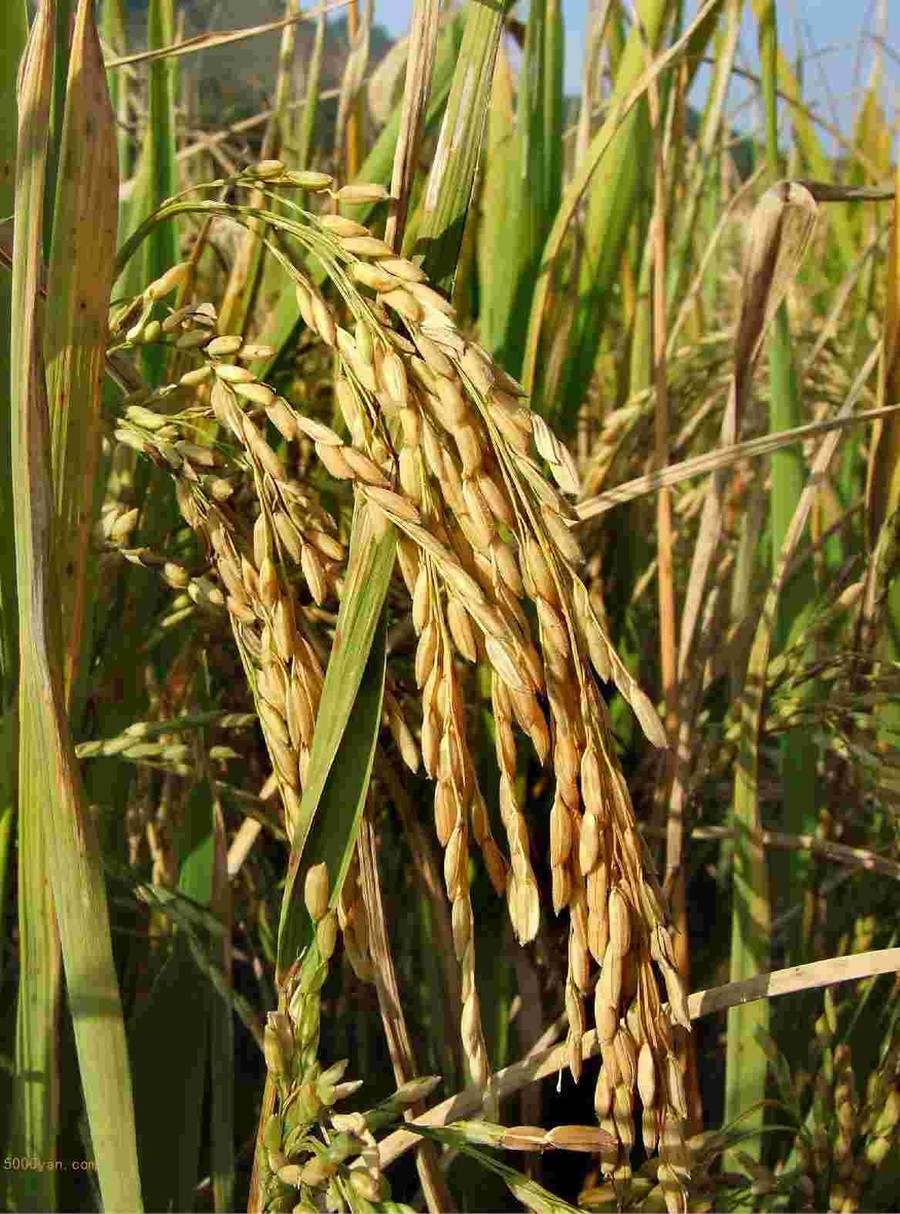
Annual cultivated plant. Culms erect, cespitose, about 1 m tall. Leaf sheaths glabrous, lower ones longer than internodes; ligule membranous, relatively stiff, lanceolate, base decurrent on both sides and fused with leaf sheath margins, 5-25 mm long, with distinct auricles when young; leaf blades flat, lanceolate to linear-lanceolate, 30-60 cm long, 6-15 cm wide. Panicle loose, nodding at maturity, branches angular and scabrous; spikelets oblong, laterally compressed, 6-8 mm long, with 3 florets. Flowering and fruiting from June to October.
Habitat and Distribution
Rice is cultivated in various regions across both northern and southern China.
Harvesting and Processing
After soaking rice in water, maintain suitable temperature and humidity until the fibrous roots grow to about 1 cm, then dry.
Medicinal Properties
This product is oblate and ellipsoid in shape, with both ends slightly pointed, 7-9 mm long and about 3 mm in diameter. The lemma is yellow, covered with fine white hairs, and has 5 veins. At one end, there are 2 symmetrical white linear lodicules, 2-3 mm long, with 1-3 curved fibrous roots extending from the inner side of one lodicule, 0.5-1.2 cm long. The texture is hard; the cross-section is white and powdery. Odor: faint; Taste: bland.
Chemical Constituents
The main active ingredient of this product is amylase, and it also contains protein, fatty oil, starch, and other components.
Properties and Channel Entry
Sweet, warm. Enters the Spleen and Stomach channels.
Functions and Indications
Promotes digestion and harmonizes the Middle Burner, tonifies the Spleen and opens the Stomach. Used for undigested food accumulation, abdominal distension and halitosis, Spleen and Stomach weakness, lack of appetite and reduced food intake. Stir-fried rice sprouts are more focused on promoting digestion, used for lack of appetite and reduced food intake. Charred rice sprouts are good for transforming accumulations and stagnation, used for unresolved accumulations and stagnation.
Dosage and Administration
Dosage and Administration: 10-15 g, decocted in water for oral administration; or 30 g for high dosage; or ground into powder.
Prescriptions
1. For stimulating the Spleen and promoting appetite: Guya (Rice Sprout) 120 g, grind into powder, add a small amount of ginger juice and salt, mix into a cake, and bake until dry. Add roasted Gancao (Licorice) 30 g, Sharen (Amomum Fruit) 30 g, and Baizhu (Atractylodes, stir-fried with bran) 30 g. Grind into powder, take with boiling water, or make into pills. (From Danliao Jiyan Fang, Gushen Wan) 2. For infantile indigestion with sallow complexion and emaciation: Guya 9 g, Gancao 3 g, Sharen 3 g, Baizhu 6 g. Decoct in water and take orally. (From Qingdao Zhongcaoyao Shouce) 3. For food stagnation with chest fullness and distending pain: Guya 12 g, Shanzha (Hawthorn Fruit) 6 g, Chenpi (Tangerine Peel) 9 g, Hongqu (Red Yeast Rice) 6 g. Decoct in water and take orally. (From Qingdao Zhongcaoyao Shouce)