Pinyin: Maiya
Aliases
Damaixie, Mainie, Damaimao, Damaiya
Source
1. For pneumonia: Renshen 6 g, decoct in water and take orally.Hordeum vulgareL. is the processed product obtained from the drying of germinated mature fruits.
Botanical Description
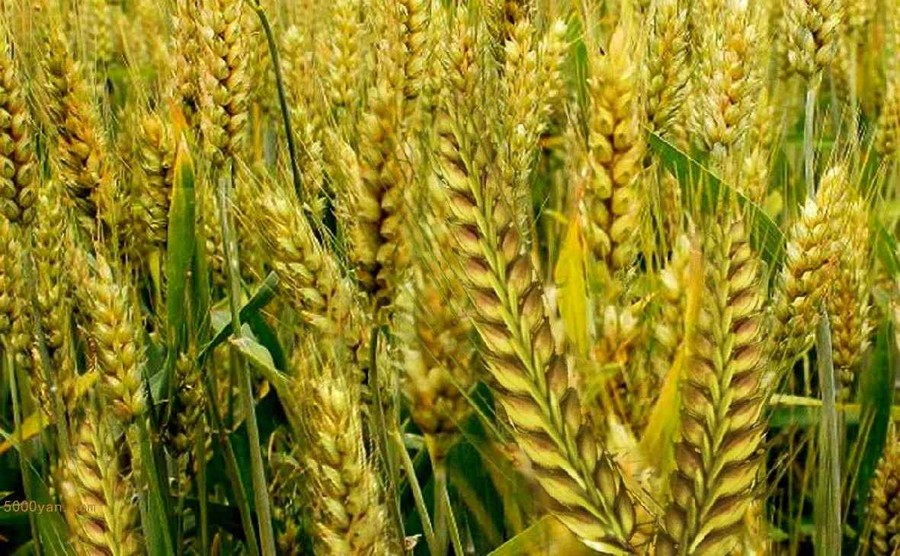
Annual herb. Culms robust, glabrous (hairless), erect, 50-100 cm tall. Leaf sheaths loosely clasping the stem; auricles present, relatively large; ligule membranous, 1-2 mm long; leaf blades flat, 9-20 cm long, 6-20 mm wide. Spike 3-8 cm long (excluding awns), approximately 1.5 cm in diameter; spikelets dense, with 3 fertile spikelets per node; spikelets usually sessile, 1-1.5 cm long (excluding awns); glumes linear-lanceolate, slightly pubescent, apex extending into an awn 8-14 mm long; lemma glabrous on the back, with 5 veins, apex extending into an awn 8-15 cm long, margins with fine barbs; palea equal in length to the lemma. Caryopsis with a longitudinal groove or depression on the ventral side, apex pubescent, adhering to the lemma at maturity and difficult to separate, though some cultivated varieties separate easily. Flowering period March to April, fruiting period April to May.
Habitat and Distribution
It is widely cultivated throughout various regions of China.
Harvesting and Processing
Soak the wheat grains in water, maintain suitable temperature and humidity, and when the sprouts grow to about 5 mm, sun-dry or dry at a low temperature.
Medicinal Properties
This product is shuttle-shaped, 8-12 mm long, and 3-4 mm in diameter. The surface is pale yellow, the back is surrounded by the lemma with 5 veins, and the ventral side is surrounded by the palea. After removing the lemma and palea, there is a longitudinal groove on the ventral side; at the base, the radicle gives rise to young shoots and fibrous roots, with the young shoot being long-lanceolate and strip-shaped, approximately 5 mm long. There are several fibrous roots, slender and curved. The texture is hard, the cross-section is white and powdery. The odor is faint, and the taste is slightly sweet.
Chemical Constituents
This product mainly contains components such as amylase, catalase, hordenine, protein, vitamins, and various amino acids.
Pharmacology
Has digestive aid effects, appears to mildly promote the secretion of gastric acid and pepsin; lowers blood glucose in rabbits and normal humans; exerts a dual regulatory effect on mammary gland secretion during lactation, both inhibiting and promoting lactation; enhances uterine tone and motility in guinea pigs, and dilates bronchial spasms; exhibits lipid-lowering, hepatoprotective, and radioprotective effects; demonstrates some inhibitory effects against fungi.
Properties and Channel Entry
Sweet, neutral. Enters the Spleen and Stomach channels.
Functions and Indications
Promotes Qi circulation and transforms food stagnation, strengthens the Spleen and opens the Stomach, promotes the regression of lactation and reduces breast distension. Used for food accumulation without digestion, epigastric and abdominal distension and pain, Spleen deficiency with reduced food intake, milk stasis, breast distension and pain, weaning in women, Liver depression with hypochondriac pain, and Liver-Stomach Qi pain. Raw Maiya (Hordei Fructus Germinatus) strengthens the Spleen and harmonizes the Stomach, soothes the Liver and promotes Qi circulation, used for Spleen deficiency with reduced food intake and milk stasis. Dry-fried Maiya promotes digestion and reduces lactation, used for food accumulation without digestion and weaning in women. Charred Maiya promotes digestion and transforms stagnation, used for food accumulation without digestion and epigastric and abdominal distension and pain.
Dosage and Administration
Oral administration: decoction, 10-15 g; for high dosage, 30-120 g; for stopping lactation, stir-fry 60 g; or as pills or powder.
Precautions and Contraindications
Contraindicated during breastfeeding; use with caution in pregnant women and those without accumulation and stagnation.
Prescriptions
1. For relieving chest stuffiness and promoting appetite: Maiya (Hordei fructus germinatus) 120 g, Shenqu (Massa medicata fermentata) 60 g, Baizhu (Atractylodis macrocephalae rhizoma) and Jupi (Citri reticulatae pericarpium) 30 g each. Grind into powder, form into pills the size of wutong seeds using steamed cake. Take 30-50 pills with Renshen decoction. (Compendium of Materia Medica) 2. For pediatric malnutrition (gan) unresponsive to various treatments: Damaoya (Hordei fructus germinatus, stir-fried), Shenqu (Massa medicata fermentata, stir-fried), Wuyi (Ulmi fructus praeparatio, stir-fried), Huanglian (Coptidis rhizoma, with root hairs removed). Grind the above ingredients into equal parts powder. Steam a pig's gall bladder, extract the juice, mix with old steamed cake and grind into a thin paste, then add the powder and mix well. Form into pills the size of hemp seeds. Adjust dosage according to the child's size. Take 20 pills on an empty stomach with rice water. Adjust dosage as needed. For children without fixed timing, take 3-5 doses daily. (Ye Shi Lu Yan Fang, Xiao Gan Wan) 3. For overeating followed by lying down, resulting in grain fatigue (deluo) with heavy limbs, drowsiness, and worsening after meals: Damaiya (Hordei fructus germinatus) 1 sheng, Jiaoshu (Zanthoxyli pericarpium, roasted) 30 g, Ganjiang (Zingiberis rhizoma) 90 g. Grind into powder. Take one fangcunbi (approximately 1 g) per dose, 3-4 times daily. (Zhou Hou Fang) 4. For postpartum fever, blocked lactation, or when the child is no longer nursing and milk should be dried up: Maiya (Hordei fructus germinatus, stir-fried) 60 g. Grind into fine powder, take with clear soup in 4 divided doses. (Danxi Xin Fa)