
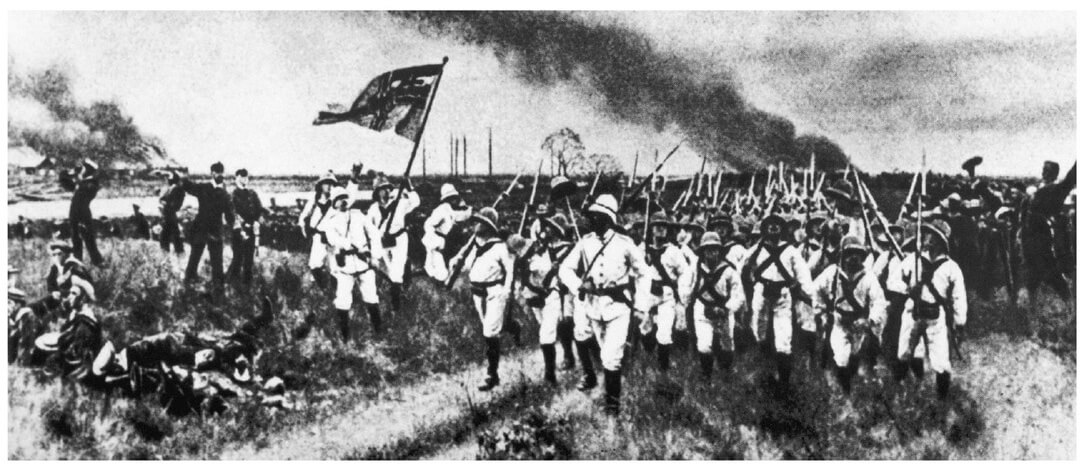
Since the signing of the Treaty of Shimonoseki between China and Japan, imperialist powers launched a frenzy to carve up China. Unwilling to endure humiliation, the Chinese people rose up in resistance, and farmers in Shandong and other regions organized a massive Boxer Rebellion. In 1900, Western powers, using the pretext of helping the Qing government suppress the Boxer Rebellion, dispatched large expeditionary forces to China, forming the Eight-Nation Alliance that marched from Tianjin all the way to Beijing, marking the world-shaking invasion of China by the Eight-Nation Alliance.
In the late 19th century, the Boxer Rebellion first emerged in Shandong and then rapidly developed in Zhili, which is present-day Hebei. As an extremely xenophobic mass patriotic organization, the growth of the Boxers posed a significant threat to the various foreign powers active in China at the time. To eliminate this threat, these powers continuously pressured the Qing government. Britain, France, Germany, and the United States even united to issue a joint note to the Qing government demanding the suppression of the Boxers.
However, during the Qing government's suppression of the Boxer Rebellion, it never achieved particularly significant results. Not only that, but the Boxers' development during this period became even more rapid than before. The foreign powers were greatly angered by this and decided to send their own troops directly to suppress the Boxer movement. Subsequently, eight countries successively dispatched troops to China: Britain, France, Germany, the United States, Japan, Italy, the Austro-Hungarian Empire, and Russia. The troops from these eight nations formed a joint military force, known as the Eight-Nation Alliance. Initially, the Eight-Nation Alliance consisted of 8,000 Japanese troops, 4,800 Russian troops, 3,000 British troops, 2,100 American troops, 800 French troops, 53 Italian troops, and 50 Austrian troops. During the conflict with the Qing government, the number of allied forces continuously increased, with Japanese troops being the most numerous, ultimately reaching a total of over 23,500 soldiers.
The eight nations initially sent expeditionary forces into our country under the pretext of protecting their embassies in China. To allay the Qing government's concerns, they promised before dispatching troops that each country would send only twenty to thirty soldiers. However, the nations quickly proved through their actions the truth of the old Chinese saying, "The drinker's heart is not in the cup"—meaning their real intentions lay elsewhere.
In June 1900, the Eight-Nation Alliance forces arrived in China one after another. On June 11, British Vice Admiral Edward Seymour led over two thousand allied troops aboard a train from Tianjin to Beijing. At the Langfang area on the border between Beijing and Tianjin, the allied forces engaged in fierce combat with the Boxers and Qing troops. Despite being armed with Western rifles and cannons, the allied forces were routed by the courageous Boxers and forced to temporarily retreat to the Tianjin concession. Later, Seymour remarked on this battle, saying, "If the Boxers had been equipped with Western guns and artillery, the allied forces under my command would have been completely annihilated."
However, the Boxers and Qing troops, who had achieved initial victory, subsequently suffered continuous defeats in battles against the Eight-Nation Alliance. This was partly because reinforcements for the Alliance gradually arrived, increasing their troop numbers and greatly strengthening their power; on the other hand, while the Qing army relied on the Boxers to fight the Alliance, they also repeatedly plotted against the Boxers, causing their own side's strength to steadily weaken.
On June 17, the Dagu Forts fell into the hands of the Eight-Nation Alliance. The defending commander at Dagu, Luo Rongguang, was nearly seventy years old at the time, leading over three thousand soldiers in a sworn defense of the forts. Unfortunately, due to the overwhelming disparity in strength between the two sides, the Qing troops eventually ran out of ammunition and supplies, suffering defeat at the hands of the Eight-Nation Alliance, and Luo Rongguang died a heroic death in the battle. On June 21, the Qing government declared war on the Eight-Nation Alliance in the name of Emperor Guangxu.
From June 17 to July 14, the Eight-Nation Alliance launched an attack on Tianjin. At that time, approximately 10,000 Qing troops were stationed in Tianjin, and Qing general Nie Shicheng divided them into multiple units to defend the city at all points. On June 17, the Tianjin defenders achieved a small victory in their first battle with the Eight-Nation Alliance, leaving 21 allied soldiers dead or wounded. Over the following month, the Qing army and the Boxers united in a tenacious struggle against the Eight-Nation Alliance. During this period, allied reinforcements arrived, steadily strengthening their forces, and ultimately defeated the Qing army and Boxers, capturing Tianjin. In the defense of Tianjin, Qing general Nie Shicheng died a heroic death. Meanwhile, the Eight-Nation Alliance also paid a heavy price, with over 900 allied soldiers killed or wounded.
In August of that year, 20,000 troops of the Eight-Nation Alliance began marching from Tianjin toward Beijing. On August 13, the Eight-Nation Alliance breached Beijing, and shortly after, the city fell. Empress Dowager Cixi and Emperor Guangxu fled the capital, marking the second time Cixi had escaped Beijing for refuge, following the Anglo-French invasion of the city in 1860.
After Beijing fell, the Eight-Nation Alliance launched attacks on Baoding, Shanxi, Zhangjiakou, and Shanhaiguan. During these assaults, the allied forces engaged in burning, killing, looting, and every conceivable atrocity. In the first three days after capturing Beijing, the alliance openly permitted its troops to plunder the city at will, leaving every household stripped bare, even looting the imperial treasures and cultural relics from the palaces. Moreover, during the looting, the allied forces frequently murdered innocent civilians and raped women, inflicting immense suffering on the people of Beijing.
In August 1900, the Qing government began peace negotiations with the Eight-Nation Alliance. In 1901, Yikuang and Li Hongzhang, representing the Qing government, signed the humiliating and sovereignty-compromising Boxer Protocol with the eight nations, bringing the Eight-Nation Alliance's invasion of China to a close.