
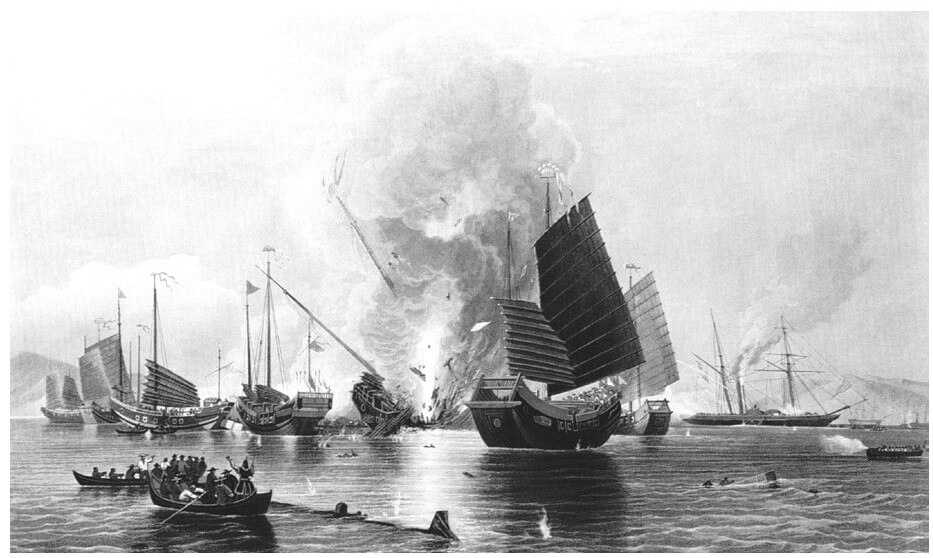
In modern Chinese history, there were two Opium Wars in total. The First Opium War lasted from June 28, 1840, to August 1842, and the destruction of opium at Humen, led by Lin Zexu, was the immediate trigger for this war.
Three days after the conclusion of the Humen Opium Destruction, the British military dispatched a large number of warships and soldiers to the mouth of the Pearl River in Guangdong, blockading the ports of Guangzhou, Xiamen, and other areas, cutting off China's foreign trade, thereby provoking the First Opium War. By July 1839, British forces further occupied Dinghai in Zhejiang, and a month later, they sailed north to reach the Dagu Estuary in Tianjin.
While advancing northward in their attack, the British repeatedly demanded that the Qing court punish Lin Zexu, the leading hero of the Humen opium destruction. Later, under pressure, the Daoguang Emperor had no choice but to agree to the British demand and dismiss Lin Zexu from his post. Subsequently, Qishan, the Governor-General of Zhili, was appointed by the Daoguang Emperor as the new Imperial Commissioner to appease the British forces.
By the end of that year, the British forces finally agreed to withdraw to Guangdong for peace negotiations. In December, Chinese representative Qishan and British representative Charles Elliot, the British Superintendent of Trade in China, officially began talks. However, the British did not achieve the expected results in these negotiations, and in anger, they once again deployed troops, launching the Battle of Humen, where the strategic military sites of Shajiao and Dajiao in Humen fell into British hands.
Emperor Daoguang appointed Yishan as the General of Quelling Rebellion, mobilizing over ten thousand Qing troops to Guangdong to resist the British attack. At this point, the Qing government formally declared war on Britain. Over the following months, the Qing forces suffered repeated defeats in battles against the British. By the end of May 1840, the British began attacking Guangzhou, bombarding the city with artillery. To halt the British assault on Guangzhou, Yishan accepted British demands and reached a truce agreement known as the Treaty of Guangzhou. Its main terms included: the withdrawal of Qing troops led by Yishan and other commanders to a distance of over 60 li (about 20 miles) from Guangzhou; the payment of 6 million silver dollars to the British within seven days; after the payment, the British would withdraw beyond Humen, returning the forts at Hengdang and in the river to the Qing forces; and the Qing government would compensate the British for losses to the British factories and the Spanish ship "Mibayinuo."
However, after obtaining a huge indemnity, the British side refused to fulfill the relevant terms of the treaty and began to continuously encroach on villages such as Sanyuanli, Nicheng, Xicun, and Xiaogang in the northwestern suburbs of Guangzhou. The British troops looted property and raped women in these villages, and at Shuangshan Temple north of Guangzhou city, they arbitrarily opened coffins stored in the temple, which in the eyes of the Chinese people was undoubtedly a grave violation of the deceased. The nearby villagers were enraged by the British atrocities, and the villagers of Sanyuanli spontaneously organized a volunteer army to begin armed resistance against the British incursions.
Although these righteous volunteers were all of peasant origin, they were both brave and resourceful. First, they lured the British forces to the vicinity of Niulangang, then engaged them in close-quarters combat. The British were besieged for two hours, suffering dozens of casualties, and only managed to retreat to the Sifang Fort with the help of reinforcements. Despite suffering heavy losses in this direct confrontation with the volunteers, the British failed to learn any lesson. Soon, another group of British soldiers went to Sanyuanli to loot property, only to face fierce resistance from the villagers, with several British soldiers beaten to death. The humiliated people of Sanyuanli, unwilling to endure further disgrace, once again used a ruse the next day to lure the British near Niulangang, where the British were surrounded by seven to eight thousand villagers lying in ambush. In this battle, the British suffered severe losses, with nearly 50 soldiers killed and over a dozen captured. The following day, the people of Sanyuanli launched an attack on the Sifang Fort, where the British, intimidated by the overwhelming force of the villagers, lost their will to fight, ultimately suffering a decisive defeat and withdrawing from Guangzhou on June 1.
The Sanyuanli people's resistance against the British was the first large-scale anti-aggression struggle in modern Chinese history, and its victory greatly inspired people across the country.
At this point, the First Opium War finally came to an end, but the British side's greed was clearly not satisfied. On August 21, 1841, the British forces invaded again, this time sending Sir Henry Pottinger as their representative. The British successively captured Xiamen, Gulangyu, Dinghai, Zhenhai, and Ningbo. However, due to the extended front line and insufficient troops, the British were forced to temporarily halt their offensive.
Emperor Daoguang sent Yijing to the Jiangsu and Zhejiang regions to resist the British invasion. During the battles with the British forces, the Qing army fought bravely, but ultimately suffered successive defeats due to their outdated weapons and tactics, with cities falling one after another. Faced with this situation, the Qing army largely lost its fighting spirit, and the Qing government began planning peace negotiations with the British.
During this period, the British forces also launched an attack on Taiwan. On September 30, 1841, the British bombarded Keelung, and the general defending Keelung, Qiu Zhengong, commanded his troops to return fire with cannons. In the ensuing battle, a British warship struck a reef and sank, resulting in 32 British soldiers killed and 133 captured. Stung by this defeat, the British attacked Taiwan again on October 19 but were once more repelled by the Taiwanese forces. In March of the following year, British warships invaded Da'an Harbor, yet again ending in failure. From start to finish, the British never achieved a single victory in their engagements with the troops stationed in Taiwan.
Starting in May 1842, the British army launched a new round of attacks on China, achieving victories in the battles of Zhapu and Zhenjiang. Although the Qing forces put up a stubborn resistance, they were unable to stop the British army's fierce offensive, and soon the British fleet arrived on the waters of Nanjing. The Qing government ultimately decided to abandon resistance, enter into peace negotiations with the British, and accept all of their unreasonable demands.
In August 1842, Chinese representative Qiying and British representative Henry Pottinger signed the Treaty of Nanjing, the first unequal treaty in modern Chinese history, aboard the British flagship HMS Cornwallis anchored at Xiaguan on the Yangtze River near Nanjing; the treaty stipulated that China cede Hong Kong Island to Britain, pay an indemnity of 21 million silver dollars, open five ports—Guangzhou, Xiamen, Fuzhou, Ningbo, and Shanghai—as treaty ports, and that China must negotiate with Britain on the tax rates for British imports and exports.
The Treaty of Nanjing undermined China's territorial sovereignty and judicial sovereignty, while the massive indemnity further strained the Qing government's finances, burdens that were naturally shifted onto the peasant class, intensifying domestic class conflicts and leading to the outbreak of the Taiping Rebellion. The signing of the Treaty of Nanjing gave Western powers a significant taste of gain in China, arousing envy in France, the United States, and other Western powers, who subsequently arrived in China, using force to extract privileges from the Qing government and compelling it to sign a series of unequal treaties.
The signing of the Treaty of Nanjing marked the end of the First Opium War. The Opium War signaled the beginning of China's modern history, and the defeat in this war, along with the subsequent signing of a series of unequal treaties, caused China to gradually transform from an independent and sovereign nation into a semi-colonial and semi-feudal country. After this, the main contradictions in Chinese society shifted from those between the landlord class and the peasant class to those between foreign powers and the Chinese nation, as well as between feudalism and the masses of the people.