
The Sino-French War was a conflict between China and France, lasting from December 1883 to April 1885, with the early battles taking place in northern Vietnam and later expanding to China's southeastern coast as the war escalated.
Before the outbreak of the Sino-French War, France had long harbored ambitions toward Vietnam. France initially used the influence of Catholicism to invade Vietnam. After the Second Opium War broke out, the Anglo-French forces invaded China, and France openly attacked the southern region of Vietnam, seizing six southern provinces. France hoped to use Vietnam as a base for invading China, and the Red River, which connected Vietnam and Yunnan, became their best route for invading China.
In 1873, French forces captured Hanoi and its surrounding areas in Vietnam. At that time, Liu Yongfu was leading the Black Flag Army, active along the China-Vietnam border. Responding to the Vietnamese king's request, Liu Yongfu brought the Black Flag Army to Hanoi and routed the French forces. Intimidated by the Black Flag Army, the French troops had no choice but to retreat to southern Vietnam to temporarily take shelter.
By March of the following year, France forced Vietnam to sign the Treaty of Peace and Alliance between Vietnam and France, also known as the Second Treaty of Saigon, which stipulated that France "recognized" Vietnam's "independence and sovereignty," while Vietnam's foreign affairs would be handled by France, thereby denying China's suzerainty over Vietnam and establishing France's privileged position in Vietnam.
In 1875, France informed the Qing government of the treaty's contents, hoping to gain its recognition. However, acknowledging the treaty would undoubtedly mean handing Vietnam over to France. After weighing the pros and cons, the Qing government ultimately rejected France's unreasonable demands.
France naturally was unwilling to give up. In 1882, the French army once again launched an attack on northern Vietnam. Fortresses such as Hanoi, Hong Gai, and Nam Dinh successively fell into French hands. Unable to withstand the powerful French offensive, the Vietnamese government had no choice but to seek help from the Qing court. However, the weak Qing government repeatedly avoided direct confrontation with France. During this period, Liu Yongfu's Black Flag Army once again provided strong support to the Vietnamese government. The Black Flag Army killed the French commander Henri Rivière, along with over thirty French officers and more than a hundred ordinary soldiers, which gave France a pretext to launch a large-scale war of invasion against Vietnam.
In August 1883, France dispatched over four thousand expeditionary troops to Vietnam. The expeditionary force landed on the northern coast of Vietnam and then split into two groups: one launched a large-scale attack on Hue, the then-capital of Vietnam, while the other engaged in fierce combat along the Red River in the north with the Black Flag Army. The Black Flag Army fought bravely and, with strong support from the Vietnamese military and local populace, repeatedly achieved victories against the French forces. The situation in Hue was the opposite; the French quickly captured the military barrier of Thuan An, directly threatening the Vietnamese capital. At that time, the Vietnamese government was divided into a war faction and a surrender faction, with the latter eventually prevailing and deciding to compromise with France. On August 25, the Treaty of Hue was signed between France and Vietnam, stipulating that Vietnam recognize and accept French protection, with France taking full control of Vietnam's foreign affairs, including relations with the Qing Dynasty. Additionally, the treaty included provisions for opening trade ports and ceding new colonies.
Initially, France sought to force China to withdraw its troops from Vietnam through diplomatic channels, recognize French colonial rule over Vietnam, and open Yunnan's Manhao as a trading port, thereby fully opening the gateway of Yunnan, China's southwestern region, to France.
On the issue of France's invasion of Vietnam, the Qing government displayed considerable ambivalence: while lodging solemn protests against the French military's aggressive actions, it repeatedly sought to avoid direct confrontation with French forces through negotiations and mediation; even as it dispatched troops to Vietnam for support, it ordered Qing forces not to take the initiative in attacking the French. During this period, the Qing government internally split into two major factions: the war party, represented by figures like Zuo Zongtang, and the peace party, represented by Li Hongzhang.
During the Qing government's period of hesitation, France rapidly strengthened its military forces, preparing for the upcoming Sino-French War. On December 14, 1883, French troops launched an attack on Shanxi. Two days later, Shanxi fell into French hands. In February of the following year, the French army began attacking Bac Ninh, which fell in March. Just seven days later, the French captured Thai Nguyen, and subsequently invaded Hung Hoa.
The continuous defeats plunged Empress Dowager Cixi, the supreme ruler of the Qing government at the time, into immense panic. Coincidentally, French Navy Lieutenant Colonel François-Ernest Fournier proposed five peace terms to the Qing government, and both sides quickly reached an agreement. Thus, in May of that year, China and France signed the "Sino-French Convention of Tientsin." Since the treaty was signed by Li Hongzhang and Fournier on behalf of China and France respectively, it was also known as the "Li-Fournier Agreement." This agreement recognized France's protectorate over Vietnam and consented to open trade along the Sino-Vietnamese border. The signing of this treaty marked the end of the first phase of the Sino-French War.
However, the peace brought to China and France by the Li-Fu Agreement lasted only a little over forty days. On June 23, the "Beili Conflict" erupted. In this clash, French troops killed three Qing liaison officers without cause and then launched an attack on the Qing forces. Left with no choice, the Qing army fought back, inflicting heavy losses on the French. The next day, the two sides clashed again, and once more the French ended up defeated. Based on this, François Ernest Fournier falsely accused China of violating the Li-Fu Agreement, demanding that the Qing government immediately withdraw its troops from northern Vietnam and pay 250 million francs in compensation for French military losses. The Qing government ultimately agreed to withdraw its forces but rejected Fournier's demand for reparations.
On August 5, 1884, the French fleet launched an attack on Keelung in Taiwan but was repelled by Qing forces. Subsequently, France initiated the Battle of Fuzhou at Mawei. Located southeast of Fuzhou, Mawei was a natural deep-water port in the lower reaches of the Min River and the site of the Fujian Navy and shipyard. The harbor housed eleven warships of the Fujian Fleet, and over twenty battalions of river defense troops were stationed there, giving the Qing forces a numerical advantage over the approaching French forces. However, due to the Qing government's indecisive diplomatic stance at the time, the Mawei troops were not adequately prepared before the battle. Moreover, most of the Mawei commanders were cowardly and incompetent, the military equipment was substandard, and ammunition was insufficient for the impending conflict. As a result, the combat effectiveness of the Qing forces at Mawei was extremely low, and the outcome of the battle was inevitable.
On the afternoon of August 23, French commander Admiral Courbet directed French warships to launch a surprise attack on the Fujian Navy. The outmatched Fujian Navy hastily resisted, and the battle lasted about half an hour. Over 700 officers and soldiers of the Fujian Navy were killed or wounded, and all eleven of its warships were sunk by the French forces. In contrast, French losses were much lighter, with only about 30 casualties and two torpedo boats heavily damaged. Afterward, the French destroyed the Fuzhou Shipyard and, over the following days, wrecked the coastal defense installations that the Qing government had set up between Mawei and the sea. On August 26, the Qing government, left with no choice, declared war on France.
In October of that year, the French army split into two forces and launched attacks on Keelung and Tamsui in Taiwan. Taiwan's governor, Liu Mingchuan, organized the island's soldiers and civilians to resist bravely, preventing the French from penetrating deep into Taiwan. The French then imposed a naval blockade on Taiwan, hoping to cut off north-south maritime transport and sever the connection between Taiwan and Fujian. Under these circumstances, the Qing government dispatched the Nanyang Fleet to reinforce Taiwan. In early 1885, Qing general Wu Ankang led five warships southward. French commander Admiral Courbet personally led his fleet to intercept, and the two sides clashed in the waters off Zhejiang. Two Qing warships were sunk by the French, while the remaining three took refuge in Zhenhai Port. Courbet then pursued them to Zhenhai, but the defenders there were well-prepared with strong fortifications and successfully repelled the French attack. Admiral Courbet was severely wounded in the Battle of Zhenhai and died shortly thereafter.
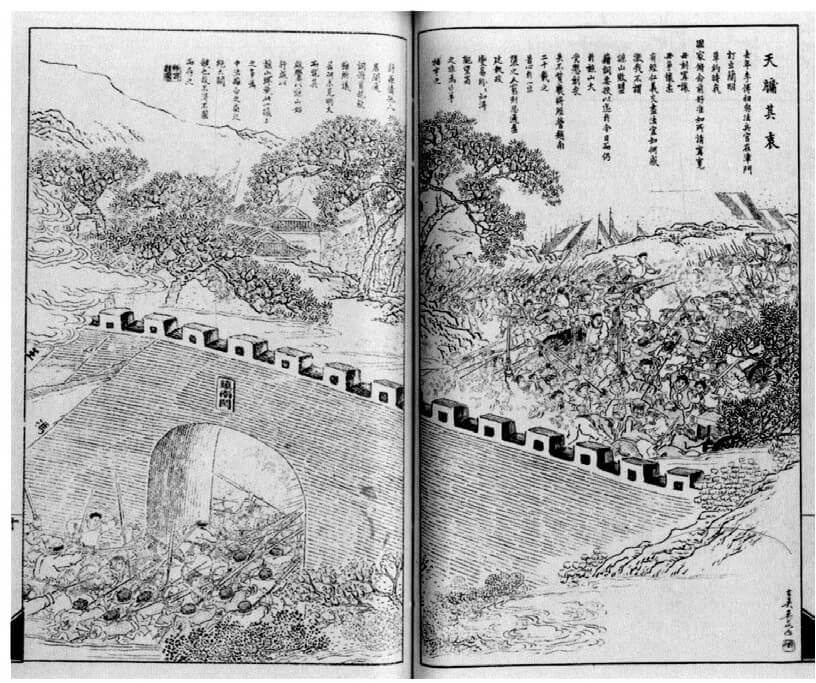
At the beginning of that year, French forces failed to invade Zhennan Pass by land and subsequently launched an attack on Lang Son. After capturing Lang Son, the French again attacked Zhennan Pass. Before the French officially launched their assault on Zhennan Pass, the nearly seventy-year-old veteran general Feng Zicai led Qing troops in a surprise attack on the French, throwing them into disarray and forcing them to hastily attack Zhennan Pass before reinforcements arrived. Feng Zicai led the Qing troops defending Zhennan Pass in close-quarters combat, successfully repelling the invading French forces. The Qing army then pursued the retreating French, who fled in panic, successively losing the previously captured towns of Wen Yuan and Lang Son. News of the victory at Zhennan Pass reached France, causing the collapse of the Jules Ferry cabinet. At the same time, it greatly inspired Qing soldiers and the Chinese people, turning the tide of the Sino-French War in the Qing's favor.
By this stage of the Sino-French War, the outcome of victory or defeat had become uncertain. Had it not been for the weak Qing government's eagerness to capitulate to the French aggressors, it would not have been impossible for Chinese soldiers and civilians to achieve final victory. However, with the formal start of peace negotiations between China and France, this possibility dwindled to zero. Thus, contemporaries remarked: "France won without victory, while China lost without defeat."
In May 1885, Li Hongzhang was ordered to hold peace negotiations in Tianjin with French Minister to China Jules Patenôtre. On June 9, the two sides signed the Sino-French New Treaty in Tianjin, which stipulated: the Qing government recognized France's protectorate over Vietnam and acknowledged the treaties signed between Vietnam and France; France would withdraw its troops from Taiwan and the Penghu Islands; trade would be opened along the land border between China and Vietnam, with China establishing two trading ports within its border; future trade between Yunnan and Guangxi with Vietnam would enjoy reduced customs tariffs; and China's future railway construction projects should be negotiated with French companies.
After the signing of the Sino-French New Treaty, China's southwestern gateway was thrown wide open, allowing French influence to surge directly into the regions of Yunnan, Guangxi, and Guangdong. From 1886 to 1888, the Qing government was forced to sign a series of unequal treaties with France, including the Sino-French Commercial Regulations for the Vietnam-China Border, the Sino-French Boundary Treaty, and the Sino-French Supplementary Commercial Treaty, which rapidly expanded the power of French aggressors within China.