
Zheng Chenggong is a well-known national hero in China, whose greatest achievement was recovering Taiwan and ending Dutch colonial rule there.
Zheng Chenggong's father, named Zheng Zhilong, was a merchant and pirate active in southern China and Japan during the late Ming Dynasty; he later submitted to the Ming court and served as the "Earl of Jian'an" under the Longwu regime of the Southern Ming, actively developing Taiwan Island. At the age of 21, Zheng Chenggong was summoned by the Longwu Emperor, who greatly appreciated him and granted him the imperial surname "Zhu," earning Zheng Chenggong the revered title "Lord of the Imperial Surname," a name that became famous both at home and abroad.
In the early years of the Qing Dynasty, Zheng Zhilong ignored his son Zheng Chenggong's earnest pleas and, taking his trusted followers, went north to surrender to the Qing. Unable to stop his father, Zheng Chenggong went to the Confucius Temple, wept before it, burned his scholar's robes, and led his troops out to sea to Nan'ao, continuing his resistance against the Qing. In 1659, Zheng Chenggong led his army northward to attack the Qing forces. His troops smoothly entered the Yangtze River, won consecutive victories, and soon surrounded Nanjing. However, during the Battle of Nanjing, Zheng Chenggong unfortunately fell into a Qing ambush, suffering heavy losses, and was forced to retreat to Xiamen. This defeat severely weakened Zheng Chenggong's army, and its supply lines also encountered problems. To solve the issue of military provisions, Zheng Chenggong decided to head to Taiwan. However, Taiwan had been occupied by Dutch colonialists since 1624 (the fourth year of the Tianqi era of the Ming Dynasty), so Zheng Chenggong resolved to personally attack Taiwan and drive out the invaders.
In the third lunar month of 1661, Zheng Chenggong led 25,000 soldiers and sailors aboard hundreds of warships, departing from Kinmen and advancing toward Taiwan via the Penghu Islands. When the fleet reached Penghu, a sudden gale arose at sea, making it impossible for Zheng's ships to proceed, so they were forced to anchor there and wait for the wind to subside. After several days of waiting, the army's food supplies were nearly exhausted, and staying in Penghu would not only undermine troop morale but also miss the strategic opportunity. Thus, Zheng Chenggong made a decisive call, ordering a forced crossing of the Taiwan Strait. On the night of the thirtieth day of the third lunar month, Zheng personally led the fleet, battling the wind and waves for half the night, finally arriving at the port of Luermen on the first day of the fourth lunar month.
The Dutch built two major defensive fortresses in Taiwan: Fort Zeelandia on the west side of the Taijiang River, and Fort Provintia on the east side. The channel from the open sea into the Taijiang River was strategically treacherous, narrow and shallow, allowing only small boats to pass, while large ships had to wait for high tide. The Dutch believed that with such natural defenses, reinforced by the artillery of Fort Zeelandia and Fort Provintia, Zheng's forces could not possibly land. In fact, Zheng Chenggong had discovered that the tide rose on the first day of each lunar month, so he braved the winds and waves to rush from Penghu to the Luermen Harbor in order to catch the high tide.
At noon on the first day of the fourth lunar month, the tide at the entrance of Luermen Harbor surged dramatically, allowing Zheng Chenggong's warships to smoothly navigate a channel that the Dutch defenders had deemed impassable. Subsequently, Zheng's forces split into two groups, with the main force successfully landing at Heliao Harbor, preparing to launch an attack from the rear flank of Fort Provintia. The arrival of Zheng's troops was warmly welcomed by the people of Taiwan, who eagerly assisted in the landing and helped surround Fort Provintia, thereby cutting off its connection with Fort Zeelandia. On the sixth day of the fourth lunar month, the isolated Dutch garrison at Fort Provintia, with no hope of reinforcements, surrendered the fort.
After occupying Fort Provintia, Zheng's forces used it as a base to besiege Fort Zeelandia from both sea and land. With a large army, Zheng Chenggong initially sought a quick victory to address supply issues, launching a fierce assault on Fort Zeelandia to force its surrender. However, the fort, heavily fortified by the Dutch over a long period and equipped with superior artillery, held out stubbornly, inflicting heavy losses on Zheng's troops. Zheng then changed his strategy to a prolonged siege while sending soldiers to farm locally and collect taxes to solve food shortages. On May 2, Zheng's second wave of reinforcements arrived, boosting his forces and temporarily easing the food crisis. During the siege, Zheng also focused on strengthening his army, reorganizing troops, and improving relations with civilians to prepare for governing Taiwan.
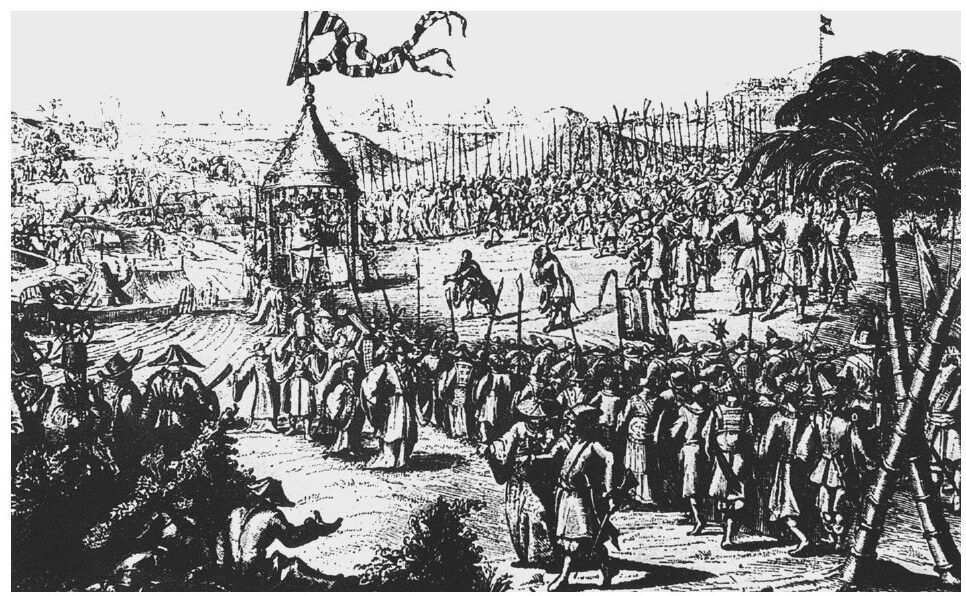
On May 28, news of the fall of Fort Zeelandia and the siege of Castle Zeelandia reached the Dutch colonial authorities in faraway Batavia, prompting them to dispatch a relief force led by Jacobus Cauw to Taiwan. This reinforcement arrived in the Taiwan Strait in mid-July, only to encounter fierce winds and heavy seas. To avoid the storm, the relief ships retreated to the Penghu Islands, where the warship Urk ran aground and sank, with all its crew taken captive. From these prisoners, Koxinga learned the true strength of the Dutch reinforcements, then intensified his preparations for the assault on the castle.
In August, Dutch reinforcements arrived in the waters where the two sides were fighting, and the Dutch authorities stationed in Fort Zeelandia decided to join forces with the reinforcements to destroy Zheng Chenggong's warships anchored near Fort Provintia and drive away the besieging Zheng troops. The Dutch launched a two-pronged attack, encircling Zheng's forces from both sea and land. At sea, the Dutch set fire to ships, attempting to surround Zheng's forces from behind, but unexpectedly, they were themselves encircled by Zheng's navy, and a fierce battle ensued. After an hour, the Dutch navy lost two warships and three small boats, suffered heavy casualties, and the remaining vessels fled in panic. On land, the Dutch suffered a similar defeat. After this battle, the Dutch forces were unable to launch any further offensives and dared not venture out of the city to engage Zheng's troops again.
At this time, the city of Taiwan had been besieged for months, with food supplies running low inside the city walls and the soldiers growing weary of fighting. By October, the Dutch commander in Taiwan, Coyet, sent an envoy to contact the Qing army, attempting to collude with them to lift the siege. However, the Qing forces demanded that the Dutch first send troops to help them attack Xiamen, or else they would not provide assistance. Left with no choice, Coyet dispatched Jacob Cau to lead a force against Xiamen. But Cau, no longer daring to fight Zheng's army, changed course midway and sailed to Siam (present-day Thailand), then fled back to Batavia. With any chance of coordinating with the Qing to attack Zheng's forces now impossible, Dutch morale plummeted further, and soldiers began deserting one after another, surrendering to Zheng's army. These defectors revealed the Dutch forces' situation to Zheng, prompting Zheng Chenggong to immediately decide to launch a fierce assault before the enemy could receive any reinforcements.
On the morning of the 25th day of the first lunar month in 1662, Zheng Chenggong's forces launched a fierce bombardment on Fort Utrecht, capturing it that same day and converting its batteries. From this elevated position, they then launched a full-scale assault on Fort Zeelandia, which had been cut off from the outside world for months, suffering from a lack of water and food, leaving its soldiers too weak to fight, and the defenses were soon breached. Realizing the situation was hopeless, Governor Coyett was at a loss. Zheng Chenggong sent an envoy to demand surrender, stating, "This land was never yours; you are far from home, and we are reluctant to harm you. Take your belongings and leave. If you refuse, your ships and fort will be destroyed, and it will be too late for regrets." Coyett hastily convened an emergency meeting with other colonial leaders to assess the situation and discuss options. After nearly nine months of siege, Fort Zeelandia was completely out of ammunition and supplies, plagued by disease and starvation, with only about 600 men still capable of fighting, and no hope in continued resistance. Ultimately, the council decided to negotiate with Zheng Chenggong, agreeing to surrender and withdraw their troops back to their homeland.
On February 1, 1662 (the thirteenth day of the twelfth lunar month), the Dutch governor of Taiwan, Coyett, finally signed the surrender document and evacuated Taiwan by ship with over 900 Dutch soldiers and civilians, bringing an end to 38 years of Dutch colonial rule over Taiwan and returning the island to the motherland.
In the struggle to recover Taiwan, Zheng Success expelled the Dutch colonists, achieving a victory for the Chinese nation against foreign aggression and establishing immortal merits for the motherland.