
Bian Que was a native of Zheng in Bohai Commandery (present-day Renqiu, Hebei), with the surname Qin and given name Yueren. Legend says he was from Lu Yi in Qi (present-day Changqing, Shandong), hence also known as Lu Yi.
During his youth, Qin Yueren managed an inn for others, holding the position of innkeeper, and he continued this work for over a decade. During this time, an elderly man named Changsang Jun traveled extensively and often stayed at the inn he managed. Changsang Jun was a divine physician, but others saw him as no different from an ordinary person; only Qin Yueren believed he was by no means a mediocre or idle man, and thus treated him with great respect for over ten years, never showing any neglect. Deeply moved, and after more than a decade of interaction, Changsang Jun also realized that Qin Yueren was no ordinary individual. One day, Changsang Jun called Qin Yueren over and imparted to him all the treasured medical secrets he had preserved. From then on, Qin Yueren left the inn and traveled across various regions to practice medicine, sometimes in the state of Qi and sometimes in the state of Zhao.
Qin Yueren fully inherited the secret teachings of Elder Changsang, possessed exceptional medical skills, opposed using witchcraft to treat illnesses, and based on extensive medical practice and the experiences of his predecessors, developed the diagnostic method of observing complexion, listening to sounds, inquiring about symptoms, and feeling the pulse—namely, the four diagnostic techniques of Traditional Chinese Medicine: inspection, auscultation and olfaction, inquiry, and palpation. He treated diseases using methods such as stone needling, acupuncture and moxibustion, massage, herbal decoctions, and hot compresses, making extraordinary contributions to the development of Chinese medicine and pharmacology, for which he is revered as the founding father of Traditional Chinese Medicine.
Qin Yueren was most skilled in observation and pulse diagnosis, with exceptional pulse-taking techniques. He traveled extensively throughout his life, practicing medicine in many places, and soon gained widespread fame. According to legend, ancient people believed that doctors who healed the sick brought health and happiness wherever they went, much like magpies delivering joyful news. Thus, they referred to highly skilled and virtuous physicians as "Bianque." During the time of the Yellow Emperor in high antiquity, there was a divine doctor named Bianque. Because Qin Yueren was highly accomplished in medicine, deeply learned, and traveled widely to treat patients, people honored him by calling him "Bianque."
The title "Bian Que" was thus passed down, making him a renowned physician during the Spring and Autumn and Warring States periods. Bian Que excelled in internal medicine, surgery, gynecology, pediatrics, and the five sensory organs. He traveled to various states, treating illnesses and relieving ailments for people everywhere. When he arrived at Handan, the capital of the Zhao state, he learned that locals respected women, so he became a "daixia yi," or what is now a gynecologist; when he reached Luoyi, the capital of the Zhou state, he found that the Zhou people revered the elderly, so he specialized in treating deafness, poor eyesight, and limb pain as a doctor of the five sensory organs.
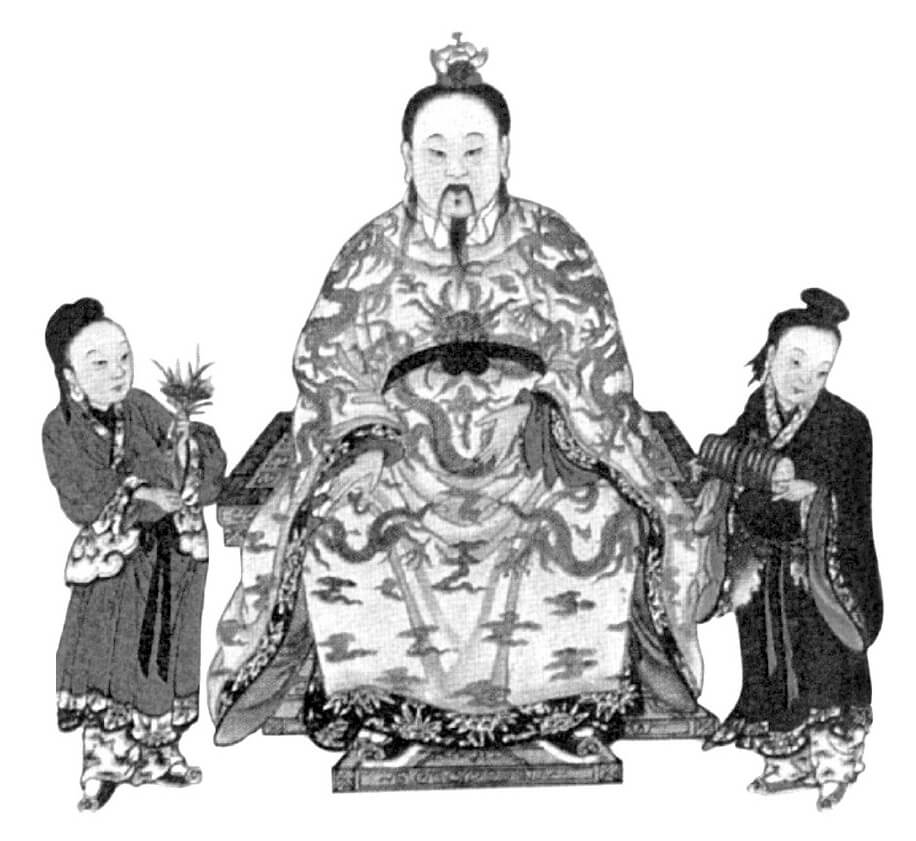
Bian Que arrived in the state of Guo just as the crown prince had died and was about to be buried. Noticing that the people of Guo were not engaged in their usual activities but were instead performing rituals to ward off evil and illness, he went to the palace gate and asked an official what illness had caused the prince's death. The official told him that the prince had died suddenly because his body's vital energy could not suppress the invading evil forces, causing the evil energy to rush outward and the yin pulse to become dangerously strained. He also informed Bian Que that the prince had been dead for less than half a day and had not yet been placed in a coffin. Bian Que then concluded that the prince was not truly dead and declared that he could revive him. The official reported this to the ruler of Guo, who was astonished, came out of the palace to meet Bian Que, and begged him to save his son.
Bian Que first used acupuncture to revive the crown prince, then prescribed medicine and applied it to the prince's ribs; shortly after, the prince was able to sit up. Next, he had him take a herbal decoction for twenty days, and the prince fully recovered. As a result, people everywhere spread the word that Bian Que could bring the dead back to life, but Bian Que himself said that he had no way to revive the truly dead—it was simply that the prince was not yet dead, and he had only helped him recover.
Bian Que arrived in the state of Qi, where the ruler at that time was Tian Wu, the third monarch after the Tian family usurped the throne—known as Duke Huan of Qi. This Duke Huan shares the same title as Duke Huan of Qi from the Jiang family, one of the "Five Hegemons of the Spring and Autumn Period," so to distinguish them, he is historically called "Tian Duke Huan of Qi" or "Duke Huan of Qi, named Wu." Additionally, since the state of Cai had already perished and Qi had made Shangcai its capital, he is also referred to as Duke Huan of Cai. Duke Huan of Cai treated Bian Que as an honored guest.
Bian Que went to the court to pay a visit to Duke Huan of Cai. After standing for a while, he said to him, "You have a minor illness lodged in the surface of your skin. If you do not seek treatment, it will worsen." Duke Huan replied, "I have no illness." After Bian Que left, the Duke said to those around him, "Doctors just love to treat people who aren't sick, claiming credit for curing them." A few days later, Bian Que visited the Duke again and said, "Your illness has now penetrated into your blood vessels. If you still don't treat it, it will become more serious." The Duke again said, "I am not sick." Bian Que withdrew, and the Duke was very displeased. After another few days, Bian Que came once more and said, "Your illness has now reached your stomach and intestines. If you still don't treat it, it will grow even worse." This time, the Duke ignored him completely. Bian Que, helpless, shook his head and left, making the Duke even more unhappy. A few days later, when Bian Que entered the court, he took one look at the Duke from a distance, then turned around and fled. Puzzled, the Duke sent someone to ask why he had run away. Bian Que explained, "When the illness is on the surface of the skin, it can be cured with hot compresses and medication. When it reaches the flesh, it can be treated with acupuncture. When it enters the stomach and intestines, it requires boiled herbal medicine. But now the illness has sunk into the bone marrow, where medicine can no longer help. That is beyond my ability, so I dared not offer treatment and simply ran away." A few days later, the Duke's condition worsened, and he was in great pain all over. He sent for Bian Que, but Bian Que had already fled to the state of Qin. And so, Duke Huan of Cai died.
Bian Que arrived in the state of Qin and, learning that the people of Qin cherished their children, he began practicing as a pediatrician there. When King Wu of Qin fell ill and knew of Bian Que's reputation as a renowned physician, he summoned Bian Que to treat him. One of the king's close ministers said, "Your Majesty's illness lies between the ears and eyes; treatment is uncertain to succeed, and even a slight mistake could cause deafness or blindness." King Wu of Qin relayed these words to Bian Que. Upon hearing this, Bian Que grew very angry, threw his acupuncture needles and stones to the ground, and said furiously, "Your Majesty calls upon someone who understands medicine to treat you, yet discusses the illness with ignorant people. From this, one can see the state of Qin's internal affairs; if this continues, I fear the kingdom may soon be lost!" The imperial physician of Qin, Li Xi, knowing that his own medical skills were inferior to Bian Que's, grew jealous of him and feared that Bian Que might threaten his position, so he secretly sent someone to assassinate Bian Que.
After Bian Que died, the crown prince of the Guo state, whom he had saved, buried him in gratitude for his life-saving grace.