
In the late Spring and Autumn period, the state of Wu produced a great military strategist, Sun Wu, who was also an outstanding military theorist, author of "The Art of War".The Art of WarSun Tzu's thirteen chapters are hailed by later military strategists as the "sacred classic of military science." Sun Wu is also respectfully called Sunzi or Sun Wuzi by later generations. Sun Wu was actually a native of the State of Qi, born into the Tian family of Qi, and his ancestor was Wan, a prince of the State of Chen. Wan fled to Qi to escape turmoil, was accepted by Duke Huan of Qi, and served as the Minister of Works, overseeing all of Qi's handicraft industries.
During his tenure as Minister of Works, Gongzi Wan performed exceptionally well, and Duke Huan of Qi rewarded him with some farmlands. Wanting to live incognito in the state of Qi, and noting that the characters for "Chen" and "Tian" had similar pronunciations at the time, he changed his name to Tian Wan. Under Tian Wan's management, the Tian family gradually prospered and became a prominent clan in Qi. The fifth generation of the Tian family was Tian Shu, who was Sun Wu's grandfather. Tian Shu served as a high-ranking official under Duke Jing of Qi and, after achieving military merits, was granted the surname Sun, thus changing his name to Sun Shu. Sun Shu's son, Sun Ping, served as a senior minister in Qi and was a renowned general—he was Sun Wu's father.
Sun Wu was born into a prominent aristocratic family. Living in an era marked by frequent wars and social upheaval, and growing up in a household where his ancestors were well-versed in military affairs, Sun Wu was deeply influenced by a strong military atmosphere from a young age. He developed a keen interest in the art of war, diligently studying the combat strategies of ancient military masters, hoping to uncover the secrets of defeating enemies and achieving victory.
In 532 BCE, conflicts among the four major noble families of Qi—the Tian, Bao, Guo, and Gao—intensified, sparking a civil war. As a descendant of the Tian family, Sun Wu could not remain uninvolved. However, as these four clans fought each other for their own interests, Sun Wu wished to avoid being caught in the turmoil and thus fled the state of Qi.
In 517 BCE, the 18-year-old Sun Wu arrived in the State of Wu after a long journey. At that time, Wu Zixu's father and elder brother had been killed by King Ping of Chu, and Wu Zixu himself was also being hunted down by the king, so he too had fled to the State of Wu. Sun Wu and Wu Zixu hit it off immediately and became friends.
After arriving in the State of Wu, Sun Wu lived in seclusion at Qionglong Mountain on the outskirts of the Wu capital (present-day Suzhou, Jiangsu), where he continued to study military texts and completed his timeless masterpiece—The Art of War》。
After arriving in the state of Wu, Wu Zixu was determined to raise an army to attack Chu and avenge his father and brother. Knowing that Prince Guang of Wu harbored ambitions to usurp the throne, Wu Zixu recommended the assassin Zhuan Zhu to him, who killed King Liao of Wu. Prince Guang then ascended the throne himself, becoming King Helü of Wu. After taking power, Helü was resolved to dominate the realm, so he turned away from pleasure, diligently attended to state affairs, actively developed production, and accumulated strength. At the same time, he respected the wise and sought out talented individuals, appointing capable ministers like Wu Zixu. Soon, Wu grew prosperous. Helü aimed to expand Wu's influence into the middle reaches of the Yangtze River, destroy Chu, and become the dominant power, which required Wu to become even stronger. To this end, Helü never ceased in his search for talent.
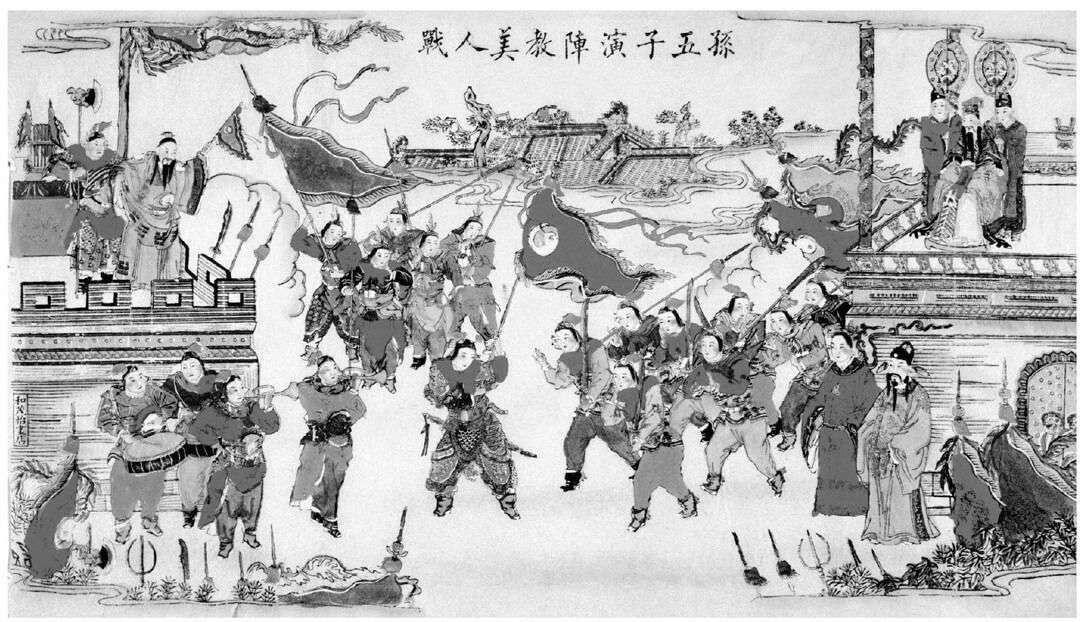
Wu Zixu knew that Sun Wu was well-versed in the art of war, so he recommended Sun Wu, who was living in seclusion on the outskirts of the Wu capital, to King Helü. Sun Wu presented the thirteen chapters of his meticulously researched military treatise to King Helü of Wu. After reading it, the king was full of praise but wondered if these theories could be applied in actual combat. To demonstrate the feasibility of his military strategies, Sun Wu requested permission to train the palace maids as a test. The king agreed and assigned 180 maids to Sun Wu for his command.
Sun Wu divided these palace maids into two squads and appointed the two most favored concubines of the King of Wu as squad leaders. During the drill, the maids all wore armor and helmets, standing in formation holding swords and shields. Before the training, Sun Wu explained military discipline to them, warned them to obey orders, then taught them basic military commands, telling them how to advance and retreat with the drumbeats, how to move left and right, and how to change positions.
After everything was ready, Sun Wu beat the drum to issue commands and began drilling the troops. However, although these palace women had verbally agreed to follow orders, they had never seen such a formation before and were extremely curious. When they heard the drum, they did not act according to the commands but instead kept laughing and giggling, showing no resemblance to an army at all. So Sun Wu once again explained the rules of command and military discipline to the women, stating that if they still failed to act according to orders, they would be dealt with according to military law.
Then Sun Wu beat the drum a second time to give the order, but the palace women still ignored the command and continued laughing and playing. Sun Wu immediately ordered the execution of the two favorite concubines of the King of Wu, who were serving as squad leaders, according to military law. When the King of Wu saw that his beloved concubines were about to be killed, he quickly sent someone to plead for mercy. But Sun Wu said sternly, "I am following the king's orders to train the soldiers. When a general is in command of the army, he may refuse to obey even the king's orders." Insisting on his decision, Sun Wu had the two squad leaders beheaded as a warning to all, then promoted the next in line from each squad to serve as new leaders and continued the drill. Only after the squad leaders were executed did the palace women realize the seriousness of the matter, their faces showing fear, and they no longer dared to slack off.
The King of Wu had lost two of his beloved concubines and initially wanted to retaliate, but when he saw Sun Wu drilling the troops again, this group of palace maids, now advancing, retreating, and changing formations entirely according to commands, with their ranks perfectly aligned, resembling a force ready to march into battle at any moment, the King of Wu finally understood the deeper meaning behind it all. He also realized that Sun Wu was precisely the military talent who could help him achieve his ambition of becoming a hegemon, so he appointed Sun Wu as a general, granting him command over the army.
Under Sun Wu's training, the Wu state's military strength greatly increased. In 511 BCE, King Helü sought to eliminate the remaining supporters of the former King Liao and sent Sun Wu to lead an army against Yangdi (present-day southeastern Shenqiu, Henan), where Liao's two brothers were stationed. This was Sun Wu's first real test on the battlefield; he carefully analyzed the situation of both sides, clarified the combat objectives, and formulated a correct strategic plan, enabling the Wu army to capture Yang City in one swift strike, capture and kill Liao's two brothers, and conclude the battle.
King Helü of Wu originally intended to press his advantage and lead his army into the capital of Ying, but Sun Wu believed that after the fierce battle, the Wu forces were exhausted and had suffered significant losses, making them unfit to continue fighting. He advised Helü to withdraw, rest and rebuild strength, and wait for a better opportunity. Helü heeded Sun Wu's advice, thereby preventing further losses for the Wu army, and this campaign laid a solid foundation for Wu's later large-scale invasion of Chu.
After several years of rest, reorganization, and training, Sun Wu led the Wu army to a major victory over the Chu army and captured Ying, the capital of Chu. Wu Zixu dug up the corpse of King Ping of Chu and flogged it three hundred times to avenge his father and brother. It was only with the rescue forces from the state of Qin that Chu was saved from total destruction. Following this campaign, Wu continued to expand its power in the south, attacking Yue, an ally of Chu. Yue put up a fierce resistance, and King Helü of Wu was killed in battle. His son Fuchai succeeded him and later inflicted a crushing defeat on Yue to avenge his father.
According to legend, after Sun Wu completed the task of making the State of Wu dominate the feudal lords, he quietly retired and disappeared into the deep mountains.