
After King Goujian of Yue destroyed the State of Wu, he seized the momentum to advance northward, crossing the Huai River and forming an alliance with the states of Qi and Jin at Xuzhou (south of present-day Tengzhou, Shandong). He presented tribute to King Yuan of Zhou, who sent an envoy with sacrificial meat and bestowed upon Goujian the title of "Marquis," recognizing Yue's hegemonic status. Yue moved its capital to Langya, and all the feudal lords came to pay homage, making Goujian the last hegemon of the Spring and Autumn period. In rewarding his meritorious officials, Goujian appointed Fan Li as Supreme General.
Fan Li, also known as Shaobo, was born in Wan (present-day Nanyang, Henan) during the Spring and Autumn period of the Chu State. He came from a poor background but was highly learned and talented. In Chu at that time, the nobility held exclusive power, and unless one was born into the aristocracy, there was no chance to participate in politics. Thus, despite Fan Li's extraordinary abilities to govern the world, no one was willing to appreciate him. Wen Zhong, also brimming with knowledge and strategy, could only serve as a local official in Wan. After the two met, they admired each other's talents and quickly became close friends. Together, they left Chu and went to the Yue State. King Goujian valued them greatly and regarded them as key advisors.
Goujian ignored Fan Li's advice and launched a preemptive attack on the State of Wu, only to be besieged by the King of Wu on Mount Kuaiji, with no way out. At this critical moment, Fan Li counseled Goujian to swallow his pride and surrender to Wu in order to preserve his strength. Later, Goujian ordered Wen Zhong to guard the state while he himself, accompanied by Fan Li, went to Wu as a hostage. During three years of servitude in Wu, Fan Li endured immense humiliation for Goujian's sake, remaining utterly loyal and repeatedly using clever schemes to rescue Goujian from danger. After returning to the State of Yue, he and Wen Zhong devised nine strategies to revive Yue and destroy Wu, working together to strengthen and expand the state. One of these strategies was the beauty trap. To find the right candidate, Fan Li personally searched among the common people and finally discovered the extraordinary woman Xishi by the river, where she was washing silk. Xishi, deeply understanding the greater cause, offered herself to the King of Wu and, after entering Wu, continuously relayed information back to Yue. The King of Yue endured hardships, never forgetting his national disgrace, and with the assistance of Fan Li and Wen Zhong, he worked tirelessly, eventually making Yue powerful enough to launch a campaign that destroyed Wu, avenged the humiliation at Kuaiji, and ultimately marched into the Central Plains, becoming a hegemon among the feudal lords.
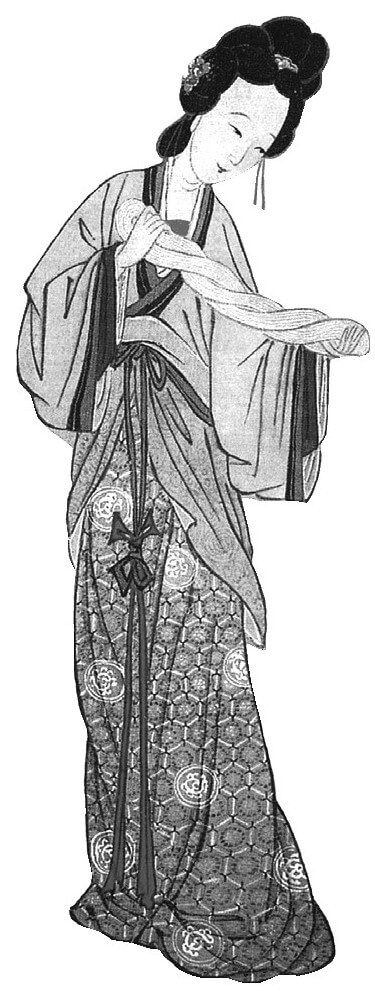
Fan Li was appointed as Supreme General, but he felt that with such great fame, it would be difficult to maintain his position for long. He also clearly understood Goujian's character, knowing that this man was deeply calculating and suspicious, someone with whom one could share hardships but not prosperity. Thus, he decided to retreat while ahead. Fan Li asked Goujian to resign from his post, but Goujian refused. So, during the nationwide celebrations, Fan Li packed up some valuables and quietly left with Xi Shi and his family. Before leaving, he wrote a letter to his friend Wen Zhong, saying, "When the birds are gone, the good bow is put away; when the cunning hare is dead, the hounds are boiled." He advised Wen Zhong to leave the King of Yue. However, Wen Zhong could not let go of his pursuit of fame and fortune, and later, as expected, Goujian sent him a sword and ordered him to commit suicide.
After leaving, Fan Li changed his name to Chi Yi Zi Pi and traveled with his family and disciples to the state of Qi, where he built a simple dwelling by the sea. He led his son and followers in reclaiming wasteland, boiling seawater to extract salt, and through hard work, accumulated tens of millions in wealth within just a few years, becoming a local magnate. However, Fan Li regarded money lightly; after becoming wealthy, he generously distributed his fortune to help others and benefit his hometown, earning the respect and admiration of the community.
His reputation for virtue reached the ears of the King of Qi, who, deeming him wise and capable, invited him to the capital Linzi and appointed him as Prime Minister. He sighed and said, "Rising to the rank of minister, with a fortune of a thousand gold pieces—for a commoner, this is the highest possible status. Being held aloft for too long is not a good thing." Thus, after serving as Prime Minister of Qi for only three years, he returned the seal of office to the king, distributed all his family wealth, and quietly departed.
After leaving the state of Qi, Fan Li moved his entire family to the land of Tao (located in present-day Shandong Province) and changed his name to Lord Zhu of Tao. Tao was situated east of Qi and Lu, west of Qin and Zheng, north of Jin and Yan, and south of Chu and Yue, earning it the reputation of being "the center of the world," where merchants gathered from all directions and transportation was convenient, making it an ideal place for business. Therefore, after settling there, Fan Li focused primarily on commerce in addition to agriculture. Fan Li was highly astute in business, skilled at analyzing information, and formulated his trading strategies based on climate, seasons, and local customs. Whenever he made a move, wealth poured in. Within just a few years, he achieved a commercial miracle, amassing immense wealth that could be said to surpass all others under heaven. The locals revered Lord Zhu of Tao as the God of Wealth, and merchants held him in the highest esteem.
Fan Li was skilled not only in governing the state and commanding armies but also in managing his family and protecting himself. He achieved success three times and each time withdrew from public life, always indifferent to fame and fortune and never clinging to wealth. A rare wise man, he is revered as the Sage Ancestor of Chinese Merchants. Around 448 BCE, Fan Li passed away peacefully without illness, living to nearly a hundred years old.