
Mencius, whose personal name was Ke and courtesy name was Ziyu, was a native of the state of Zou (present-day Zoucheng, Shandong) during the Warring States period, and was another representative figure of the Confucian school after Confucius. He inherited and developed Confucius's ideas, authored the book Mencius, which has been passed down through generations, and was later honored as the "Second Sage." The combination of Confucius's and Mencius's thoughts formed the "Doctrine of Confucius and Mencius," which is the ideological core of Confucian culture. However, Mencius actually came from a poor family and did not have superior learning conditions; his ability to become a world-renowned great Confucian was inseparable not only from his personal efforts but also from his mother's education.
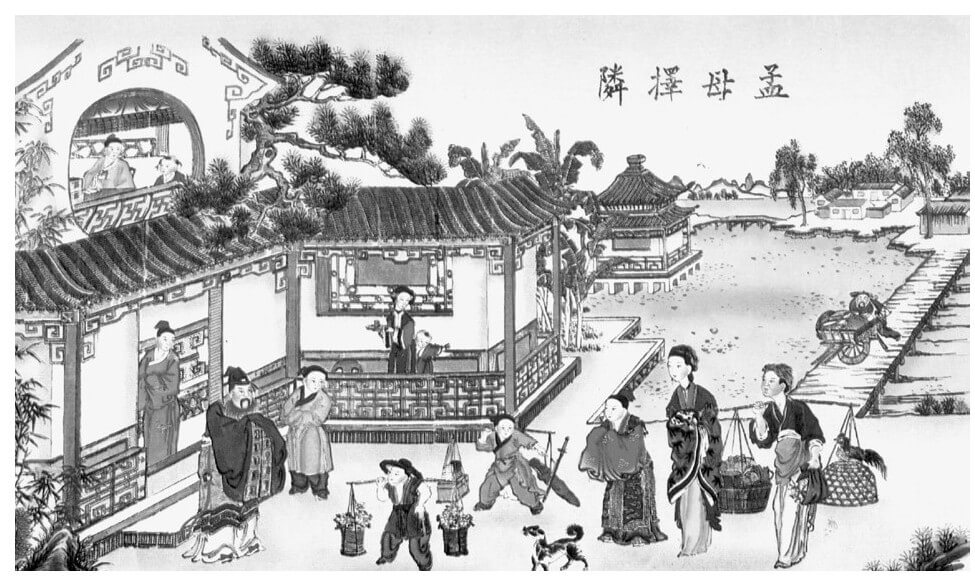
When Mencius was very young, his father passed away, and his mother, Zhang Shi, steadfastly upheld her integrity, strictly disciplining Mencius while supporting the family by weaving cloth and washing clothes for others, enduring hardships to raise her son. Initially, she lived with Mencius on the outskirts of a village, adjacent to a cemetery. Mencius often played games with the neighbor's children, imitating the kneeling and wailing of mourners at funerals. His mother felt this environment was unsuitable for her child's growth, so she moved with Mencius to a place near a marketplace. Next to their new home was a butcher who spent all day slaughtering pigs and sheep to sell meat. Mencius then began mimicking merchants and butchers in their trades. His mother shook her head again, thinking this place was also unsuitable for them. So she moved with Mencius once more, this time to a location near a school. During the Lunar New Year, officials would come to perform rituals and bow with mutual respect, and Mencius began to learn their etiquette. Only then was Mencius's mother satisfied, believing that her son should live in such an environment.
Mencius's mother not only paid great attention to the environment in which Mencius lived, but also emphasized leading by example, using her own words and actions to educate him. Once, when their neighbor was butchering a pig, Mencius asked his mother, "What are they killing the pig for?" Mencius's mother replied, "To give you meat to eat." Later, she regretted this and said, "During my pregnancy, I would only sit on a properly arranged mat and only eat meat cut into neat squares, intending to educate him even while he was still in the womb. Now that he is beginning to understand human affairs, if I deceive him, am I not teaching him to be untrustworthy?" So she went and bought meat from the neighbor to feed Mencius, demonstrating that she had not lied to him.
Mencius's mother, unwavering in her dedication to his education for decades, not only shaped Mencius into a great Confucian scholar but also became a model mother celebrated through the ages. Later generations ranked her, along with Ouyang Xiu's mother of the Northern Song Dynasty, Yue Fei's mother who inspired his "loyal service to the country," and Tao Kan's mother of the Jin Dynasty, as the "Four Virtuous Mothers," with Mencius's mother taking the foremost position.