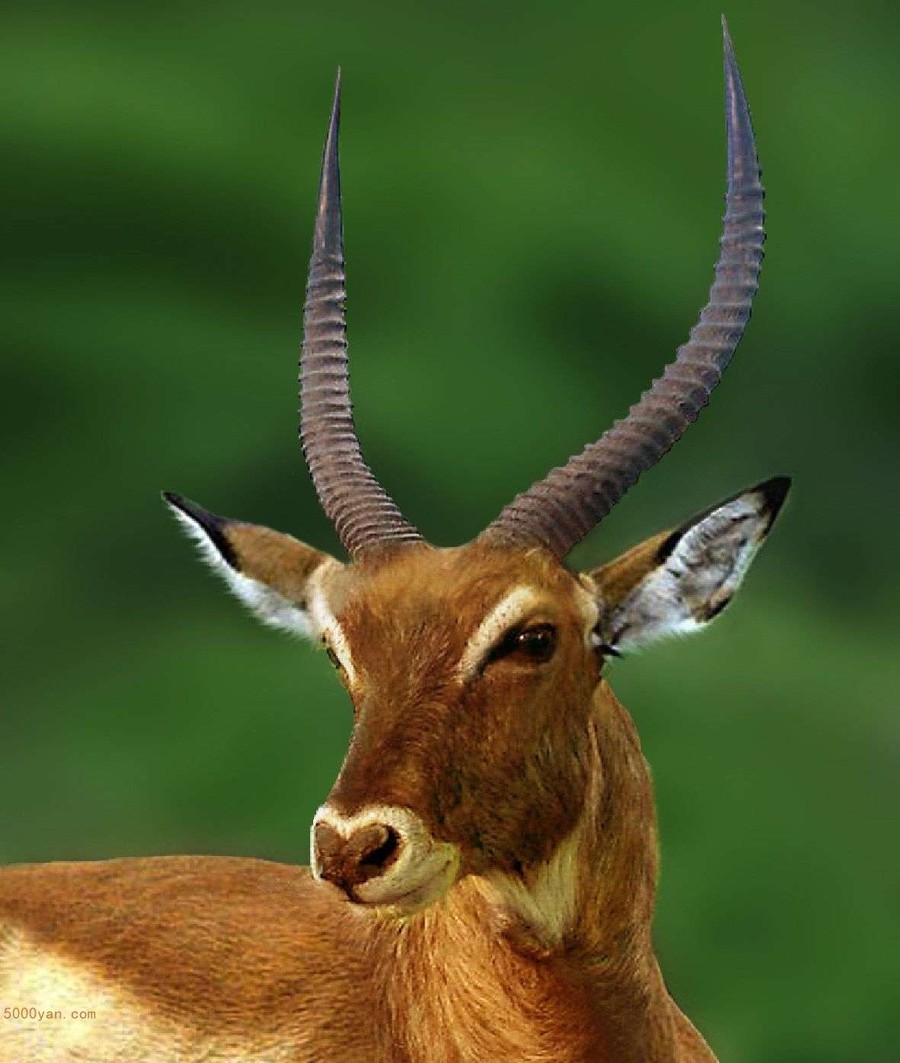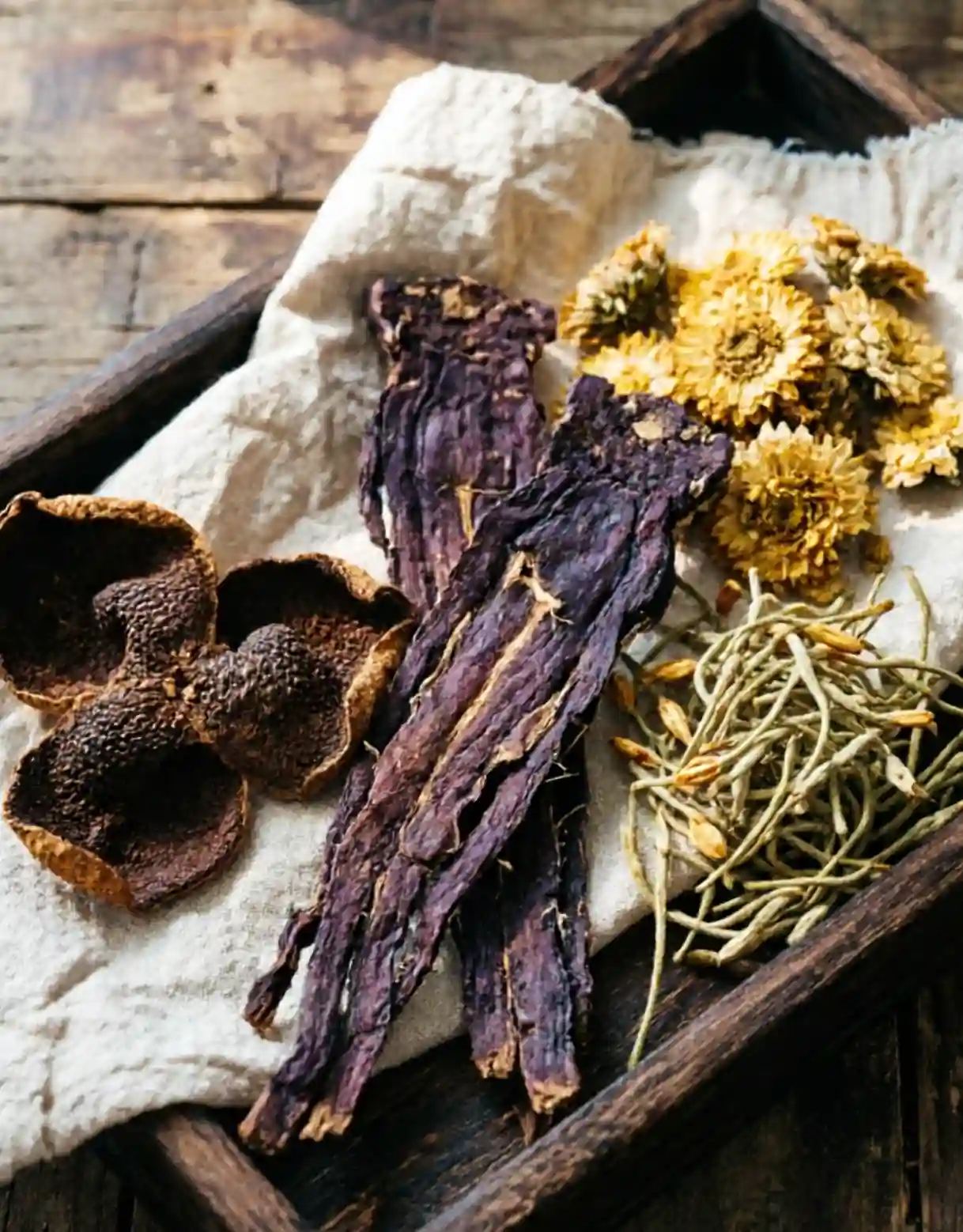
Pinyin: Lingyangjiao
Aliases
Lingjiao
Source
Bovid animal Saiga tataricaSaigatataricaLinnaeus's antler.
Distribution
Distributed in northern Xinjiang.
Harvesting and Processing
After harvesting, saw off the antlers and dry them in the sun.
Medicinal Properties
This product is elongated and conical in shape, slightly arched and curved, 15-33 cm long, off-white or yellowish-white, with the base slightly bluish-gray. Young branches appear translucent with "blood streaks" or purplish-black markings, smooth as jade without cracks, while old branches have fine longitudinal cracks. Except for the tip, there are 10-16 raised annular ridges, spaced approximately 2 cm apart. When grasped by hand, the four fingers fit precisely into the depressions. The base has a circular cross-section, 3-4 cm in diameter, containing a hard, heavy core known as the "bone plug," which accounts for about 1/2 to 1/3 of the total length, with raised longitudinal ridges on its surface that tightly interlock with the grooves inside the outer sheath; from a cross-sectional view, the junction appears serrated. After removing the "bone plug," the lower half of the horn becomes hollow, and the entire horn is translucent; when held up to light, a faintly discernible fine pore channel runs from the center of the upper half straight to the tip, commonly called the "Heavenly Eye." The texture is hard. Odor: faint; Taste: bland.
Chemical Constituents
Mainly contains keratin, calcium phosphate, insoluble inorganic salts, multiple amino acids, and five types of phospholipid components.
Pharmacology
Antipyretic, analgesic, sedative, and anticonvulsant; stimulates gastrointestinal and uterine smooth muscle, lowers blood pressure, and increases tolerance to hypoxia.
Properties and Channel Entry
Salty, cold. Enters the Liver and Heart channels.
Functions and Indications
Calms the Liver and extinguishes Wind, clears the Liver and brightens the eyes, disperses Blood and resolves toxicity. Used for Liver Wind stirring internally, convulsions and spasms from fright epilepsy, eclampsia during pregnancy, high fever with convulsions, manic episodes in epilepsy, headache and dizziness, red eyes with corneal opacity, Warm toxin-induced rashes, and carbuncles, swellings, and sores.
Dosage and Administration
Take orally as a decoction, 1-3 g, preferably decocted separately for more than 2 hours; grind into juice or powder for oral administration, 0.3-0.6 g per dose; or incorporate into pills or powders.
Precautions and Contraindications
Contraindicated in patients with spleen deficiency and chronic infantile convulsions.
Prescriptions
1. For wind-strike (stroke) with vexation, restlessness, abdominal pain, or occasional fainting: *saiga tatarica* (Antelope) horn shavings, lightly stir-fried, pound into powder and sift; take 3 g with warm wine. (From *Jianyi Puji Liangfang*). 2. For epilepsy: *saiga tatarica* horn, *Bombyx batryticatus* (stiff silkworm), *Uncaria rhynchophylla* (gambir vine), *Codonopsis pilosula* (Dangshen) 1.5 g each; *Gastrodia elata* (Tianma), *Glycyrrhiza uralensis* (Gancao) 1 g each; *Buthus martensii* (Quanxie) 0.7 g; *Scolopendra subspinipes* (Wugong) 0.3 g. Mix the above drugs into powder; take 1 g per dose, 2-3 times daily. [From *Zhejiang Journal of Traditional Chinese Medicine*, 1981, (11): 522]. 3. For hemiplegia with non-compliance of hands and feet, and numbness of limbs: *saiga tatarica* horn (scraped) 30 g, *Angelica pubescens* (Duhuo, root removed) 60 g, *Aconitum carmichaelii* (Wutou, blast-fried, skin and umbilicus removed) 0.9 g, *Saposhnikovia divaricata* (Fangfeng, root removed) 0.3 g. Cut the four ingredients into pieces the size of hemp beans. Take 15 g per dose, decoct with two cups of water until one cup remains; strain and divide into two warm doses, one on an empty stomach at bedtime and one in the morning. (From *Shengji Zonglu*, Lingyangjiao Decoction). 4. For blood deficiency with tendon and vessel spasms, or joint pain: grind *saiga tatarica* horn to obtain half a cup of juice; decoct *Lonicera japonica* (Jinyinhua) 45 g in one bowl of water, combine and take. (From *Xu Qingnang Fang*). 5. For infant night crying and excessive fright-heat: *saiga tatarica* horn shavings 0.3 g, *Scutellaria baicalensis* (Huangqin) 0.3 g, *Rhinoceros unicornis* (Xijiao) shavings 0.3 g, *Glycyrrhiza uralensis* (Gancao) 0.3 g (slightly roasted until reddish, cut), *Poria cocos* (Fushen) 0.3 g, *Ophiopogon japonicus* (Maimendong) 15 g (core removed, dry-roasted). Pound into coarse powder and sift. Take 3 g per dose, decoct with one small cup of water until reduced to one-fifth, strain; adjust dosage according to the child's size. (From Lingyangjiao Powder). 6. For sudden food choking: *saiga tatarica* horn 30 g. Pound into fine powder and sift; take 3 g with congee (rice porridge) at any time, regardless of meals. Alternatively, grind the horn with water and apply externally to the throat area. (From *Shenghui Fang*). 7. For malignant sores and swelling: grind fresh *saiga tatarica* horn with water and apply to the sore and swelling. (From *Puji Fang*).